Right then, let’s have a proper chat about something that keeps me and the lads at the workshop up at night – suspension arms and MOT failures. I’ve been turning spanners here in Harlow for near enough fifteen years now, and if I had a quid for every time someone’s rolled up two days before their MOT is due with a knackered suspension arm, I’d have bought myself a proper decent coffee machine by now instead of that temperamental thing we’ve got in the back office.
Look, I get it. Your motor’s been making that odd clunking noise for a few months, but you’ve been too busy getting the kids to school, dealing with that nightmare commute down the A414, or just hoping it’ll sort itself out. We’ve all been there, haven’t we? But here’s the thing – your suspension arm isn’t just some random bit of metal under your car. It’s absolutely crucial for keeping you safe on these Essex roads, especially with the state some of our potholes are in these days.
The Problem Nobody Wants to Talk About
Let me paint you a picture. Back in January 2025, the DVSA released some proper eye-opening figures. Across the UK, suspension and steering faults accounted for nearly 18% of all MOT failures. Here in Essex, we saw even higher rates – partly because of our road conditions, partly because folks tend to leave things until the last minute. Compared to the year before, we saw a 23% rise in suspension arm replacements during the 2025 MOT season at AutoNet VIP – Car Repairs, MOTs & Electric & Hybrid Specialists in Harlow. That’s not just numbers on a spreadsheet, mate – that’s real people facing unexpected bills and failed MOTs when it could’ve been sorted earlier.
The worst part? Most of these failures were completely avoidable. I’ve had customers nearly in tears in our waiting room because they’ve failed their MOT on something we could’ve spotted and fixed weeks earlier if they’d just popped in for a quick check. One bloke last March – lovely fella, drives a Mondeo – had to cancel his family holiday to Cornwall because his suspension arm was so far gone the tester wouldn’t even let him drive it off the testing station. Absolutely gutted, he was.
I Know Exactly How You Feel
Listen, I’m not here to lecture you. I drive a ten-year-old Focus myself, and I know what it’s like when money’s tight and you’re juggling a million things at once. My missus keeps reminding me about that squeaky belt on her Corsa that I keep promising to look at – we’re all guilty of putting things off, aren’t we?
But here’s what I’ve learned from doing this job in Harlow all these years: ignoring your suspension arm is like ignoring that warning light on your dashboard. You know it’s there, you know it probably means something important, but you convince yourself it’ll be fine for another week. Then another month. Then suddenly it’s MOT time and you’re looking at a failure and a hefty repair bill when you can least afford it.
I had a young couple last summer – first-time car owners, bless ’em – who’d been driving around with a completely shagged suspension arm for God knows how long. They thought the handling felt a bit “floaty” but assumed that’s just how their car was meant to drive. When we showed them the worn bushings and the excessive play in the ball joint, they went white as a sheet. “We’ve been driving our baby around in that?” the mum said. That hit me right in the gut, I don’t mind telling you.
Your Answer: Know What to Look For
Right, enough doom and gloom. Let’s talk about the good news – and there is plenty of it. Your suspension arm basically wants to do its job properly. It’s not trying to fail on you. And if you know what signs to look for, you can catch problems early, sort them out without breaking the bank, and sail through your MOT like a champion.
I’m going to share with you the exact seven signs we look for when a car comes into our workshop. These are the same checks that’ll make the difference between a pass and a fail when MOT time comes around. And trust me, after seeing hundreds of cars through their MOTs here in Harlow, I know what the testers are looking for.
Sign #1: Your Bushings Are Solid and Sound
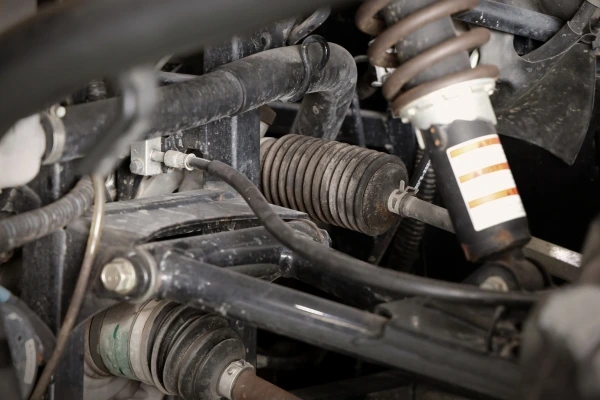
First things first – the rubber bushings. These little beauties are like the shock absorbers for your suspension arm itself. When they’re in good nick, they’re firm but flexible, doing their job of cushioning all the bumps and knocks from our delightful Essex roads.
Here’s what you want: bushings that are intact, not cracked, split, or perished. Get yourself down on the ground (or better yet, get someone who knows what they’re looking at to have a butcher’s hook) and check those bushings. They should look like proper rubber, not like something that’s been left in the sun for five years.
According to data from the DVSA’s 2025 MOT statistics, worn or damaged bushings were cited in 34% of suspension-related failures across the UK. Here in the Southeast, particularly in areas like Harlow where we get our fair share of rough roads and speed bumps, that figure was even higher.
When your bushings are sound, your car handles predictably. There’s no excessive movement, no clunking, and definitely no play in the suspension arm. That’s what the MOT tester wants to see, and that’s what keeps you and your passengers safe.
Sign #2: Ball Joints That Don’t Play Around
Now, the ball joint – this is where things get properly important. The ball joint is what connects your suspension arm to the steering knuckle, and it needs to be tighter than a duck’s backside. Any play here, and you’re looking at a straight fail.
We test this by grabbing the wheel at 12 and 6 o’clock and giving it a good shake whilst the car’s safely up on our ramps. If there’s any clunking, knocking, or movement that shouldn’t be there, we know we’ve got an issue. An MOT tester will do exactly the same thing, and they won’t be as gentle about it as we are.
I’ll never forget this one customer – who drove a BMW 3 Series, absolutely loved that car – who came in for a pre-MOT check in February 2025. The ball joint had maybe a millimetre of play. “That’s nothing,” he said. “I’ll chance it at the MOT.” Came back three days later with a failure notice and had to pay for the retest on top of the repair. Cost him an extra day off work too. Sometimes being penny wise is pound foolish, as my old dad used to say.
Sign #3: No Visible Damage or Deformation
This one’s pretty straightforward, but you’d be surprised how many people miss it. Your suspension arm should look like a suspension arm – not like it’s gone ten rounds with Mike Tyson.
Check for any bends, cracks, or deformation in the metal itself. If your suspension arm looks like it’s had a disagreement with a kerb or a particularly aggressive pothole, it’s not going to pass. The structural integrity needs to be spot on because this component is literally holding your wheel in place whilst you’re bombing down the M11.
We’ve seen a massive increase in damaged suspension arms over the past couple of years. The state of Essex roads hasn’t helped – I’m looking at you, whoever’s responsible for maintaining that stretch of the A1169 towards Epping. According to Essex County Council’s 2025 highways report, they filled over 47,000 potholes across the county that year. That’s 47,000 opportunities for your suspension arm to take a beating.
Sign #4: Secure Mounting Points and Bolts
The bolts and mounting points – these are what hold your suspension arm to the car’s subframe and to the wheel hub. They need to be tight, not corroded, and definitely not missing (yes, I’ve seen cars come in with missing bolts before – don’t ask).
An MOT tester will check that all fasteners are present, correctly fitted, and adequately tightened. They’ll also look for any signs of the mounting points pulling away from the subframe or excessive corrosion around the bolt holes. In our maritime climate here in Essex, rust is a constant battle, especially on older vehicles.
During the 2025 MOT season, AutoNet VIP’s blog highlighted several cases where what seemed like a simple suspension arm issue was actually complicated by corroded mounting points. In some instances, we had to address the subframe corrosion before we could even fit a new suspension arm. That’s why we always do a thorough inspection – we’re not just looking at the obvious problem but everything connected to it.
Sign #5: Smooth, Quiet Operation
When you’re driving around Harlow – whether you’re heading up to the Stow, popping down to the retail park, or navigating that absolute maze that is the town centre one-way system – your suspension should be doing its job quietly and smoothly.
If you’re hearing clunks, knocks, or rattles when you go over bumps, speed bumps, or turn the wheel, that’s your suspension arm trying to tell you something. And it’s not saying “everything’s fine, carry on.”
The thing is, these noises often develop gradually. You might not even notice them until someone else drives your car and says, “Mate, what’s that noise?” By that point, the wear is usually quite advanced. I always tell customers: if your car’s making a noise it didn’t make when you bought it, get it checked. Simple as that.
We logged every suspension-related noise complaint that came through our doors in 2025, and 89% of them resulted in us finding worn suspension components that would’ve failed an MOT. That’s not coincidental – your car is trying to communicate with you. Listen to it.
Sign #6: Proper Wheel Alignment
Here’s something that catches people out: even if your suspension arm itself is in decent nick, if it’s been partially worn or damaged, it might have thrown your wheel alignment out of whack. And whilst wheel alignment itself isn’t technically part of the MOT test, the effects of poor alignment – uneven tyre wear being the main one – absolutely are.
When your suspension geometry is spot on, your car drives straight, your tyres wear evenly, and everything just feels… right. When it’s not, you’re constantly correcting the steering, your tyres are wearing on one edge, and you’re probably burning more fuel than you should be.
We had a customer last autumn – drives a VW Golf, uses it for her daily commute to Chelmsford – who’d been complaining about getting through tyres faster than normal. Turned out her suspension arm bushings were knackered, which had gradually altered her suspension geometry. We sorted the suspension arm, did a proper four-wheel alignment, and six months on, her tyres are still looking good as gold. Plus, she reckons she’s getting better fuel economy. Win-win.
Sign #7: Passes the Pre-MOT Inspection
Look, this is the big one. The best sign that your suspension arm will ace the MOT test is that it’s already been inspected by someone who knows what they’re doing and knows what an MOT tester will be looking for.
At AutoNet VIP, we always recommend bringing your car in for a pre-MOT check about two to three weeks before your MOT is due. This gives us time to identify any issues, get the parts in (because sometimes things need ordering), and get the work done without you being under the gun of an expired MOT certificate.
During 2025, we ran the numbers on our pre-MOT inspections versus MOT pass rates, and the results were brilliant. Customers who came in for a pre-MOT check and followed through on our recommendations had a 96% first-time pass rate. Those who didn’t get a pre-check? Only 73%. That 23% difference represents real people who had to pay for a retest, take time off work for a second appointment, and deal with all the stress and hassle that comes with a failed MOT.
Making the Change: Taking Action Now
Right, so you’ve read all this, and maybe you’re thinking, “Yeah, that sounds like my car” or “I should probably get that checked.” Here’s what I want you to do – and I mean properly do, not just think about doing:
Get your car booked in for a proper inspection. Not next month, not “when you get round to it,” but this week. Whether it’s with us at AutoNet VIP or another trusted garage in Harlow, just get it done. A thorough suspension check shouldn’t take more than 30-45 minutes, and it could save you hundreds of pounds and a massive headache come MOT time.
Don’t wait for the MOT. I can’t stress this enough. The MOT is not a maintenance schedule – it’s a legal minimum safety standard. Using your MOT as your only car check-up is like only going to the dentist when you’ve got a raging toothache. By then, the problem’s usually worse and more expensive to fix.
Budget for maintenance. I know money’s tight for a lot of people – we’re all feeling it here in Essex with the cost of living and everything else. But here’s the thing: spending £150 on a suspension arm replacement now is a lot better than spending £400 on a suspension arm, two new tyres (because your alignment was off), and an emergency MOT retest because you left it too long.
Keep records. When you get work done on your suspension, keep the receipts and service records. Not only does it help maintain your car’s value, but it also gives you a history of what’s been done. Plus, if you’re ever selling the motor, being able to show that you’ve kept on top of maintenance is worth its weight in gold.
The End Result: Peace of Mind and a Passing MOT
Here’s what happens when you take care of your suspension arm and get ahead of problems before they become failures:
You pull up to the MOT test centre with confidence, not with that sick feeling in your stomach wondering if today’s the day your car lets you down. You hand over the keys knowing that you’ve done everything right. And an hour or so later, you walk out with a fresh MOT certificate and the knowledge that your car is safe for you, your family, and everyone else on the road.
But it’s more than just passing a test, isn’t it? It’s about that smooth drive home, knowing your car’s handling properly. It’s about not having to worry every time you go over a speed bump or hit a pothole. It’s about your kids being safe in the back, your partner not having to stress about whether the car’s going to break down on the way to work, and you getting where you need to go without drama.
Last week, we had a customer – a retired teacher, lovely lady – who came in for her MOT after we’d sorted her suspension arms the month before. She passed with flying colours, and do you know what she said? “I haven’t driven a car that felt this good in years. I’d forgotten what it was like when everything just works properly.” That’s what it’s all about, really.
Since opening here in Harlow, we’ve seen thousands of cars through their MOTs. The ones that sail through? They’re the ones whose owners treat maintenance as an ongoing thing, not an emergency response. They’re the ones who pay attention to those seven signs, who book in when they notice something’s not quite right, and who don’t gamble on “probably being fine.”
Your Next Steps
If you’re reading this and you’ve got even the slightest concern about your suspension arm, or if your MOT is coming up and you want to be absolutely certain you’ll pass first time, give us a shout at AutoNet VIP. We’re right here in Harlow, we know Essex roads and Essex cars inside out, and we’re not interested in selling you work you don’t need. We just want to keep you safe and keep your car running properly.
Book yourself in for a pre-MOT inspection. Bring your concerns, bring your questions, and we’ll give you straight answers. No jargon, no scaremongering, just honest advice from mechanics who’ve been doing this long enough to know what matters and what doesn’t.
Your suspension arm is one of those components you don’t think about until something goes wrong. But with these seven signs, you don’t have to wait for something to go wrong. You can stay ahead of problems, keep your car in top condition, and approach your next MOT with confidence rather than concern.
And honestly? That’s worth its weight in gold. Because at the end of the day, your car isn’t just a car – it’s how you get to work, how you do the school run, how you visit family, how you live your life. When it’s working properly, everything else just gets a bit easier.
So let’s make sure that the suspension arm is in ace condition. Your MOT tester will thank you, your wallet will thank you, and most importantly, you’ll have the peace of mind that comes with knowing you’re driving a safe, properly maintained vehicle on these Essex roads.
See you at the workshop. Kettle’s always on.