
The ECU on a car has revolutionised how modern vehicles operate, transforming simple mechanical systems into sophisticated computer-controlled powerhouses. Whether you’re driving through Harlow town centre or cruising along the M11, your vehicle’s Electronic Control Unit works tirelessly behind the scenes, making thousands of calculations every second to ensure optimal performance and reliability.
Understanding the ECU on a Car: The Brain Behind Modern Motoring
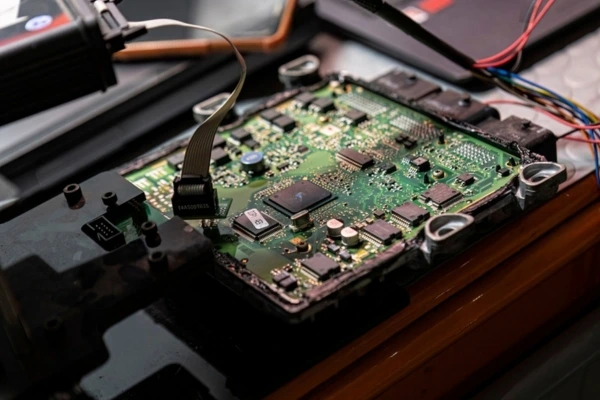
The Electronic Control Unit, commonly known as the ECU on a car, serves as the vehicle’s primary computer system. This compact yet powerful device monitors and controls virtually every electronic system in your vehicle, from fuel injection timing to emissions control. Think of it as your car’s brain – constantly processing information from dozens of sensors and making split-second decisions to keep everything running smoothly.
Modern vehicles can contain multiple ECUs, with some high-end models featuring over 100 separate control units. However, the main engine control unit remains the most critical, directly influencing your vehicle’s performance, fuel economy, and overall reliability. At AutoNet VIP in Harlow, we fix cars and do MOTs and are experts in electric and hybrid cars. We’ve seen how good ECU management can greatly improve a car’s performance and make it last much longer.
1. Enhanced Fuel Efficiency Through Intelligent Management
The ECU on a car dramatically improves fuel efficiency by precisely controlling the air-fuel mixture entering your engine’s combustion chambers. Unlike older carburettor-based systems that relied on mechanical adjustments, modern ECUs make real-time calculations based on numerous variables including throttle position, engine temperature, air intake volume and oxygen sensor feedback.
Real-Time Fuel Optimisation
Your ECU constantly adjusts fuel delivery to match driving conditions. When accelerating onto the A414, the system richens the mixture for more power. During steady motorway cruising, it leans out the mixture to maximise efficiency. This dynamic adjustment happens thousands of times per minute, ensuring you’re never wasting fuel unnecessarily.
Research from the University of Essex’s Department of Computer Science and Electronic Engineering has demonstrated that modern ECU-controlled fuel injection systems can improve fuel economy by 15-25% compared to older mechanical systems. This translates to substantial savings at the pump, particularly important given current fuel prices across Essex and the broader UK.
Adaptive Learning Capabilities
What makes the ECU on a car truly remarkable is its ability to learn your driving habits over time. The system creates a digital map of your typical acceleration patterns, preferred speeds, and common routes. This adaptive learning allows the ECU to anticipate your needs and adjust fuel delivery accordingly, optimising performance whilst maintaining efficiency.
For hybrid vehicles, this becomes even more sophisticated. The ECU determines the most efficient times to engage the electric motor versus the petrol engine, helping to boost hybrid vehicle gas mileage significantly. Many hybrid drivers report fuel economy improvements of 30-40% in urban driving conditions, largely thanks to intelligent ECU management.
2. Precise Ignition Timing for Maximum Power Output
The second major way an ECU on a car improves performance relates to ignition timing control. Proper ignition timing is absolutely critical – fire the spark plugs too early or too late, and you’ll experience reduced power, increased fuel consumption, and potential engine damage.
Dynamic Timing Adjustments
Traditional distributors used mechanical advance mechanisms that couldn’t account for varying conditions. The modern ECU, however, adjusts ignition timing based on:
- Engine speed (RPM)
- Load conditions
- Intake air temperature
- Coolant temperature
- Knock sensor feedback
- Fuel octane rating (through knock detection)
This level of accuracy guarantees the best combustion in all driving situations. When you’re accelerating hard up the steep incline on Muskham Road in Harlow, your ECU advances the timing for maximum power. During gentle cruising, it adjusts for efficiency and reduced emissions.
Knock Prevention and Engine Protection
Perhaps most importantly, the ECU on a car protects your engine from destructive knock (pre-detonation). Knock sensors detect the characteristic high-frequency vibrations of abnormal combustion, and the ECU immediately retards timing to prevent damage. This protection system has saved countless engines from catastrophic failure, particularly when drivers accidentally fill up with lower octane fuel than recommended.
At our Harlow workshop, we regularly perform car checks that include ECU diagnostics. We’ve found that vehicles with properly functioning knock sensors and ECU timing control last significantly longer than older models without these protections.
3. Emissions Control and Environmental Compliance
The ECU on a car plays an indispensable role in meeting stringent UK emissions standards, particularly important for MOT testing. Your vehicle must comply with Euro 6 standards (for newer vehicles) or earlier Euro standards depending on its age.
Continuous Emissions Monitoring
Modern ECUs continuously monitor exhaust emissions through various sensors:
- Oxygen sensors measure oxygen content in exhaust gases
- Lambda sensors ensure the air-fuel ratio stays within optimal ranges
- NOx sensors monitor nitrogen oxide levels
- Particulate matter sensors track diesel particulate filter efficiency
The ECU on a car uses this data to make constant adjustments, ensuring your vehicle remains within legal emission limits. This isn’t just about passing your MOT – it’s about reducing your environmental impact whilst driving around Essex and beyond.
EGR and Catalytic Converter Management
The ECU controls your Exhaust Gas Recirculation (EGR) valve and monitors catalytic converter efficiency. The EGR system reduces harmful nitrogen oxides by recirculating a portion of exhaust gases back into the combustion chamber. Your ECU determines precisely when and how much exhaust gas to recirculate based on engine temperature, load, and speed.
For electric vehicle battery management, the ECU takes on an entirely different but equally crucial role. It monitors individual cell voltages, temperature, and state of charge to maximise battery life and performance. This sophisticated management system is why modern electric vehicles can maintain battery health for hundreds of thousands of miles when properly maintained.
4. Transmission Control and Drivetrain Optimisation
The ECU on a car doesn’t just manage the engine – in most modern vehicles, it also controls or heavily influences transmission behaviour. This integration creates seamless power delivery and improved reliability across the entire drivetrain.
Intelligent Gear Selection
For automatic transmissions, the ECU determines optimal shift points based on:
- Vehicle speed
- Throttle position
- Engine load
- Road gradient
- Driver aggression
This intelligent management ensures smooth gear changes whilst protecting transmission components from excessive wear. During DSG and CVT gearbox servicing at AutoNet VIP in Harlow, we’ve observed that vehicles with well-maintained ECU systems experience far fewer transmission problems.
DSG (Direct Shift Gearbox) systems particularly benefit from ECU control. The dual-clutch design requires microsecond-precise engagement timing, something impossible without computer control. The ECU on a car with DSG technology manages clutch pressure, gear preselection, and shift timing to deliver both the efficiency of a manual and the convenience of an automatic.

CVT Optimisation
Continuously Variable Transmissions (CVTs) rely entirely on ECU control to maintain optimal engine speed for any given situation. Unlike traditional automatic gearboxes with fixed ratios, CVTs can infinitely vary the drive ratio. Your ECU calculates the ideal ratio based on power demand and efficiency requirements, often keeping the engine at its most efficient RPM range regardless of vehicle speed.
This ECU-CVT partnership is particularly effective in hybrid vehicles, where the system must coordinate between the petrol engine, electric motor, and transmission to boost hybrid vehicle gas mileage. The complexity of this three-way coordination would be impossible without sophisticated ECU management.
5. Comprehensive Diagnostics and Fault Detection
Perhaps the most underappreciated benefit of the ECU on a car is its diagnostic capability. Your ECU constantly monitors hundreds of parameters, comparing them against expected values. When something falls outside normal ranges, it stores a diagnostic trouble code (DTC) and often illuminates your check engine light.
Early Problem Detection
This diagnostic capability catches problems early, often before you notice any symptoms. A failing oxygen sensor, for example, might trigger a code days or weeks before you’d notice any change in performance or fuel economy. Early detection means early repair, preventing minor issues from becoming major failures.
During regular car checks, technicians can read these stored codes using professional diagnostic equipment. At AutoNet VIP in Harlow, we use advanced diagnostic scanners that communicate directly with your vehicle’s ECU, retrieving not just fault codes but also live data streams showing real-time sensor values and system performance.
Freeze Frame Data
When your ECU on a car detects a fault, it doesn’t just store a code – it captures “freeze frame” data showing exact operating conditions when the problem occurred. This snapshot includes:
- Engine RPM
- Vehicle speed
- Coolant temperature
- Load value
- Fuel system status
- Oxygen sensor readings
This information proves invaluable for diagnosing intermittent problems that might not be present when the vehicle reaches the workshop. It’s like having a black box recorder that documents exactly what was happening when something went wrong.
Component Protection Modes
Modern ECUs feature “limp mode” or “limp home mode” – a failsafe that activates when serious problems are detected. Rather than allowing continued operation that might cause catastrophic damage, the ECU on a car limits performance (typically to around 2000-3000 RPM and reduced power output) allowing you to safely drive to a garage.
Whilst frustrating when it occurs, limp mode has prevented countless expensive engine failures. The University of Essex’s research into automotive electronics has shown that vehicles equipped with comprehensive ECU protection modes experience 40% fewer major mechanical failures compared to older vehicles without these safeguards.
ECU Remapping: Unlocking Hidden Performance
Many drivers across Essex and the UK are discovering that their ECU on a car contains untapped potential. Manufacturers typically program ECUs conservatively, leaving a substantial performance margin for various reasons including fuel quality variations across different markets, warranty considerations, and regulatory compliance.
What Is ECU Remapping?
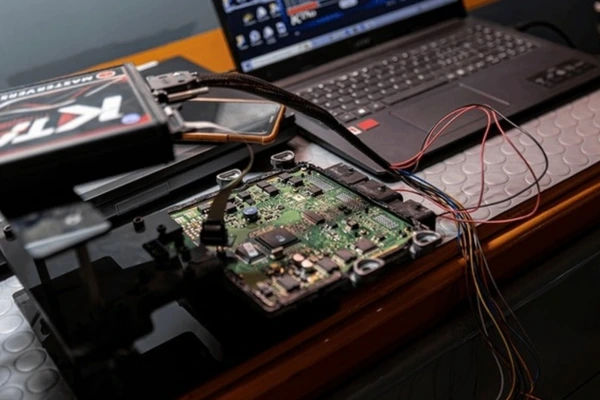
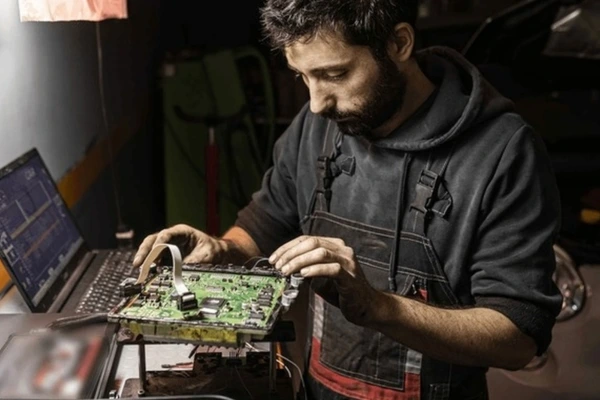
ECU remapping, also called chip tuning or ECU tuning, involves modifying the software parameters stored in your vehicle’s ECU. A qualified technician connects specialist equipment to your vehicle’s OBD-II port and uploads revised calibration data that optimises various engine parameters.
Typical adjustments include:
- Modified fuel injection maps
- Adjusted ignition timing curves
- Revised boost pressure limits (for turbocharged engines)
- Altered throttle response characteristics
- Optimised torque limiters
Performance and Economy Benefits
Professional ECU remapping can deliver impressive gains:
- Diesel engines: 20-40% power increase, 15-25% torque increase
- Turbocharged petrol engines: 15-30% power increase, 20-35% torque increase
- Naturally aspirated petrol engines: 5-15% power increase
Perhaps surprisingly, proper ECU remapping can also improve fuel economy. By optimising torque delivery across the rev range, many drivers find they need less throttle input for normal driving, resulting in reduced fuel consumption despite the increased performance potential.
Important Considerations
Before considering ECU remapping, understand these critical points:
Insurance implications: You must declare any ECU modifications to your insurance provider. Failure to do so may invalidate your policy coverage.
Warranty concerns: Manufacturer warranties may be voided by unauthorised ECU modifications.
Component stress: Increased power and torque place additional stress on drivetrain components. Ensure your clutch, gearbox, and other components can handle the extra output.
Quality matters: Only use reputable tuning companies. Poor quality remaps can damage engines, increase emissions, and reduce reliability.
At AutoNet VIP in Harlow, we work with certified tuning partners who provide custom remapping solutions backed by comprehensive warranties and insurance-approved modifications.
ECU Maintenance and Care
Whilst the ECU on a car is generally reliable, proper maintenance ensures it continues functioning optimally throughout your vehicle’s lifetime.
Regular Software Updates
Manufacturers occasionally release ECU software updates addressing bugs, improving performance, or updating emissions control strategies. These updates, often applied during routine servicing, keep your vehicle running at its best. During MOT testing and routine car checks, ask your technician whether any ECU updates are available for your vehicle.
Electrical System Health
Your ECU requires stable electrical power to function correctly. Weak batteries, corroded connections, or charging system problems can cause ECU malfunctions. Modern ECUs are sensitive to voltage fluctuations – even brief drops below 11 volts or spikes above 15 volts can corrupt data or damage circuits.
For electric vehicle battery systems, maintaining proper charge levels and avoiding extreme temperatures helps protect the battery management ECU. These sophisticated controllers require optimal conditions to accurately monitor and control the high-voltage battery pack.
Physical Protection
ECUs are typically mounted in protected locations, but water ingress remains a common failure cause. After driving through flood water (unfortunately common in parts of Essex during heavy rain), have your vehicle inspected. Water damage to ECU circuits can cause immediate failure or create corrosion that leads to problems months later.
The Future of ECU Technology
The ECU on a car continues evolving rapidly, incorporating artificial intelligence, machine learning, and connectivity features that seemed like science fiction just a decade ago.
Connected ECUs
Modern vehicles increasingly feature ECUs with internet connectivity, enabling:
- Remote diagnostics and software updates
- Predictive maintenance alerts
- Real-time traffic and weather-based optimisation
- Integration with smart home systems
This connectivity allows manufacturers to improve vehicle performance and fix bugs without requiring workshop visits. Tesla pioneered this approach, but traditional manufacturers are rapidly adopting similar technologies.
AI-Powered Management
Future ECUs will incorporate genuine artificial intelligence, learning not just from your driving patterns but from millions of vehicles worldwide. This collective learning could identify potential failures before they occur, optimise routes for maximum efficiency, and continuously improve performance based on real-world data.
Research at the University of Essex and other leading institutions is exploring neural network-based engine management systems that can optimise combustion with unprecedented precision. These systems may eventually eliminate the need for predefined calibration maps entirely, instead learning optimal parameters through continuous operation.
Hybrid and Electric Vehicle Integration
As the automotive industry transitions toward electrification, ECU technology becomes increasingly critical. Managing the complex interaction between traditional engines, electric motors, regenerative braking systems, and high-voltage batteries requires computational power and sophisticated algorithms far beyond what was needed for conventional vehicles.
For drivers looking to boost hybrid vehicle gas mileage, future ECU updates may offer substantial improvements through better predictive algorithms and more efficient power management strategies. Some manufacturers already report fuel economy improvements of 5-10% through software updates alone.
ECU Diagnostics in Harlow: Professional Support
When ECU-related problems occur, professional diagnostics are essential. The complexity of modern engine management systems means that proper diagnosis requires specialist equipment and extensive training.
At AutoNet VIP – Car Repairs, MOTs & Electric & Hybrid Specialists in Harlow, our technicians use manufacturer-level diagnostic equipment that goes far beyond generic code readers. This professional-grade equipment can:
- Read and clear diagnostic trouble codes
- View live data streams from all sensors
- Perform component activation tests
- Access manufacturer-specific parameters
- Programme replacement ECUs
- Perform adaptation procedures after repairs
Comprehensive Car Checks
Regular car checks should always include ECU diagnostics. Even without an illuminated warning light, stored “pending” codes or unusual sensor readings may indicate developing problems. Early detection through professional diagnostics can save hundreds or even thousands of pounds in repair costs.
Our comprehensive checks include:
- Full ECU fault code scan
- Live data analysis
- Emissions system verification
- Transmission control module diagnostics (where applicable)
- Electric vehicle battery health assessment (for EVs and hybrids)
- DSG and CVT gearbox electronic system checks
Specialist Services
For complex ECU-related issues, we offer specialist services including:
- ECU software updates and reflashing
- Immobiliser and key programming
- ECU replacement and coding
- Hybrid system diagnostics and repair
- Electric vehicle battery management system diagnostics
- DSG and CVT gearbox servicing with comprehensive electronic diagnostics
Common ECU Problems and Solutions
Understanding common ECU issues helps you recognise problems early and seek appropriate solutions.
Water Damage
Symptoms: Intermittent starting problems, erratic gauge readings, multiple random fault codes
Solution: ECU inspection for water ingress, possible circuit board repair or ECU replacement
Corrosion
Symptoms: Gradual performance degradation, increasing number of fault codes over time
Solution: Connector cleaning, ECU connector replacement, possible ECU replacement if internal corrosion present
Software Corruption
Symptoms: Sudden inability to start, check engine light, unusual behaviour after battery disconnection
Solution: ECU reprogramming with latest manufacturer software
Component Failure
Symptoms: Permanent check engine light, limp mode activation, specific systems non-functional
Solution: Replace failed ECU, programme replacement unit, perform necessary adaptations
Battery-Related Issues
Symptoms: Random fault codes after battery replacement, immobiliser problems, lost ECU adaptations
Solution: ECU reset and recalibration, immobiliser re-synchronisation, sensor adaptations
At AutoNet VIP in Harlow, we’ve successfully diagnosed and repaired thousands of ECU-related problems. Our experience with both conventional and electric vehicle battery systems means we can tackle even the most complex electronic issues.
Maximising ECU Performance and Longevity
To ensure your ECU on a car continues delivering optimal performance and reliability:
- Maintain regular servicing schedules: Timely oil changes, filter replacements, and spark plug changes reduce stress on ECU-controlled systems
- Address warning lights promptly: Ignoring check engine lights allows minor problems to escalate into major failures
- Use quality fuel: Poor quality fuel affects combustion efficiency and can damage sensors, leading to ECU problems
- Keep electrical systems healthy: Maintain your battery, alternator, and wiring in good condition
- Avoid amateur modifications: Poorly executed modifications can confuse or damage ECU systems
- Professional diagnostics: Include ECU checks in regular car checks and MOT preparations
- Update software: Apply manufacturer ECU updates during routine servicing
The ECU Advantage: A Worthwhile Investment
The ECU on a car represents one of the most significant technological advances in automotive history. From improved fuel economy and reduced emissions to enhanced reliability and comprehensive diagnostics, these sophisticated computers have transformed modern motoring.
Whether you’re driving a conventional petrol vehicle, working to boost hybrid vehicle gas mileage, or navigating the complexities of electric vehicle battery management, your ECU works constantly to optimise performance, protect components, and ensure reliable operation.
For drivers in Harlow, Essex, and across the UK, understanding your ECU’s role and ensuring it receives proper maintenance is essential for maximising your vehicle’s performance and longevity. Regular car checks, prompt attention to warning lights, and professional diagnostics when problems arise will keep your ECU functioning optimally for hundreds of thousands of miles.
At AutoNet VIP – Car Repairs, MOTs & Electric & Hybrid Specialists in Harlow, we’re committed to providing expert ECU diagnostics, maintenance, and repair services. From routine car checks to complex hybrid system repairs and DSG and CVT gearbox servicing, our experienced technicians have the knowledge and equipment to keep your vehicle’s electronic systems running perfectly.
The ECU on a car isn’t just a component – it’s the key to modern automotive performance, efficiency, and reliability. Treat it with the care it deserves, and it will reward you with thousands of trouble-free miles of motoring enjoyment.
