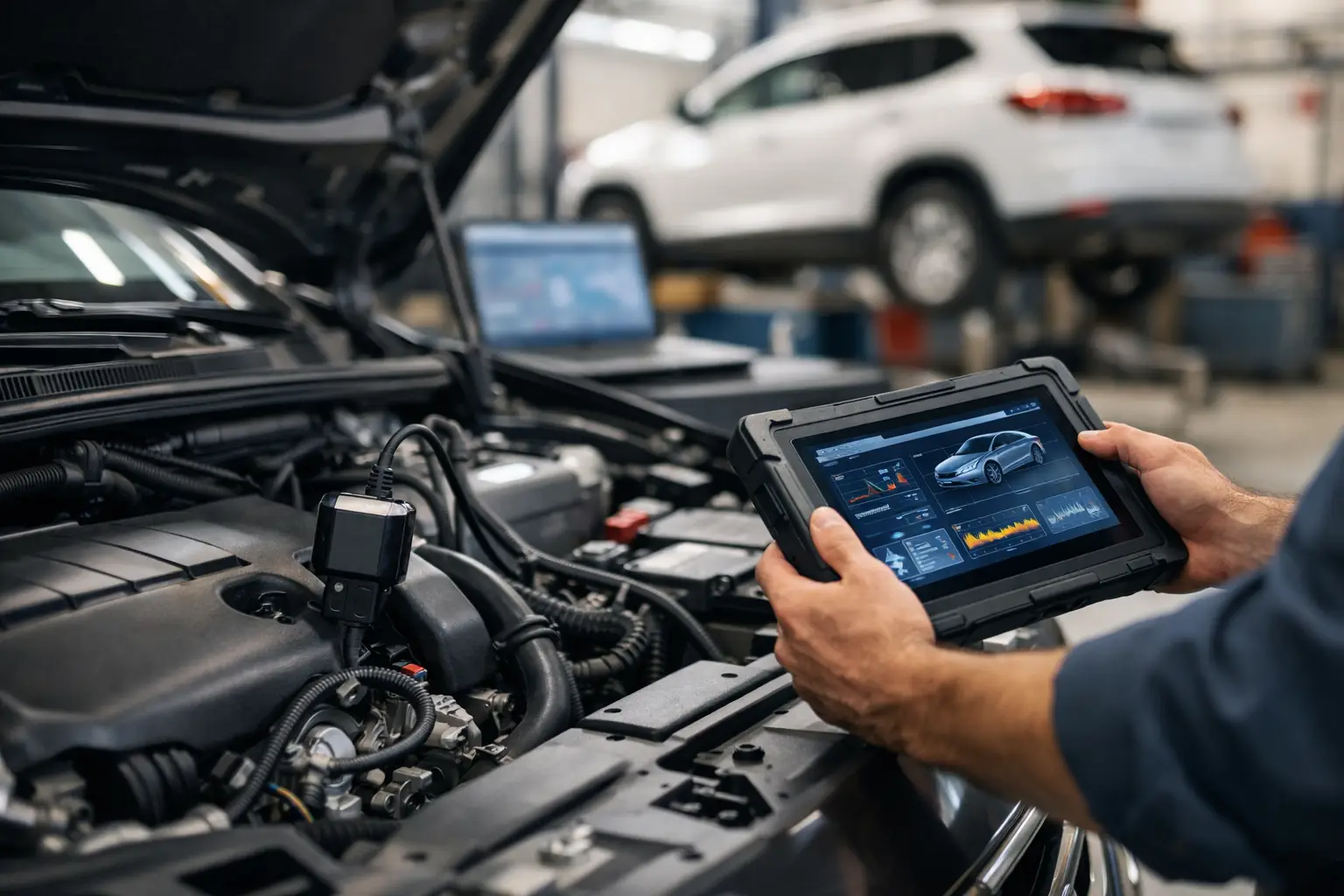
A dashboard light comes on during the school run or your van starts hesitating on the way to work, and the same question usually follows – is this something minor, or the start of an expensive repair? That is where a solid vehicle diagnostics guide helps. Good diagnostics do not just identify faults. They save time, reduce guesswork, and help you make better decisions before a small issue becomes a bigger one.
At a modern garage, diagnostics is no longer just plugging in a scanner and reading a code. Vehicles now rely on multiple control modules, sensors, software systems, and, in hybrids and EVs, high-voltage components that require a different level of care. A proper diagnostic process combines equipment, technical knowledge, and real-world testing. If any one of those is missing, the result can be an incorrect repair and a bill that did not need to happen.
What vehicle diagnostics actually means
Vehicle diagnostics is the process of identifying the cause of a fault using a mix of electronic scanning, live data analysis, physical inspection, and technician experience. The goal is not to find a symptom. The goal is to find the reason behind it.
That difference matters. A fault code might point to an oxygen sensor, for example, but the sensor itself may not be the real problem. Wiring damage, an intake leak, fuel delivery issues, or an exhaust problem can all trigger similar codes. Replacing parts based only on the first code you see is one of the most common ways money gets wasted.
This is why reliable diagnostics should feel methodical rather than rushed. A technician should be able to explain what has been found, what still needs confirming, and why a certain repair is being recommended.
A practical vehicle diagnostics guide to warning signs
Not every vehicle issue starts with a warning light. Some faults show up in the way the car drives long before the dashboard catches up. If you notice rough idling, poor acceleration, reduced fuel economy, delayed gear changes, repeated battery problems, or strange electrical behavior, diagnostics are often the fastest route to an answer.
Warning lights still matter, though. The check engine light is the one most drivers recognize, but ABS, airbag, battery, DPF, TPMS, and hybrid system warnings can all signal faults that should not be ignored. Some are urgent, while others allow limited driving. It depends on the system involved, how the vehicle is behaving, and whether the fault affects safety or risks further damage.
A flashing check engine light, for instance, often points to a misfire severe enough to damage the catalytic converter. That is very different from a steady light on a car that otherwise feels normal. Both need attention, but not with the same urgency.
How the diagnostic process should work
A good diagnostic appointment usually starts with questions. What did the driver notice? When did it start? Is the fault constant or intermittent? Did it happen after servicing, battery replacement, impact damage, or poor weather? Those details can shorten the path to the real cause.
The next step is electronic scanning. This retrieves stored and pending trouble codes, but that is only the beginning. A skilled technician will also look at freeze-frame data, system histories, and live sensor readings while the vehicle is running. That helps show whether components are operating normally in real time.
After that comes targeted testing. Depending on the fault, that may include battery and charging tests, smoke testing for air leaks, fuel pressure checks, wiring continuity tests, actuator tests, compression checks, software version checks, or road testing. On hybrids and EVs, safety procedures around high-voltage systems become essential, and not every workshop is equipped or trained to carry those out properly.
By the end of the process, the best outcome is not just a fault code printout. It is a clear explanation of the fault, the repair options, and any next steps if more investigation is needed.
Why fault codes do not tell the whole story
One of the biggest misunderstandings around diagnostics is the idea that a code equals a part. It rarely works that cleanly.
Take a code for low turbo boost. That could be a failing turbocharger, but it could also be caused by a split hose, sticking actuator, vacuum issue, boost control solenoid fault, sensor error, or intake restriction. Replacing the turbo first without proper testing is a gamble, not a diagnosis.
The same applies to battery-related warnings, transmission faults, and emissions problems. Modern vehicles are interconnected. A weak battery can trigger multiple unrelated-looking electrical faults. A software issue can mimic a hardware failure. A wheel speed sensor problem can affect ABS, traction control, and stability systems at the same time.
That is why experience matters. The right equipment reads the data, but the technician still has to interpret it correctly.
Diagnostics for gas, diesel, hybrid, and electric vehicles
This is where the workshop you choose makes a real difference. Basic diagnostics on a gas vehicle may be straightforward compared with diagnosing a diesel DPF issue, a hybrid battery fault, or an EV charging problem.
Diesel vehicles often need careful investigation when dealing with EGR faults, injector issues, DPF regeneration failures, or AdBlue system warnings. These systems are emissions-critical and can become expensive if the wrong repair path is chosen early on.
Hybrids and EVs add another layer. Faults may involve battery management systems, inverter performance, regenerative braking, charging circuits, insulation monitoring, or software communication between modules. These are not jobs for guesswork. They require proper training, safe working procedures, and diagnostic tools that go beyond generic code readers.
For drivers who want one garage to handle a broad range of vehicles, this matters. A workshop that can diagnose both mechanical and electronic faults across different powertrains gives you more confidence that the advice is based on capability, not limitation.
When a scan tool is enough, and when it is not
Consumer scan tools have their place. They can be useful for checking why a light came on, clearing historical codes after a repair, or giving a technician useful background before booking the vehicle in. For simple issues, they may even point you in the right direction.
But they also have limits. Many budget scanners only read generic engine codes and miss manufacturer-specific faults, transmission data, body control issues, ABS faults, or advanced live data. Even when they do show a code, they rarely tell you whether the fault is active, intermittent, caused by another system, or already solved.
If the problem affects drivability, safety, charging, braking, starting, or repeated warning lights, a proper workshop diagnostic is usually the safer choice. It is often cheaper than replacing the wrong parts based on incomplete information.
How diagnostics can save money
Some drivers hesitate to pay for diagnostics because they want to avoid extra cost. That is understandable, but skipping diagnostics often creates a larger bill later.
The value is in accuracy. If testing confirms a small air leak instead of a failed sensor pack, or a software update instead of a major hardware replacement, diagnostics can prevent unnecessary spending. It also helps catch wear before it becomes breakdown-level damage. A misfire found early may need a coil pack. Left too long, it may also damage the catalytic converter.
Transparent garages explain this clearly. You should know what the diagnostic charge covers, whether further testing might be needed, and how any repair estimate is built. That clarity matters just as much as the technical work itself.
Choosing a garage for diagnostic work
If you need diagnostics, look for a garage that explains the process in plain language, has the equipment to deal with modern systems, and does not jump straight to parts replacement. Certifications, training, and broad vehicle coverage all help, but communication is what gives customers confidence.
A dependable workshop should be comfortable saying, “Here is what we know so far, here is what we still need to confirm, and here is the fairest way forward.” That approach is far better than overpromising a quick answer on a fault that clearly needs more than a basic scan.
For drivers in busy areas such as Harlow and across Essex or London, where losing the car for even a day can cause real disruption, accurate diagnostics also help with planning. If the issue is identified properly at the start, repairs are more likely to be approved quickly and completed without repeat visits.
At AutoNet VIP, that customer-first approach is what good diagnostics should feel like – clear, honest, and focused on the right repair rather than the fastest guess.
What to do when a warning light appears
If a warning light comes on, start with the basics. Notice how the vehicle feels, whether any sounds have changed, and if the problem appears only when cold, under load, or at highway speed. If the car is overheating, losing power sharply, showing brake warnings, or flashing the check engine light, stop driving if it is unsafe to continue.
If the vehicle still feels normal, avoid ignoring it for weeks. Small faults have a habit of creating larger ones, especially with emissions, charging, or ignition systems. Booking diagnostics early usually gives you more options and lower costs.
The most useful mindset is simple: warning lights are messages, not verdicts. The code is not the repair. The symptom is not the cause. A careful diagnostic process turns uncertainty into a plan, and that is what gets you back on the road with confidence.
When your vehicle starts telling you something is wrong, the smartest move is not to guess. It is to get the right answer first.