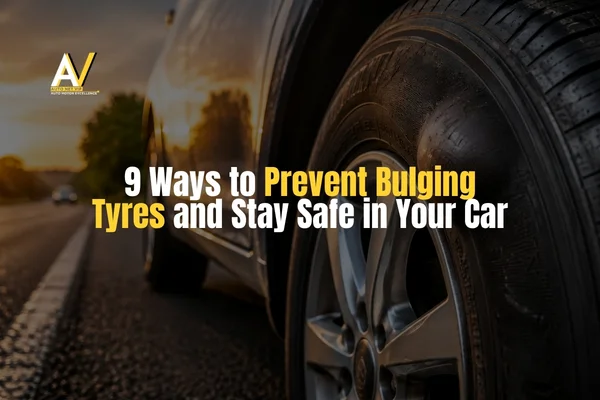
It starts with a sound you almost ignore — a faint thud against the wheel arch, a slight pull to the left on the A414, or the car sitting a touch lower on one corner than it should. Most drivers in Harlow and across Essex shrug it off. Then one morning, they clock the bulge — that unmistakable bubble pressing out from the sidewall of the tyre — and the gut drops. That bulge is not cosmetic. It is the tyre telling you, clearly and urgently, that it is about to fail.
According to data published by TyreSafe UK in 2025, tyre-related incidents remain one of the leading causes of sudden vehicle loss of control on British roads, with bulging tyres — also known as tyre sidewall bubbles — cited in a significant proportion of blowout-linked breakdowns reported to roadside assistance services across the South East, including Essex. The problem is real, it is preventable, and if you are already seeing one on your vehicle, it is fixable — sooner rather than later.
This guide — written with the experience of mechanics here at AutoNet VIP – Car Repairs, MOTs & Electric & Hybrid Specialists in Harlow — walks you through exactly what causes bulging tyres, how to spot them early, and most importantly, nine practical, proven ways to stop them happening in the first place.
What Exactly Is a Bulging Tyre — And Why Should It Scare You?
A tyre bulge forms when the internal structure of the tyre — specifically the layers of cord fabric and steel belt beneath the rubber — becomes damaged or weakened. Air then pushes outward through those damaged layers, creating a visible bubble on the sidewall. Unlike a slow puncture, a bulging tyre gives very little warning before it goes. When it does fail, it typically fails catastrophically, often at speed.
The roads around Harlow are not kind to tyres. The A10 corridor, stretches of the M11 near junction 7, and many of the older B-roads across West Essex are riddled with pothole damage that barely makes it onto council repair schedules. Essex County Council’s 2025 Highways Condition Report acknowledged a backlog of carriageway defects, particularly on unclassified roads, that continues to affect vehicle safety across the county. Every pothole strike, every hard kerb mount, every overloaded boot-run to IKEA in Waltham Abbey — they all add stress to a tyre that was not designed to absorb it.
9 Ways to Prevent Bulging Tyres — Starting Today
1. Check Your Tyre Pressure Every Fortnight — Without Exception
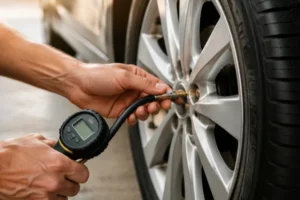
Under-inflated tyres are the single most common cause of bulging tyres that we see come through the workshop. When a tyre runs too soft, its sidewall flexes excessively on every rotation. That constant flexing generates internal heat — and heat, over time, breaks down the bond between the rubber and the internal cords. Once that bond goes, the structural integrity of the tyre is gone with it.
Check your tyre pressure when the tyres are cold — before you have driven more than a mile. Use the manufacturer’s recommended PSI, which you will find on the sticker inside the driver’s door frame or in your vehicle handbook. A decent digital gauge costs under a tenner from any motor factor in Harlow and will pay for itself many times over.
2. Walk Around Your Tyres Before You Drive — Make It a Habit
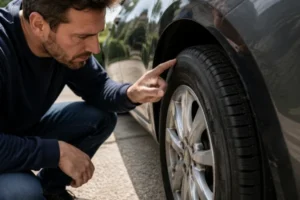
This takes thirty seconds. Thirty seconds that could stop you joining the 1-in-4 drivers across the UK who, according to a 2025 RAC Foundation survey, have never performed a visual tyre check outside of a garage visit. Walk around the car. Crouch down at each corner. Look at the sidewalls. If something is pushing outward — even slightly — do not drive on it. Call your garage.
A bulging tyre spotted early, before the structural damage progresses, gives you options. A bulging tyre spotted on the hard shoulder of the M11 gives you very few.
3. Slow Down for Potholes — They Are Worse Than They Look
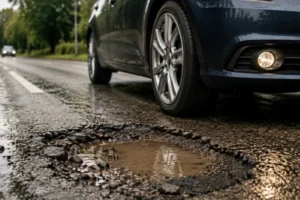
Essex has a problem with potholes — and it is not getting better quickly. Figures from the 2025 Local Authority Road Condition Survey showed that nearly 18% of B-roads and unclassified roads across Essex were rated in poor or very poor condition. That is a lot of road hazard between you and wherever you are going.
The physics is simple: striking a pothole at 40mph delivers several times the impact force compared to hitting it at 20mph. Slowing before the pothole — not through it — dramatically reduces the stress on both the tyre and the wheel rim. If you cannot avoid it, keep the steering wheel straight and release the brakes just before impact to allow the tyre to absorb more of the blow.
4. Do Not Overload Your Vehicle
Every tyre has a load rating. It is marked on the sidewall as a number — 91, 94, 98 — and it corresponds to a maximum carrying weight. Exceed that weight consistently and you are compressing the tyre beyond its design tolerance. The sidewall buckles under load. The internal structure weakens. Eventually, the bubble appears.
This is particularly relevant for van drivers, tradespeople, and anyone making regular heavy-load runs — something we see a lot of in and around the Harlow industrial estates. Check your tyre load rating against your typical payload. If you are regularly running heavy, consider tyres rated for the job.
5. Replace Tyres Before They Are Dangerously Old — Not Just Worn
Tread depth gets all the attention, but tyre age matters just as much. Rubber degrades from the inside out. A tyre that looks fine on the outside — decent tread, no obvious damage — can have seriously compromised internal cords if it is more than six or seven years old. The DOT date code on the sidewall (a four-digit number showing week and year of manufacture) tells you exactly how old your tyres are.
British Tyre Manufacturers’ Association guidance published in 2025 recommends that tyres over ten years old should be replaced regardless of visible condition. Many mechanics — ourselves included — would push that to six years for vehicles in regular daily use on UK roads.
6. Get Your Wheel Alignment Checked Regularly
Misaligned wheels do not just eat through your tread unevenly — they put lateral stress on the tyre’s sidewall that accelerates internal breakdown. You might notice your car pulling gently to one side, or the steering wheel sitting slightly off-centre when you are driving straight. Both are signs worth investigating.
A wheel alignment check at AutoNet VIP in Harlow takes under an hour and costs a fraction of a replacement tyre. Most manufacturers recommend checking alignment every 10,000 miles or after any significant kerb strike or pothole impact — whichever comes first.
7. Rotate Your Tyres Every 6,000 to 8,000 Miles
Front tyres wear faster than rears on most vehicles — particularly on front-wheel-drive cars, which are still the majority on British roads. When one tyre wears faster, it also weakens faster. Rotating your tyres regularly ensures even wear across all four, extending their working life and keeping the structural integrity balanced across the axles.
This is an easy one to add to your service schedule. Ask your garage to include a tyre rotation alongside your annual service — it adds very little time and makes a meaningful difference to tyre longevity.
8. Never Drive on a Bulging Tyre — Not Even to the Garage
This one needs saying directly, because we have seen people do it: if you spot a bulge on your tyre, the tyre should not be driven on. Full stop. A bulging tyre can fail without further warning. The forces involved in a high-speed blowout — loss of control, potential rollover, collision risk — are not a gamble worth taking.
Fit the spare if you have one, call for breakdown assistance, or arrange collection. If you are local to Harlow or anywhere across West Essex, you can call us directly at AutoNet VIP and we will advise you on the safest next step. Do not risk it.
9. Book a Tyre Safety Check — Once a Year at Minimum
A professional tyre inspection goes beyond what you can see standing in a car park. A trained technician will check internal pressure integrity, inspect the tyre bead and sidewall for micro-cracks that are invisible to the naked eye, assess tread wear patterns for signs of alignment or suspension issues, and flag any developing concerns before they become dangerous.
TyreSafe — the UK’s leading tyre safety charity — ran its 2025 national tyre safety campaign under the message that 40% of UK drivers could not correctly identify an unsafe tyre. An annual professional check closes that gap. It is inexpensive, quick, and could genuinely save your life or someone else’s.
You Have Already Spotted a Bulge — Here Is What to Do Right Now
First — do not panic. Finding a bulge is actually the best case scenario compared to discovering the problem mid-motorway. You have caught it. Now act on it.
Step one: Do not drive the vehicle. Step two: Check whether your spare tyre is serviceable and correctly inflated. Step three: If you are safe to do so, fit the spare and drive carefully — at reduced speed — to your nearest tyre specialist. Step four: Do not attempt to repair a bulging tyre. There is no patch for this. Internal structural damage cannot be reversed. The tyre must be replaced.
At AutoNet VIP – Car Repairs, MOTs & Electric & Hybrid Specialists in Harlow, we stock a wide range of tyres to suit all vehicles — from everyday hatchbacks to larger SUVs, vans, and electric and hybrid models. Our technicians will fit and balance your replacement tyre, check the spare, assess whether the rim has sustained any damage, and make sure you leave safely. We also serve drivers from Epping, Bishops Stortford, Sawbridgeworth, and across the surrounding areas of West Essex.
A Word for Electric and Hybrid Vehicle Drivers in Harlow
Electric vehicles are heavier than their petrol equivalents — often significantly so, owing to the weight of the battery pack. That extra weight translates directly into increased tyre stress, particularly on the sidewalls. EV tyres are specifically engineered to handle this load and the instant torque delivery that EVs are known for. Fitting standard passenger tyres on an EV and expecting the same safety margins is a mistake we see more of as EV ownership grows across Harlow and Essex.
If you drive an electric or hybrid vehicle, ensure your replacement tyres carry the correct EV or XL load rating for your model. Our team at AutoNet VIP specialises in electric and hybrid vehicle servicing and can advise on the right tyre specification for your car. Read more on our electric and hybrid vehicle services page.
The Bottom Line on Bulging Tyres
Bulging tyres are not a minor inconvenience. They are a structural failure waiting to happen — and on the busy roads of Harlow, the M11, or the A414, a tyre blowout at speed can have consequences that go far beyond a repair bill. The good news is that this is almost entirely preventable. Regular pressure checks. Visual inspections. Sensible driving over potholes. Tyres appropriate to your vehicle and load. A professional eye on them once a year.
None of these things are complicated. None of them are expensive. And every single one of them keeps you, your family, and everyone else on the road that much safer.
If you have a concern about your tyres — whether it is a suspected bulge, uneven wear, a handling issue, or simply overdue for a check — get in touch with the team at AutoNet VIP in Harlow. We are here to help you fix the problem, get back on the road, and stay there safely.
📍 AutoNet VIP – Car Repairs, MOTs & Electric & Hybrid Specialists
Harlow, Essex | Serving Epping, Bishops Stortford, Sawbridgeworth & West Essex
Book online: autonet-vip.co.uk