Your car’s air conditioning rarely stops working without warning. It may take longer to cool the cabin, blow cold air only while driving, or feel noticeably weaker on warm days. Knowing how to diagnose aircon leak symptoms early can help you avoid wasted money on a regas that only provides a short-term fix.
A properly sealed air conditioning system should retain its refrigerant for years. If the aircon has lost its cooling performance, there may be a leak, but there are other possible faults too. The compressor, condenser fan, pressure sensor, cabin filter and electrical controls can all affect how well the system works. A careful diagnosis identifies the cause before any repairs are recommended.
Start with the signs of an aircon leak
The most common sign is air that is no longer properly cold. Set the climate control to its lowest temperature, switch the aircon on and allow the engine to run for a few minutes. If the air becomes slightly cool but never cold, low refrigerant is a likely possibility.
Cooling that comes and goes can also point to a low refrigerant charge. Modern systems use pressure sensors to protect the compressor. When pressure falls too low, the system may switch the compressor off rather than allow it to run without sufficient refrigerant and lubricant.
Listen for changes when the aircon is selected. A faint click as the compressor engages is normal on many vehicles. Repeated clicking, unusual rattling or a squeal from the auxiliary belt needs investigation. These noises do not automatically prove a leak, but they can indicate that the system is struggling or that a compressor-related fault is developing.
A musty smell from the vents is usually a separate issue. It often comes from bacteria and moisture on the evaporator or a blocked cabin filter, rather than refrigerant escaping. It is worth resolving for comfort and air quality, but it should not be confused with a refrigerant leak.
How to diagnose an aircon leak safely
The first practical check is visual. With the engine switched off and cool, look through the grille at the condenser, which sits at the front of the vehicle ahead of the radiator. Stone damage, bent fins, corrosion and oily staining can all provide useful clues. Refrigerant oil travels with the gas, so a greasy patch around a pipe joint, condenser or compressor may suggest a leak point.
Also inspect accessible aluminium pipes and flexible hoses. Pay particular attention to connections, service ports and areas where pipes are clipped to the bodywork. Road salt, moisture and vibration can cause corrosion or wear over time. However, do not press valve cores, loosen fittings or attempt to release anything from the system. Refrigerant is pressurised, can cause cold burns and must be handled with approved equipment.
A visual inspection is only a starting point. Many leaks are too small to see, and the refrigerant gas itself is colourless. The most reliable diagnosis requires specialist equipment and a controlled test procedure.
Check whether the system is actually operating
With the engine running, aircon selected and the blower switched on, a technician will assess whether the compressor is being commanded to operate. Depending on the vehicle, this may involve checking compressor activity, cooling fan operation, live diagnostic data and relevant fault codes.
This matters because a system may fail to cool even when it has not leaked. A damaged condenser fan, failed pressure sensor, electrical fault, seized compressor or climate-control issue can all produce similar symptoms. On hybrid and electric vehicles, the process needs additional care because many use electrically driven high-voltage compressors and specific insulating refrigerant oils.
Use pressure readings as a clue, not a verdict
Professional aircon service machines measure the amount of refrigerant recovered from the system and can assess operating pressures after the correct charge has been installed. Low readings or a significantly reduced recovered quantity support the case for a leak, but pressure readings alone do not reveal where the leak is.
Ambient temperature, engine speed and vehicle design all influence normal readings. This is why a quick pressure check can be useful, but it is not enough to justify replacing parts or simply adding more gas.
Find the leak with the right method
The best test depends on the suspected fault and how quickly refrigerant has escaped. An electronic leak detector can trace refrigerant vapour around joints, hoses, the condenser, compressor and service ports. It is highly sensitive when used correctly and is often effective for small external leaks.
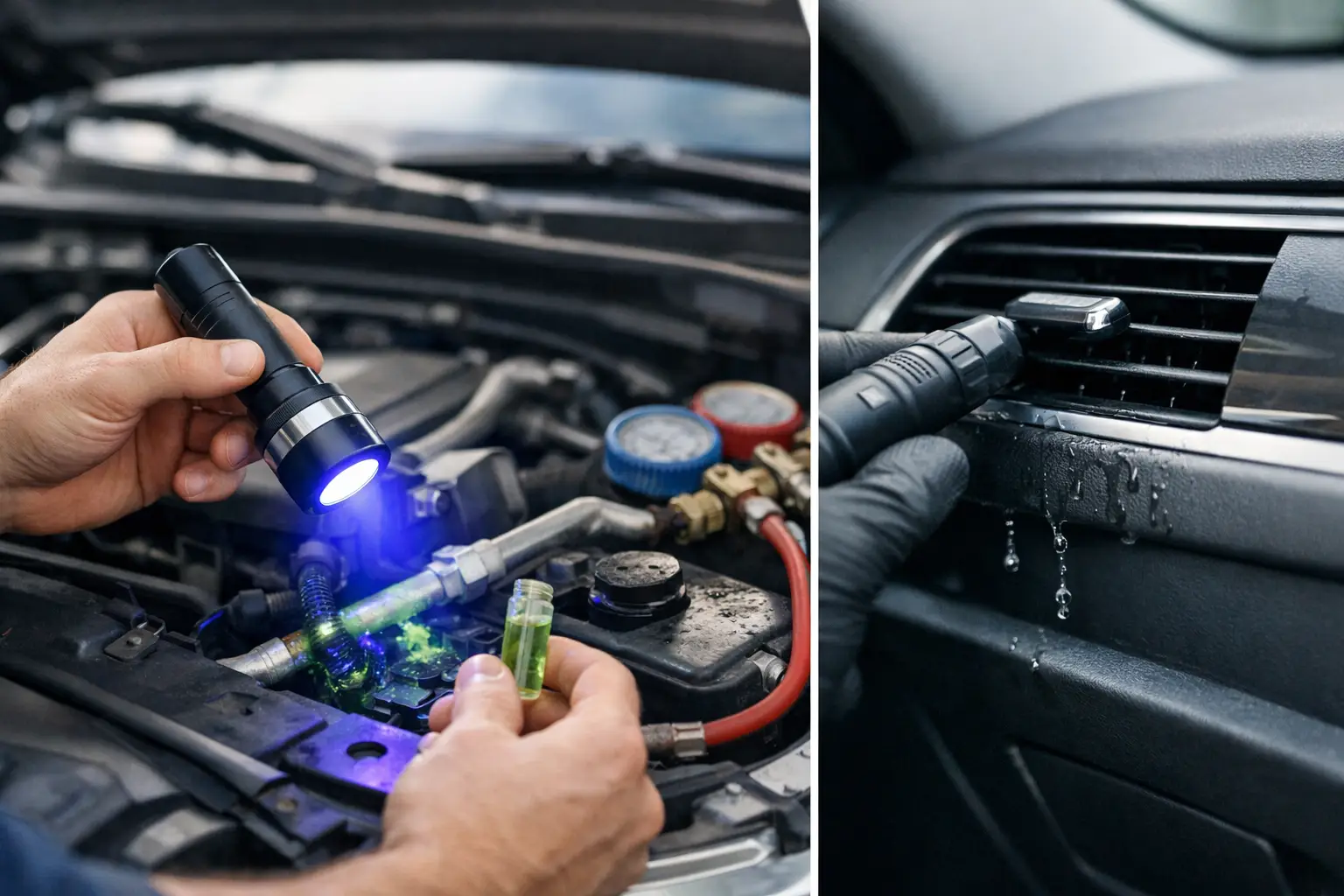
UV dye can be added to some systems, then checked under an ultraviolet lamp after the aircon has run. The dye leaves a visible trace with escaping oil. It can be helpful where there is evidence of a slow leak, although it may not identify every fault straight away.
A nitrogen pressure test is another valuable option. After refrigerant is recovered safely, the system can be pressurised with dry nitrogen and monitored for pressure loss. This helps locate leaks without releasing refrigerant and is particularly useful before a major repair or where the system is empty.
Some leaks occur inside the dashboard at the evaporator. A sweet or chemical smell through the vents, unexplained refrigerant loss and detector readings at the drain tube may point in that direction. Evaporator repairs can involve substantial labour because of the access required, so accurate testing is especially important before authorising work.
Common places car aircon systems leak
The condenser is one of the most frequent leak locations. It is exposed to road debris, water and salt at the front of the car. A pinhole from corrosion may be almost impossible to spot without proper testing.
Service port valves and sealing caps are small components, but they matter. A leaking valve core can slowly release refrigerant, while a missing or damaged cap removes an extra layer of protection. Pipe connections and O-rings can also harden, flatten or corrode with age.
Flexible hoses may deteriorate near crimps or rubbing points. Compressor shaft seals, though less common on some modern systems, can leak after long periods of non-use. This is one reason it is sensible to run the air conditioning for around 10 minutes every week, including in winter, where vehicle guidance allows. It circulates lubricant and helps keep seals in better condition.
Why a regas is not always the answer
A regas restores the manufacturer-specified refrigerant quantity, which can return cooling performance if the system is simply low. But refrigerant does not get used up like fuel. If a significant amount is missing, there is usually a reason.
A regas without leak diagnosis may feel like a cheaper solution, particularly before a hot spell or long journey. The trade-off is that the cooling may fade again within days, weeks or months. Repeatedly recharging a leaking system costs more in the long run, risks compressor damage if the charge becomes too low, and releases refrigerant that has an environmental impact.
There are situations where a very gradual reduction over several years can be addressed with an aircon service and close monitoring. If cooling disappears again quickly, or the system is empty, a leak test should be the next step rather than another recharge.
What to tell your garage
A clear description can make diagnosis faster. Let the technician know when the fault began, whether the aircon works better at speed, whether it has been regassed recently and whether there has been any front-end damage or repair work. Mention warning lights, unusual noises and any dampness or smell inside the cabin.
Ask for the findings to be explained before repairs go ahead. A trustworthy garage should be able to tell you whether the evidence points to refrigerant loss, an electrical issue, a failed component or a combination of faults. You should also receive a clear recommendation on the repair required, the likely cost and whether a regas is included after the system has been repaired.
At AutoNet VIP, air conditioning faults are assessed with proper diagnostic equipment rather than guesswork, so you can make a decision with a clear understanding of the work involved.
If your aircon is no longer keeping the cabin comfortable, arrange a professional inspection before the problem turns into a summer breakdown. A precise leak diagnosis protects your comfort, your compressor and your budget.