That shake through your steering wheel. That subtle buzz under your seat that wasn’t there last week. The way your whole car trembles when you hit 60mph on the A414 out of Harlow and you’re telling yourself it’ll probably go away on its own.
It won’t.
Vibration while driving is one of those symptoms that drivers in Essex — and across the UK — dismiss far too often, until it becomes something far more expensive, or far more dangerous. We see it week in and week out at our garage. A driver comes in because their MOT is due, and we find tyres that are down to the canvas, a CV joint on its last legs, or a wheel so far out of balance it’s wearing through the suspension components. Could have been caught months earlier. Could have cost a fraction of the repair bill.
This guide is written by our team of mechanics here in Harlow — not a content agency, not a copywriting bot. We work on these exact faults every single day. We’ve seen the consequences. And we want you to understand what your car is trying to tell you before it becomes a serious safety issue.
📊 What the 2025 Data Tells Us About UK Roads and Your Car
If you’ve felt more vibration whilst driving on Essex roads lately, you are not imagining it. According to data published in 2025 by First Response Finance, Essex County Council saw a staggering 162% increase in potholes between 2022 and 2024 — the highest percentage rise of any county in England, even while holding the UK’s largest road repair budget of £72 million for 2025/2026.
Meanwhile, the RAC Pothole Index recorded 26,048 pothole-related vehicle breakdowns across the UK in 2025 — a 15% increase on the previous year, and the equivalent of 71 breakdowns every single day. Damaged shock absorbers, broken suspension springs, and distorted wheels accounted for the bulk of those call-outs.
Essex drivers are, quite literally, absorbing the cost of this. A 2025 IAM RoadSmart survey found that 5% of UK drivers spent over £1,000 repairing pothole-related damage in a single year. The average repair bill? Around £320 to £460.
Vibration while driving doesn’t always start with a pothole, though. Sometimes it’s gradual wear. Sometimes it’s a single hard impact. Sometimes it’s a part that’s simply reached the end of its life. Let’s go through the four most serious causes our mechanics diagnose, what causes each one, and — most importantly — how you can get it sorted.
Issue 1: Tyre Imbalance and Uneven Tyre Wear
Why Your Tyres Are the First Place to Look When You Feel Vibration While Driving
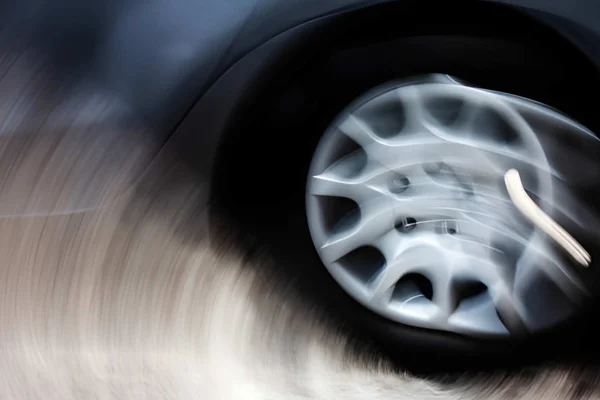
The majority of vibration-while-driving complaints we diagnose — particularly that steering wheel shimmy you feel at motorway speeds — come down to one of two tyre-related issues: imbalance or uneven wear. Both are more common than most drivers realise, and both are easily overlooked until the vibration becomes bad enough to feel through the seat or floorpan.
Wheel balancing is something that should be done every time a new tyre is fitted, and ideally checked every 10,000 miles or when you start noticing a shake. When a wheel and tyre assembly is even slightly out of balance, the centrifugal forces at speed create a vibration that travels straight up through the steering column and into your hands. If you’re feeling it primarily in the steering wheel between 50 and 70mph, tyre imbalance is a strong candidate.
Uneven tyre wear is a slightly different story. This develops over time and is often caused by alignment issues, under-inflation, or a suspension problem that’s been quietly worsening. You might notice a cupping or scalloping effect on the tyre surface — where sections are worn down in a wavy pattern. This creates a rhythmic thumping or buzzing vibration that can feel like it’s coming from under the car rather than the steering wheel specifically.
Here’s something worth understanding: in the UK, a tyre with less than 1.6mm of tread across three-quarters of its width is illegal. But long before it reaches that point, uneven wear patterns can be affecting your car’s stability, braking distance, and — of course — contributing to vibration whilst driving. The DVSA recorded thousands of tyre-related MOT failures in England in 2025 alone, with uneven wear and low tread depth among the most frequently cited reasons.
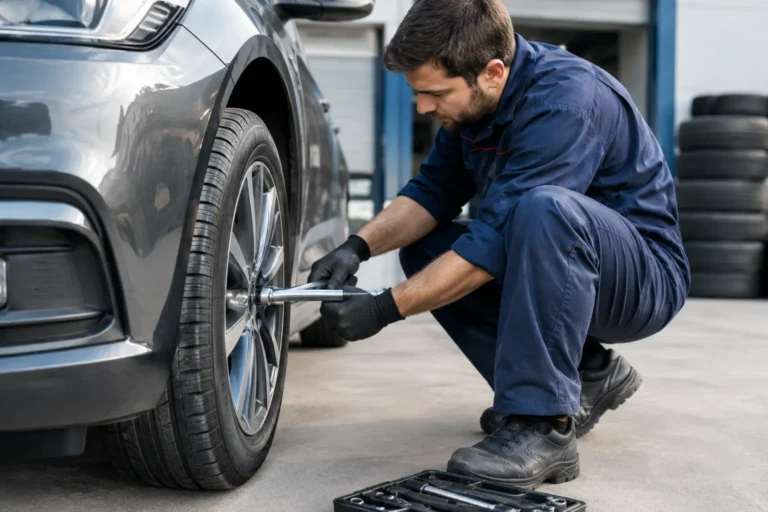
What to do: Get your wheels balanced and your alignment checked. If you’re seeing obvious uneven wear patterns, have the tyres inspected properly. At AutoNet VIP, we carry out visual tyre checks as part of every visit, and we’ll tell you the truth about what we find — not what earns us the most money.
Issue 2: Worn or Damaged Brake Components
When Vibration While Braking Is More Than Just an Annoyance
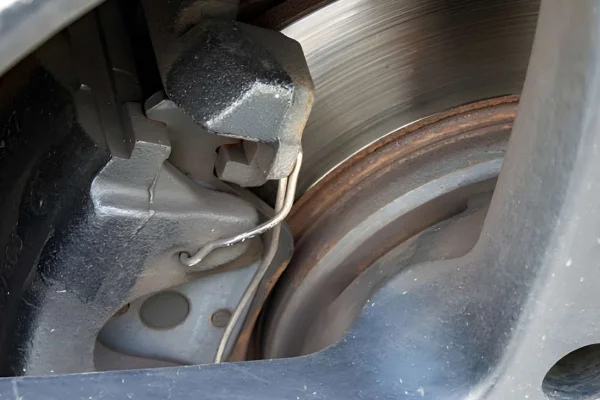
If you only notice the vibration when you apply the brakes — particularly a juddering or pulsing sensation through the brake pedal and steering wheel — the problem is almost certainly your brake discs. Specifically, warped or excessively worn brake discs.
Brake discs warp for a variety of reasons: repeated heavy braking from high speeds (particularly common on the M11 or M25 approaches around Essex), sudden cooling of hot discs from driving through standing water, or simply the natural wear that comes with age and mileage. Once a disc is warped — even slightly — the brake pads cannot make smooth, consistent contact with the disc surface. Instead, they catch and release in a rapid cycling motion, and that’s the pulsing vibration you feel through the pedal.
Brake vibration is not something to drive through and hope it resolves. Warped discs compromise your braking efficiency. In a genuine emergency stop situation, a compromised braking system increases stopping distances in ways that genuinely put lives at risk. This isn’t alarmism — it’s basic physics.
Sticky brake callipers are another brake-related cause of vibration whilst driving, though slightly less common. If a calliper is not releasing the brake pad fully after you’ve taken your foot off the pedal, that pad continues to make partial contact with the disc while you’re driving. You’ll often notice this alongside a burning smell, a car that pulls to one side, or a wheel that feels noticeably hotter than the others after a run.
What to do: If you’re feeling brake-specific vibration, get it booked in sooner rather than later. Brake work is not the area of vehicle maintenance where you want to delay. Our mechanics at AutoNet VIP carry out full brake inspections, including disc thickness measurements and calliper checks, as part of our diagnostic service. You can also read our article on 10 signs your suspension arm pin or bush has worn out to understand how suspension wear can compound brake issues.
Issue 3: Suspension and Steering Component Wear
The Hidden Culprit Behind Persistent Vibration While Driving
This is probably the most underestimated cause of vibration whilst driving that we deal with at our garage — and it’s particularly relevant to drivers in Harlow and across Essex right now.
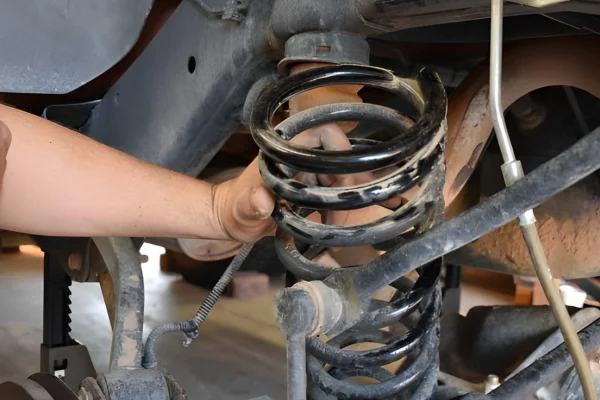
Suspension components — control arm bushes, ball joints, tie rod ends, shock absorbers, and anti-roll bar drop links — are designed to absorb the energy from road imperfections and keep your tyres in consistent contact with the road surface. When they wear out, that energy has nowhere controlled to go. It transfers directly into the vehicle body. You feel it as vibration, wobbling, or a general sense that the car isn’t tracking as solidly as it used to.
Given that Essex County Council recorded a 162% increase in potholes over three years, and that the RAC’s own data shows damaged shock absorbers and broken suspension springs as the leading cause of the 71 daily pothole-related breakdowns across the UK in 2025, the connection between road conditions in our area and suspension wear is direct and measurable.
The tricky thing with suspension-related vibration is that it can present in different ways depending on which component is worn. Worn shock absorbers often produce a bouncing or rocking sensation — the car continues to move after a bump rather than settling immediately. Worn control arm bushes can cause a low-frequency vibration at certain speeds, often accompanied by a vague, imprecise feeling in the steering. Loose or worn ball joints and tie rod ends can cause a knock or clunk over uneven surfaces that, as they deteriorate further, progresses into a more persistent shimmy.
It’s also worth knowing that steering components — particularly worn power steering rack mounts or loose steering column joints — can produce vibration that mimics what a tyre imbalance feels like. This is why a proper diagnosis matters. Assuming it’s just the wheels when it’s actually the steering rack is an easy mistake to make without the right diagnostic equipment.
What to do: Have a full suspension inspection carried out — not just a visual once-over, but a proper lift-and-check with the vehicle on a ramp and the wheels hanging free so a mechanic can test the actual movement and play in each component. That’s exactly what our team does here at AutoNet VIP. Our mechanics at our Harlow garage understand the specific demands that Essex road surfaces place on vehicles, and we see the results of both early intervention and neglect regularly enough to know which approach works better for our customers’ wallets and safety.
Issue 4: Worn or Damaged CV Joints and Driveshafts
The Cause of Vibration While Driving That Gets Diagnosed Last — and Costs the Most When Missed
CV joints — constant velocity joints — are part of your vehicle’s driveshaft assembly. They’re responsible for transferring power from the gearbox to the wheels at a constant rotational speed, regardless of the angle of the suspension travel or the steering direction. On a front-wheel-drive vehicle (which covers the majority of cars we see in Harlow and across Essex), you have two CV joints on each driveshaft: an inner and an outer.
When a CV joint is healthy, it operates almost silently and without any vibration whatsoever. When it starts to fail, the vibration can be quite dramatic — particularly during acceleration. A characteristic clicking or clunking noise when turning at low speed is one early warning sign. But as the joint deteriorates further, you’ll often begin to feel a consistent vibration whilst driving at any speed, accompanied or not by noise.
What causes CV joint failure? Most commonly, it’s a split or damaged rubber CV boot — the protective gaiter that surrounds the joint and keeps lubricating grease in and road contaminants out. Once that boot tears, it takes remarkably little time for the joint itself to become dry, corroded, and mechanically unsound. This is why regular vehicle inspections matter. A torn CV boot identified early costs very little to replace. An actual failed CV joint — or, worse, a driveshaft that has to be replaced in full — costs significantly more.
For drivers of electric and hybrid vehicles — a growing proportion of the cars we work on at AutoNet VIP — CV joint maintenance is especially important. EVs and hybrids deliver torque instantly and powerfully, placing specific demands on the drivetrain components. If you drive a hybrid like a Toyota Prius, a Honda Jazz hybrid, or one of the many plug-in hybrid models that have become increasingly common on Essex roads, keeping on top of CV joint and driveshaft condition is part of responsible EV/hybrid ownership.
What to do: If you’re noticing vibration during acceleration or when pulling away from junctions, or if you’ve recently started hearing a clicking or clunking when turning the steering wheel at low speeds, have the driveshafts and CV joints inspected as soon as possible. At AutoNet VIP, our mechanics are trained across petrol, diesel, hybrid, and electric vehicle drivetrains. We carry out full drivetrain inspections and will give you an honest assessment of what needs doing — and what can wait.
Why Getting Vibration While Driving Diagnosed Quickly Actually Saves You Money
One of the most consistent patterns we see in our workshop is the relationship between delayed diagnosis and escalating repair costs. A vibration that starts as a minor tyre balance issue doesn’t stay minor if it’s ignored. That imbalance accelerates uneven tyre wear, which throws the suspension geometry out, which puts additional strain on the ball joints and wheel bearings, which compounds the vibration further.
In the same way, a small CV boot split left unaddressed for three months means the joint itself will need replacing — not just a new gaiter. Warped brake discs that are driven on past the point of repair can score the brake pads so deeply that both need replacing at once rather than just the discs.
The good news — and we mean this genuinely — is that most of the serious issues behind vibration whilst driving are very fixable, very quickly, when caught at the right stage. Your car is already signalling a problem. That vibration is your vehicle asking for help. Catching it early means the repair is often straightforward and affordable.
AutoNet VIP – Car Repairs, MOTs & Electric & Hybrid Specialists in Harlow
If vibration while driving is something you’ve been putting off dealing with — whether it’s been a week, a month, or longer — this is your sign to get it checked.
At AutoNet VIP – Car Repairs, MOTs & Electric & Hybrid Specialists in Harlow, our mechanics have over 60 years of combined experience working on all makes and models — from everyday Ford Focuses and Vauxhall Astras to hybrids, full EVs, and prestige vehicles. We’re based at Unit 27, Harlow Business Centre, CM20 2HU, just off Edinburgh Way, and we regularly look after drivers from Harlow, Epping, Sawbridgeworth, Bishop’s Stortford, Chelmsford, and across Essex.
We use the latest diagnostic equipment — including EV-specific tools for hybrid and electric vehicles — and we’ll always explain what we find in plain language, not mechanic jargon. Our diagnostic fee is either waived or deducted from the repair cost if you proceed with work. There are no nasty surprises here.
We also publish practical guides for Essex and UK drivers on our website. If you want to understand your vehicle better before you come in, you might find these useful:
→ 10 Signs Your Suspension Arm Pin or Bush Has Worn Out
→ Is Your Hybrid Acting Strange After a Repair? Here Are the Real Problems and Solutions
→ When Is My MOT Due? Step-by-Step MOT Guide for Drivers in Harlow
📞 Call or WhatsApp us: 07300 305705
📍 Find us: Unit 27, Harlow Business Centre, Edinburgh Way, Harlow, Essex, CM20 2HU
🌐 Visit: staging.autonetvip.co.uk/
FAQs: Vibration While Driving
Why does my car vibrate when I drive at motorway speeds?
Speed-specific vibration — particularly between 50 and 70mph — most often points to a wheel imbalance issue or a tyre that has developed uneven wear. However, worn suspension components and steering parts can also produce vibration that worsens at higher speeds. A proper diagnosis will quickly identify which is the cause.
Is vibration while driving dangerous?
It depends on the cause and severity, but the short answer is: yes, it can be. Vibration caused by failing brake components directly affects your ability to stop safely. Vibration from worn suspension components affects your vehicle’s stability and handling. Even tyre-related vibration, if left unaddressed, can lead to catastrophic tyre failure at speed. Don’t drive on in the hope it resolves — get it looked at.
Why does my car vibrate when I brake?
Vibration specifically during braking — that juddering through the brake pedal and steering wheel — almost always indicates warped or excessively worn brake discs. It can also be caused by a sticky brake calliper. Both issues require prompt attention as they compromise your vehicle’s stopping ability.
Can Essex potholes cause vibration while driving?
Absolutely. Essex saw a 162% increase in potholes between 2022 and 2024 according to 2025 data. Pothole impacts can immediately distort wheels, damage tyres, and crack suspension components — all of which cause vibration. If you hit a significant pothole and notice vibration starting shortly afterwards, have your vehicle inspected as soon as possible.
How much does it cost to fix vibration while driving?
It varies enormously depending on the root cause. A wheel balance costs very little. New brake discs and pads are a moderate cost. Suspension component replacement varies by part and vehicle. CV joint or driveshaft replacement is at the more costly end — but significantly cheaper than leaving it until the joint fails completely. Getting it diagnosed early is always the more affordable route.
Don’t Drive With a Problem You Could Solve This Week
Vibration while driving is one of those problems that doesn’t get better by itself. Every mile you drive on an unbalanced wheel, a warped disc, a worn suspension bush, or a failing CV joint is another mile of unnecessary wear on everything connected to it.
But here’s the thing: it is fixable. These aren’t problems that should cause panic or anxiety. They’re mechanical issues with mechanical solutions, and in most cases, they’re resolved quickly and for reasonable money when caught early. The drivers who end up with the big repair bills are the ones who waited.
If you’re in Harlow or anywhere across Essex and you’ve been noticing vibration — whether it’s through the steering wheel, through the seat, during braking, during acceleration, or just there constantly — book in with our team at AutoNet VIP. We’ll diagnose it properly, explain what we find in plain English, and give you a clear, honest quote for any work needed.
Your car is already telling you it needs attention. We’re here when you’re ready to listen.