Your tyres are the only four patches of rubber standing between your car and the road — each one roughly the size of your hand. So when those patches start wearing unevenly, it is not just your tyres that suffer. Your steering goes. Your fuel bill creeps up. Your braking distance stretches out in the wet. And somewhere down the line, a tyre that should have lasted another year gives up the ghost on the A414 at half seven in the morning.
Here in Essex — and across the wider UK — uneven tyre wear is far more common than most drivers realise. The TyreCheck 2025 report, the largest of its kind, analysed over 58,000 vehicles and found that nearly two in every five vehicles on UK roads are running on tyres that are either illegal or barely safe. That is a staggering number of people driving around with a problem that, more often than not, could have been caught and fixed before it became dangerous.
The good news? Uneven tyre wear is almost always fixable — and once you know what to look for, you can act before it costs you. This guide walks you through the eight most common causes, what each one looks like, and exactly what to do about it. By the end, you will know more about your tyres than most drivers ever bother to learn.
1. Incorrect Tyre Pressure
This is the single most common cause of uneven tyre wear across the UK, and it is also the most preventable. When your tyres are under-inflated, the outer edges of the tread press harder into the road than the centre, causing shoulder wear on both sides. When they are over-inflated, the opposite happens — the centre of the tread balloons outward and takes all the punishment, wearing down the middle whilst the edges look almost new.
According to figures from the Department for Transport, incorrect tyre pressure is a contributing factor in thousands of road incidents every single year in Britain. The Motor Ombudsman estimates that under-inflated tyres alone are responsible for over £1 billion in wasted fuel annually across the UK — and that does not even account for the accelerated wear and premature replacement costs.
The fix: Check your tyre pressures at least once a month and always when the tyres are cold — before you have driven more than a couple of miles. The correct pressures for your car are printed on a sticker inside the driver’s door jamb or in your owner’s handbook. Do not go by the maximum pressure printed on the tyre sidewall — that is not the target, that is the ceiling.
2. Wheel Misalignment
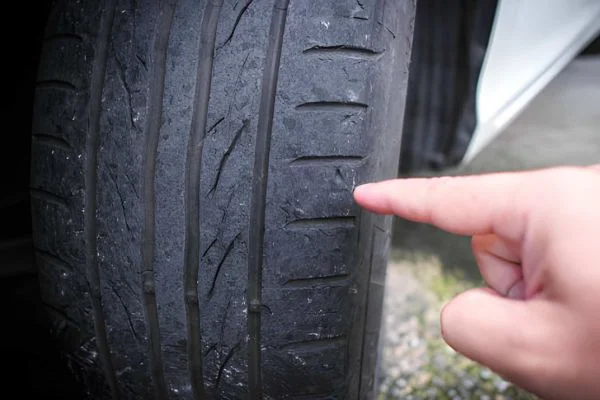
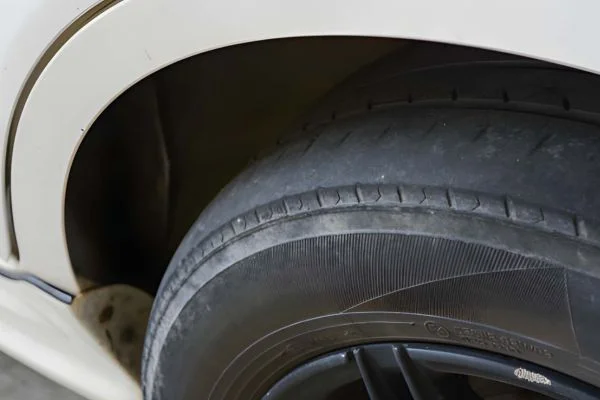
Wheel alignment — also called tracking — refers to the angle at which your tyres sit relative to the road and to each other. When those angles drift out of spec, your tyres no longer roll in a straight line. Instead, they scrub sideways ever so slightly with every metre you drive. The result is feathering (where the tread blocks are sharp on one side and rounded on the other) or one-sided wear on the inner or outer shoulder.
Around Harlow and across Essex, pothole-damaged roads are a real contributing factor. A single sharp impact — hitting a kerb, dropping into a pothole on the M11 slip road, or clipping a raised drain cover — can knock your alignment out enough to chew through a set of tyres in a fraction of the time they should last. The mechanics at AutoNet VIP – Car Repairs, MOTs & Electric & Hybrid Specialists in Harlow see misalignment-related wear regularly, particularly during the spring months after winter road surfaces have taken their toll on local vehicles.
The fix: Book a four-wheel alignment check. It takes less than an hour and is one of the most cost-effective things you can do for your tyres, your fuel economy, and your steering feel. If you have recently had a significant impact with a pothole or kerb, do not wait for the wear to show — get it checked straightaway.
3. Worn or Damaged Suspension Components
Your suspension system does more than just smooth out the bumps. It holds your wheels in the correct geometry and keeps them in consistent contact with the road. When suspension components — particularly ball joints, control arm bushes, and shock absorbers — start to wear out, they allow your wheels to move in ways they should not. The result is often cup-shaped or scalloped wear, where the tyre develops hollows at regular intervals around its circumference.
Worn shock absorbers are a particularly common culprit here. A damper that has lost its ability to control wheel bounce allows the tyre to skip and hammer against the road surface rather than rolling smoothly — and it is that repeated impact which creates the scalloping pattern. If you notice a cupped or dipped pattern across the tread, or you can feel a rhythmic vibration through the steering wheel at speed, suspension wear is high on the suspect list.
The fix: Have your suspension inspected by a qualified mechanic. The team at AutoNet VIP in Harlow carry out comprehensive suspension checks using diagnostic equipment designed to identify worn components before they become safety issues — and before they destroy your next set of tyres. You can read more on this in their guide on 10 Signs Your Suspension Arm Pin or Bush Is Worn Out.
4. Wheel Imbalance
Wheel balancing and wheel alignment are two different things — and both matter. Balancing refers to the even distribution of weight around the wheel and tyre assembly. When a wheel is out of balance, it creates a vibration at certain speeds. That vibration does not just annoy the driver; it causes the tyre to make uneven contact with the road surface, which leads to patches of accelerated wear, often in a diagonal or cupped pattern.
Weights can fall off wheels over time, especially after a pothole or a vigorous wash through a car wash. A vibration you feel through the steering wheel between 50–70mph is one of the clearest indicators that balancing has been lost on one or both front wheels.
The fix: Wheel balancing is a quick, inexpensive job that should be done whenever new tyres are fitted and whenever you notice steering vibration. Ask for it to be checked any time your car is in for a service.
5. Neglecting to Rotate Your Tyres
Front and rear tyres live very different lives. On a front-wheel drive car — which is the majority of vehicles on UK roads — the front tyres are doing the steering, the braking, and the driving all at once. They wear significantly faster than the rears, and because they wear on the same sections repeatedly, the pattern of wear becomes uneven across the axle.
Most drivers in the UK never rotate their tyres — and it shows. You end up replacing the fronts twice for every time the rears need changing, and because the wear has been concentrated on particular areas of the tread, the fronts are often well past their best long before the tread depth technically requires replacement.
The fix: Rotate your tyres every 5,000–8,000 miles, or ask your garage to assess them at every service. It is a low-cost habit that genuinely extends the life of a full set of tyres — and that means spending less money in the long run.
6. Aggressive Driving Habits
This one is not always easy to hear, but it is true: how you drive has a direct effect on how your tyres wear. Hard acceleration scuffs the inner edges of the drive wheels. Aggressive cornering puts massive lateral forces on the outer shoulder of the tread. Late, heavy braking drags tyre material off the contact patch in ways that no amount of rotation or alignment correction can fix.
On city roads, stop-start driving in places like Harlow town centre or on the A10 through Hoddesdon puts particular stress on the front tyres. Every sharp acceleration from a roundabout and every late brake before a junction adds up. Over a year of daily commuting, the difference between smooth and aggressive inputs can easily mean the difference between getting 30,000 miles out of a set of tyres or 18,000.
The fix: Smoother acceleration, earlier braking, and looking further ahead on the road are not just better for your tyres — they improve your fuel economy and reduce wear on brakes and suspension too. Small changes in driving style genuinely add up to big savings over a year.
7. Faulty Brakes or Sticking Callipers
A brake calliper that is sticking — where the braking mechanism does not fully release after you lift your foot off the pedal — will drag against the disc continuously and generate heat and friction. That friction does not just wear your brake disc; it heats the tyre abnormally and creates a flat spot or localised wear pattern on one tyre that has nothing to do with alignment, pressure, or driving style.
This is often accompanied by a burning smell after driving, a car that pulls to one side when you brake, or a single wheel that is noticeably hotter than the others after a journey. In more severe cases, the tyre may even show visible flat spots or localised bald patches — and by that point, the tyre needs replacing immediately.
The fix: If you suspect a sticking calliper, do not drive on it. This is both a tyre and a brake safety issue. Get it diagnosed and repaired by a qualified mechanic. AutoNet VIP in Harlow offers comprehensive brake and diagnostic services — and unlike some garages, they will tell you exactly what needs doing and why before they do it.
8. Overloading the Vehicle
Every tyre has a load index — a rating that tells you the maximum weight it can safely carry. When you consistently exceed that rating — whether through heavy cargo, passengers, or roof-loaded gear — the tyre flexes more than it was designed to. That excess flexion generates heat, accelerates shoulder wear, and in extreme cases, can lead to sudden tyre failure.
Van drivers and tradespeople are particularly at risk here. TyreSafe highlighted in its industry reports that overloading is common and often overlooked, with many drivers unaware of where their vehicle’s maximum load limit actually sits. For Essex-based tradespeople — plasterers, plumbers, builders running up and down the M11 with full loads — this is a very real and costly problem.
The fix: Check your vehicle’s gross vehicle weight rating (GVWR) in the handbook or on the door placard. Ensure the tyres fitted to your vehicle have a load index appropriate for the loads you carry. If you run a van or work vehicle, this is worth a conversation with your garage at every service.
What the Data Is Telling Us in 2025
The scale of the problem across the UK is not small, and the 2025 data makes for sobering reading. The TyreCheck 2025 report — the largest tyre safety study ever conducted in Britain, covering over 58,000 vehicles — found that the combined rate of illegal and barely-legal tyres has risen from 27% in 2000 to 39.5% in 2025. That means roughly two in every five vehicles you pass on the road today are running on tyres that are either illegal or perilously close to it.
Defective tyres are the fourth most common reason for an MOT advisory to be issued in England — but critically, they are classified as dangerous in almost 60% of those cases (Auto Express, 2025). Over 2.15 million vehicles failed their MOT due to tyre defects in 2024 alone, with one million of those classified as outright dangerous by the DVSA. And driving with defective tyres was the single biggest reason UK drivers received endorsement points in 2024, with 8,945 drivers stopped and prosecuted — a 44% increase on the previous year.
Closer to home, Essex roads present particular challenges. The county’s mix of busy A-roads, motorway approaches, and residential streets — combined with the pothole damage that builds up through every winter — creates the exact conditions in which uneven tyre wear accelerates. If you are commuting regularly across Harlow, Epping, Chelmsford, or into the M25 corridor, your tyres are working hard every single day.
Why Uneven Tyre Wear Is Never Just a Tyre Problem
This is the bit that often gets missed. When a driver spots uneven wear on a tyre, the instinct is to replace the tyre. But if you replace the tyre without fixing the root cause — the misalignment, the worn shock absorber, the sticking calliper, the wrong pressure — the new tyre will wear in exactly the same way. You will be back in the same position six months later, having spent money twice on a problem you only half solved.
Beyond the financial cost, there is a safety dimension that cannot be overstated. At 70mph on a wet motorway, a tyre with uneven or insufficient tread depth can add 27 metres to your stopping distance compared to a new tyre — that is nearly the length of three double-decker buses. In a genuine emergency stop, that gap is not theoretical. It is the difference between stopping in time and not.
Uneven tyre wear is your car telling you that something needs attention. The message is worth listening to.
Getting It Sorted at AutoNet VIP in Harlow
If you have spotted uneven wear on any of your tyres, or you are due for a tyre inspection and want someone who will actually look properly rather than just eyeball the tread depth at arm’s length, the team at AutoNet VIP – Car Repairs, MOTs & Electric & Hybrid Specialists in Harlow is well worth a visit.
Based at Unit 27, Harlow Business Centre, CM20 2HU — just off Edinburgh Way — the garage serves drivers from across Essex and Hertfordshire, including Epping, Bishop’s Stortford, Sawbridgeworth, and beyond. The mechanics there carry a combined experience of over 60 years, and the garage is fully equipped to handle everything from wheel alignment and balancing to full suspension diagnostics, brake inspections, MOTs, and specialist electric and hybrid vehicle servicing.
What stands out about AutoNet VIP is the transparency. They give you a clear, upfront quote before any work starts, and they explain what they have found and why it matters. No vague estimates, no work done without your say-so. If you have a work van with load issues, an EV with rapid tyre wear concerns, or a family car that has been pulling slightly to one side for months, their diagnostic approach will get to the bottom of it.
You can book by calling or WhatsApp on 07300 305705, or visit staging.autonetvip.co.uk/ to book online or learn more about their full range of services.
A Quick Monthly Tyre Check That Takes Five Minutes
You do not need to be a mechanic to stay ahead of uneven tyre wear. Five minutes once a month, when the tyres are cold, can catch most problems early. Walk around the car and look across the tread from the front and rear of each tyre — you are looking for wear that is heavier on one side than the other, or a pattern that looks scalloped or rippled rather than smooth and even.
Use a proper tyre pressure gauge — not the ones at petrol stations that are often unreliable — and check the pressures against your handbook figure. Run a 20p coin across the main tread grooves; if the outer rim of the coin is visible, your tread is approaching the point where you need professional advice. The legal minimum in the UK is 1.6mm, but many experts recommend acting at 2–3mm for genuine safety.
If anything looks off, do not leave it. Uneven tyre wear that is caught early is almost always cheap to sort. Left too long, it means replacement tyres, potential MOT failures, and — at worst — a dangerous situation on the road.
The Bottom Line
Uneven tyre wear is one of those problems that starts quietly and escalates quickly. The eight causes covered in this guide — incorrect pressure, misalignment, worn suspension, wheel imbalance, lack of rotation, aggressive driving, brake faults, and overloading — are responsible for the vast majority of premature tyre wear on UK roads. Every single one of them is fixable.
The 2025 data tells us that millions of drivers across Britain are operating vehicles on tyres that are unsafe or borderline — and that in many cases, they either do not know or have been putting it off. You do not have to be one of them. A tyre inspection takes less time than a trip to the supermarket, and the peace of mind — knowing your car will stop where you need it to, every single time — is worth far more than the cost of sorting it out.
If you are in Harlow, Essex, or the surrounding areas and you want your tyres properly assessed by mechanics who know what they are looking at, AutoNet VIP is the place to go. Give them a ring, book online, or drop in. Your tyres will thank you — and so will your wallet.