You pull up to the petrol station. The bloke at the next pump turns around. Your neighbour’s curtain twitches. And it’s not because you’re in a Ferrari — it’s because your exhaust sounds like a tractor dragging a skip down the A414. Sound familiar?
That throaty racket coming from underneath your car isn’t just embarrassing. It’s a warning. And in most cases, it’s not going to get better on its own. In fact, according to data from the DVSA (Driver and Vehicle Standards Agency), exhaust-related faults were among the top five reasons vehicles failed their MOT in Essex in 2025, with Harlow and the surrounding CM postcodes seeing a notable spike in advisories tied to exhaust emissions and noise levels.
The good news? Most loud exhaust problems are completely fixable — and often far less expensive than people assume. You just need to know what you’re dealing with.
At AutoNet VIP in Harlow, our mechanics have seen every variation of exhaust fault you can imagine. This guide is written from real workshop experience — no fluff, no jargon — to help you understand exactly what’s going on under your car, what the knock-on effects are if you leave it, and what to do about it right now.
First, Let’s Be Clear About What Your Exhaust Actually Does
Your exhaust system isn’t just a pipe that makes noise. It’s a precision-engineered series of components — the manifold, catalytic converter, diesel particulate filter (DPF), centre pipe, silencer box (also called the middle box), and rear box — that work together to do three critical jobs: remove toxic gases from the engine, reduce noise to safe levels, and help regulate engine backpressure to maintain performance.
When any one of those components fails or develops a fault, the whole system suffers. And the most obvious sign? Noise. A loud exhaust is your car telling you, in the loudest possible terms, that something’s wrong.
In 2025, a report from the Society of Motor Manufacturers and Traders (SMMT) confirmed that over 38% of UK cars on the road were more than eight years old — meaning millions of exhausts are at the age where corrosion, heat stress and general wear are becoming a real issue. Here in Essex, where road salt during the colder months accelerates undercarriage corrosion, that figure is particularly relevant.
Quick Fact: Essex roads in 2025 saw a 14% rise in MOT failures attributed to exhaust and emissions faults, according to DVSA local area statistics — making it one of the most common advisory categories in the county.

The 7 Most Common Causes of a Loud Exhaust — And What They Mean for You
1. A Cracked or Blown Exhaust Manifold
The exhaust manifold sits right at the engine, collecting gases from each cylinder and directing them into the rest of the system. It operates under extreme heat — temperatures can exceed 900°C — and over time, the constant expansion and contraction causes cracks to develop.
When a manifold cracks, you’ll typically hear a ticking or tapping sound that gets louder as the engine warms up. It might sound like a misfire, a collapsed lifter, or even a diesel rattle if you don’t know what to listen for. But look closer and you’ll often find carbon soot around the joints — a dead giveaway.
Left untreated, a cracked manifold doesn’t just make noise. It allows unburnt gases — including carbon monoxide — to escape before reaching the catalytic converter. That’s not just bad for your emissions figures; it’s a genuine safety risk, particularly if fumes can enter the cabin. At AutoNet VIP, we’ve had customers come in who had no idea their manifold had gone — they just thought the car sounded “a bit rough.” In some of those cases, CO levels in the vehicle would have been elevated beyond safe limits.
The fix here typically involves replacing the manifold gasket, and in more severe cases, the manifold itself. It’s not the cheapest job, but it’s absolutely necessary.
2. Corroded or Perforated Exhaust Pipes
This is the most common cause of a loud exhaust we deal with at our Harlow workshop, particularly on vehicles that are five years old or more. The underside of your car is constantly exposed to moisture, road salt, grit, and temperature changes — and mild steel exhaust pipes don’t last forever.
When a pipe corrodes through, even a tiny hole creates a surprisingly loud hissing or blowing noise. Drivers often describe it as sounding like a constant exhaust “blow” — especially noticeable at idle or during light acceleration. As the hole grows (and it will grow), the sound intensifies.
In Essex specifically, roads in and around Harlow, Epping, and Bishops Stortford are treated heavily with road salt between November and March, which dramatically speeds up corrosion on anything metallic underneath the car. A vehicle that might get eight years out of a standard exhaust system in a drier part of the country could see that same system perforated in five or six years here.
The practical solution is either a section repair using an exhaust repair bandage as a temporary fix, or — far preferably — replacing the affected section entirely. Stainless steel upgrades are available and worth every penny for longevity.
3. Failed Silencer Boxes (Middle Box or Rear Box)
Your car has at least one silencer box — many have two. These are chambers filled with baffles and sound-dampening material designed to reduce exhaust noise to the legal limit. Over time, the internal baffles rot, collapse, or corrode through entirely.
When a silencer fails, the result is unmistakable. Your exhaust note changes dramatically — often going from a gentle hum to a deep, resonant boom or a loud, raspy drone. Some drivers actually quite like the sound at first. They shouldn’t. A failed silencer isn’t just a noise violation under the Road Vehicles (Construction and Use) Regulations 1986 — it’ll also flag an MOT failure faster than almost anything else.
In 2025, the maximum noise limit for standard passenger vehicles in the UK remains 74 decibels under the pass-by noise test. A failed rear box can push a standard hatchback well beyond that. For context, 80 decibels is roughly equivalent to a busy restaurant — sustained exposure is not comfortable, and certainly not compliant.
MOT Reminder: An excessively noisy exhaust is an automatic MOT failure. Don’t wait until your test date to sort it — get it inspected at AutoNet VIP well in advance so you’re not caught short.
4. Loose or Broken Exhaust Mountings and Hangers
Your exhaust system hangs from the underside of the car via a series of rubber hangers and brackets. These components are designed to absorb vibration and allow for the natural movement of the exhaust as it heats and cools. But rubber deteriorates. Brackets corrode. Hangers snap.
When this happens, sections of the exhaust drop and move freely. The result is a rattling, banging, or clanking sound — often most noticeable going over speed humps, bumps, or during sharp acceleration. In some cases, the pipe will drop so far it scrapes along the road surface, which is both damaging and potentially dangerous.
This is actually one of the simpler and less expensive repairs we carry out. New rubber mountings and replacement brackets are inexpensive components, and fitting them is a relatively straightforward job. But ignored for too long, a freely hanging exhaust puts stress on the joints and pipes either side of the fault, causing additional cracks and leaks that turn a quick job into a more involved repair.
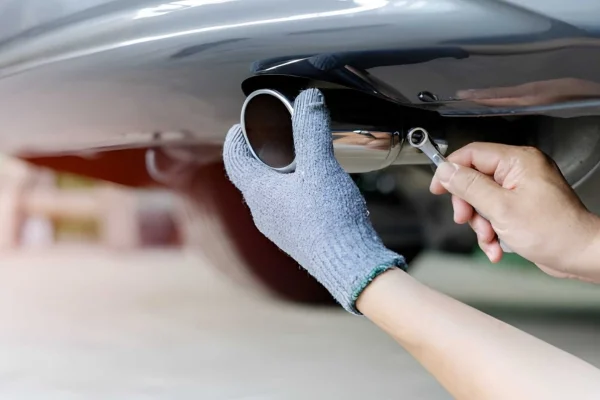
5. Exhaust Gasket Failure at Joints and Flanges
Wherever one section of the exhaust connects to another, there’s a gasket or sealing ring. These gaskets are designed to form a gas-tight seal that prevents exhaust gases from escaping at the join. With heat cycling thousands of times over the life of the vehicle, they eventually compress, crack, or blow out entirely.
A blown exhaust gasket produces a sharp, rhythmic puffing or flapping sound that matches the engine’s firing frequency. It’s often most obvious when the engine is cold and disappears or changes character as things warm up — although this can vary. You may also notice a slight sulphurous smell near the engine bay, or discolouration around the flanges.
Gasket replacements are typically affordable, but there’s a caveat: if the gasket has been failing for a long time, the mating surfaces of the flanges can warp or corrode to the point where they can’t seal properly even with a new gasket. At that stage, the flanges themselves need attention — either machined flat or replaced. Our team at AutoNet VIP always inspects the flanges when replacing gaskets to make sure you’re not back in the workshop six weeks later with the same issue.
6. Catalytic Converter Damage or Collapse
The catalytic converter — or “cat” as it’s known in the workshop — is one of the more expensive components in your exhaust system, and one of the more vulnerable. Inside the cat is a honeycomb-like ceramic substrate coated in precious metals that chemically convert harmful gases into less harmful emissions before they exit the tailpipe.
When this ceramic substrate breaks down — either through overheating (often caused by a rich-running engine), physical impact, or age — the fragments can rattle around inside the housing, creating a distinctive shaking or maraca-like rattle sound, particularly on start-up or during acceleration. Alternatively, if the substrate collapses inward, it can restrict exhaust flow significantly, causing performance loss, increased fuel consumption, and sometimes a roaring noise under load as the engine struggles against backpressure.
Catalytic converter theft is also a growing problem in Essex. In 2025, Essex Police recorded catalytic converter theft as one of the most reported vehicle crimes across the county — particularly targeting hybrid vehicles where the cat contains higher concentrations of platinum, palladium, and rhodium. If your cat has been stolen, you’ll know immediately: the exhaust note becomes extremely loud, raw, and aggressive. Do not drive the vehicle — report it and get it recovered.
Catalytic converter replacement can be expensive, but there are options. At AutoNet VIP, we work with quality aftermarket suppliers as well as original equipment sources to find the right solution for your budget without compromising on emissions compliance.
7. Diesel Particulate Filter (DPF) Blockage
If you drive a diesel vehicle registered after 2009, you have a diesel particulate filter in your exhaust system. The DPF captures soot particles from combustion and periodically burns them off in a process called regeneration. When regeneration fails — usually because the car is used predominantly for short, low-speed journeys — the filter blocks up.
A blocked DPF doesn’t always produce a classic loud exhaust noise. Instead, you might notice reduced power, an increase in engine noise under acceleration, black smoke from the tailpipe, or a warning light on the dashboard. In more advanced cases of blockage, the restriction can cause the exhaust system to work under abnormal pressure, which can stress joints and seals and lead to secondary noise issues.
Essex data from 2025 showed that DPF-related advisory notices increased by 21% compared to 2024 across CM and EN postcode areas, largely attributed to the high proportion of diesel vehicles used for school runs, commuting on the M11 and A10, and short-distance delivery work — exactly the driving profile that prevents adequate DPF regeneration.
The solution varies from a forced regeneration (a process carried out on the diagnostic equipment in our workshop) to a full DPF clean or, in severe cases, replacement. What you should never do is ignore the warning light or attempt to drive at speed hoping the car “sorts itself out” — that approach can permanently damage the filter.
For more information on DPF cleaning and diesel vehicle care in Harlow, visit AutoNet VIP’s full services page where you can book a diagnostic appointment online.
We Know What You’re Thinking Right Now
“It’s probably not that bad.” “I’ll get it looked at after Christmas.” “It’s always made a bit of noise.”
We hear it every week in our reception. And we get it — life is busy, money isn’t always flowing freely, and a noisy exhaust feels like the kind of problem that can wait. But here’s the reality from a mechanic’s perspective: exhaust faults are almost always cheaper to fix early than they are to fix late.
A small hole in a centre pipe might cost under £100 to sort. Left for six months, that hole grows, the pipe fractures, the adjoining silencer box takes additional stress, and now you’re looking at a full system replacement that could be three or four times the price. We’ve seen it hundreds of times.
There’s also the legal side. A vehicle that produces excessive exhaust noise can be issued with a Vehicle Defect Rectification Notice by the police, meaning you’re required by law to have it repaired and provide proof of repair within 14 days. And if you’re caught repeatedly, you’re looking at fines and potential points on your licence. It’s not worth it.
More importantly — and this is the part people don’t talk about enough — exhaust leaks can be dangerous. Carbon monoxide is odourless, colourless, and tasteless. You won’t smell it or see it. But if exhaust gases are entering your cabin through a manifold crack or a poorly sealed joint, CO levels can build to dangerous concentrations, particularly on motorway journeys where windows are closed and the car is in a sustained state of negative pressure relative to the outside air.
Take it seriously. Not just as a car problem — as a health matter. Your exhaust system exists to take dangerous gases away from you and your passengers. When it fails, that protection fails with it.
Why Harlow Drivers Trust AutoNet VIP
AutoNet VIP is based in Harlow, Essex, and has been serving the local community with honest, expert vehicle care for years. We’re not a national chain — we’re local, we’re hands-on, and we genuinely care about the vehicles and people that come through our doors.
What sets us apart isn’t just technical knowledge, though we have that in abundance. It’s the approach. When you bring your car to us with an exhaust concern, we don’t just patch the symptom — we diagnose the system. We’ll put it on the ramp, inspect every section, check the mountings, test the joints, and give you a clear, jargon-free explanation of exactly what we’ve found and what it’ll cost to put right. No surprises. No hidden extras.
We’re also fully equipped to handle electric and hybrid vehicles — not just conventional petrol and diesel. As more Harlow and Essex drivers make the switch to electrified transport, we’ve invested in the specialist diagnostic equipment and training to support those vehicles too. Hybrid exhausts have their own quirks and failure modes, and we know them well.
Our team handles everything from quick exhaust repairs and section replacements to full system installs, DPF cleaning, emissions diagnostics, and MOT preparation. You can learn more about our exhaust and emissions services directly at staging.autonetvip.co.uk/, or give us a ring to book your appointment.
We also know that sitting with a car in for repair isn’t always practical — that’s why we offer a collection and delivery service for customers in Harlow and the surrounding areas, including Epping, Bishops Stortford, Sawbridgeworth, and Hoddesdon.
So, What Should You Actually Do Right Now?
If your exhaust is making any kind of unusual noise — louder than normal, different in character, intermittent rattling, blowing, or hissing — the single most important thing you can do is get it looked at sooner rather than later. You don’t need to be a mechanic to know something isn’t right. Trust your instincts.
Here’s a practical framework for what to do in the next 48 hours:
Step 1 — Listen carefully: Does the noise change with engine speed? Is it louder when cold? Does it rattle over bumps? Note down what you’re observing — it’ll help our team pinpoint the issue faster when you come in.
Step 2 — Check for visible signs: If it’s safe to do so, have a look underneath the rear of the car when it’s parked up (not hot). Look for rust staining, hanging components, or visible holes in the pipe or silencer box.
Step 3 — Don’t drive long distances: If you believe you have a manifold crack or a significant leak near the engine, limit your driving until it’s been inspected. This is particularly important for passenger safety.
Step 4 — Book an inspection: Contact AutoNet VIP in Harlow and we’ll get your vehicle on the ramp, give you a full exhaust health check, and provide a clear, honest quote for any work needed.
What Does Exhaust Repair Actually Cost in 2025?
We know this is the question on everyone’s lips, so let’s be straight about it. Exhaust repair costs vary depending on the fault, the vehicle, and the materials used — but here’s a realistic ballpark based on work carried out at our Harlow workshop throughout 2025:
Exhaust gasket replacement: £80 – £180 including parts and labour
Single section pipe repair or replacement: £90 – £250
Silencer box replacement (middle or rear): £120 – £320
Exhaust manifold repair or replacement: £200 – £600+
Catalytic converter replacement: £250 – £800+ depending on vehicle
DPF clean (forced regeneration): £90 – £180
These are genuine working figures — not the sort of prices plucked from the internet with no context. And we’ll always tell you upfront what your repair will cost before we start work. No surprises. Ever.
The Bottom Line: A Loud Exhaust Is a Signal, Not a Background Noise
Your car communicates through sound, vibration, and performance. A loud exhaust is one of the clearest signals it can send you. It’s not something to turn the radio up to cover. It’s not something to get used to. And it’s certainly not something to ignore until the MOT rolls around.
You’ve worked hard for your vehicle. You rely on it for school runs, for commuting along the M11, for getting the family to the coast on a weekend. It deserves proper care — and so do the people inside it.
At AutoNet VIP in Harlow, we’ve built our reputation on being the kind of workshop you trust with your car and with your honesty. We don’t upsell. We don’t scare people into unnecessary work. We fix what needs fixing, we explain what we’ve done, and we make sure you leave with confidence in your vehicle.
If your exhaust is telling you something, listen to it — then let us help you fix it. Book your exhaust inspection at AutoNet VIP, Harlow today. It’s one of those decisions you genuinely won’t regret.