Steering wheel shaking while driving, there is a moment you probably know it. When you pull onto the A414 heading out of Harlow, hit 40 miles per hour, and feel it. A low, persistent tremor buzzes through your palms, and that steering wheel that was sitting perfectly still just moments ago is now chattering away like it has got something urgent to say. It is not aggressive. Not painful. But it is there and it does not stop.
Most drivers in Essex will ignore it for a week. Then a fortnight. Then a month. Life is busy, the school run does not wait, and the car still moves. So you tell yourself it is probably nothing.
It is almost never nothing.
Steering wheel shaking is one of the most common complaints that comes through the doors at AutoNet VIP in Harlow — from drivers heading in from Epping, Sawbridgeworth, Bishop’s Stortford, and all corners of Essex. And what the team here sees, week after week, is that the longer you leave it, the more expensive the conversation becomes. What starts as a £60 tyre balance job has a habit of turning into a £400 suspension repair if it sits unaddressed for long enough.
This guide walks you through the seven most common causes of steering wheel shaking, how to spot each one, what it means for your car, and — most importantly — what you can do about it. No jargon. No fluff. Just the straight-talking information you deserve.
Why This Problem Hits Essex Drivers Harder Than Most
Before we get into the causes themselves, it is worth understanding why steering wheel shaking seems particularly widespread among drivers in Harlow and the surrounding areas of Essex.
Road conditions in Essex have deteriorated significantly over recent years. According to a March 2025 report published by Your Harlow, Essex County Council has spent a staggering £148 million on road maintenance and pothole repairs over the past three years — and yet compensation claims for vehicle damage caused by road defects have risen by 96% since 2021. That is not a misprint. Nearly double. Meanwhile, nationwide data from First Response Finance confirms that Essex County Council holds the largest road repair budget in the UK for 2025/2026 at £72 million — yet even this record level of investment cannot keep pace with the scale of deterioration.
In the first quarter of 2025 alone, the RAC attended over 9,400 pothole-related breakdowns across the UK, with the average repair bill for drivers coming to £460.
Those potholes on the A1019, the back roads through Epping Forest, the side streets in Old Harlow — every one of them is a potential cause of the steering wheel shaking you are experiencing right now. They knock your wheel alignment out. They crack tyre sidewalls. They batter suspension bushes and wheel bearings into submission. The roads create the problem, and the problem sits in your steering column telling you about it.
The good news? Every single one of the causes below is fixable. Some are cheap. Some take a bit more investment. But none of them are the end of the world — not when you catch them early enough.

1. Unbalanced or Worn Tyres — The Most Frequent Culprit
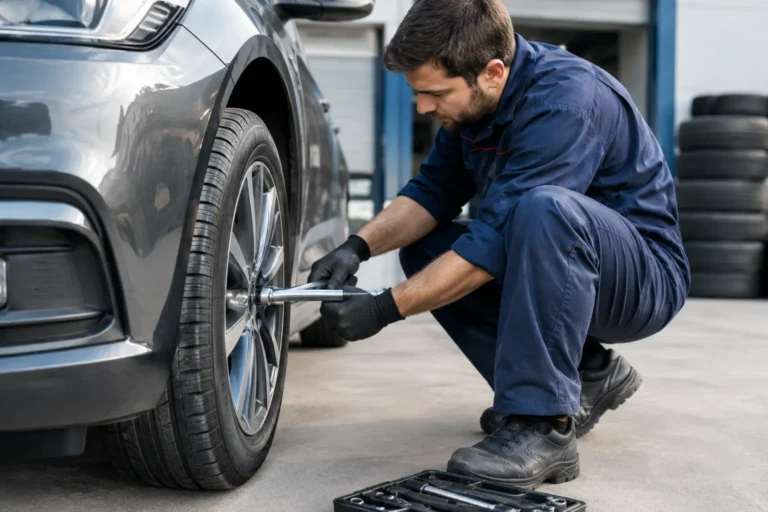
If your steering wheel shaking starts somewhere between 50 and 70 mph and smooths out above that, you are very likely looking at an unbalanced tyre. This is by far the most common cause the mechanics at AutoNet VIP deal with, and it is also one of the simplest to resolve.
Here is what happens: every tyre and wheel combination has a specific weight distribution. When that distribution goes off — through a minor kerb clip, a pothole strike, or simply normal tyre wear — the wheel develops a wobble as it spins. That wobble travels up through the suspension, through the steering column, and lands straight in your hands. It tends to worsen at motorway speeds and can ease off at higher velocities because the tyre’s rotation pattern changes.
Beyond balance, tyre wear itself matters enormously. Uneven wear patterns — where one edge of the tread is lower than the other, or where the tread has cupping or feathering — will also cause vibration. A bulge or bubble in the tyre sidewall, often the result of a sharp pothole impact, is particularly dangerous because it signals structural damage inside the tyre and dramatically raises the risk of a blowout at speed.
What to check: Look at each tyre from the front of the car. If you can see uneven wear, cracking, or any deformity in the sidewall, do not wait. Have the tyres inspected immediately. A standard wheel balance at a reputable Harlow garage is a small investment compared to the cost of a damaged suspension arm or, worse, a blowout on the M11.
Tyre pressure also plays a role. Essex roads — particularly during winter — fluctuate dramatically in temperature, which changes tyre pressure. Under-inflated tyres flex more and wear irregularly, contributing to steering wheel shaking over time.
2. Misaligned Wheels — When Essex Roads Knock Your Car Sideways
Wheel alignment is how the angles of your tyres relate to each other and to the road surface. When everything is correctly aligned, your car tracks straight, your tyres wear evenly, and there is no unnecessary stress on any steering component. When alignment is off — even slightly — the effects ripple out in ways that are surprisingly noticeable.
A car with misaligned wheels will often pull to one side as you drive. You might notice you are holding the steering wheel at a slight angle just to maintain a straight line. And yes — it vibrates. The vibration from misalignment tends to be more consistent than the speed-dependent wobble of unbalanced tyres. It is often present at lower speeds and tends to get worse under acceleration.
The most common cause of wheel misalignment in Essex? Potholes. A single hard impact on the wrong road surface can shift alignment parameters significantly. And with the M11 corridor, the B183 through Matching Green, and countless residential roads in Harlow all carrying ongoing reports of road surface damage through 2025, this is not a rare occurrence. It is weekly life for thousands of local drivers.
The important thing to understand about misalignment is that it does not just cause steering wheel shaking — it causes tyre wear that accelerates rapidly. Left uncorrected, a misalignment issue will eat through a tyre in a fraction of its expected lifespan, and potentially damage tie rod ends and steering rack components along the way.
What to check: After any significant pothole impact, it is worth getting your alignment checked. If you notice your car drifting left or right on a flat road without any input from you, book an alignment inspection. It is quick, inexpensive, and potentially saves you hundreds on premature tyre replacement.
3. Warped or Worn Brake Rotors — When Braking Starts the Shake
This one is distinctive because of when the shaking happens. If your steering wheel is relatively smooth during normal driving but vibrates specifically when you press the brake pedal — particularly at higher speeds — warped or worn brake rotors are the most probable cause.
Brake rotors (also called discs) are the large metal discs your brake pads clamp against when you slow down. They deal with enormous heat every single time you brake, and over time — or with aggressive braking patterns — they can develop an uneven surface. This is called warping, though technically it is more often a phenomenon called thickness variation. The result is the same: the brake pad finds an inconsistent surface as it contacts the disc, and that inconsistency sends a pulse back through the braking system and directly into the steering column.
The vibration here has a pulsing quality — rhythmic, matching the rotation speed of the wheel. Drivers often describe it as a judder rather than a shake, and it can be accompanied by a slight pulling sensation to one side under braking. In some cases, it will feel like the pedal itself is pulsing underfoot.
This should never be left alone. Warped rotors reduce braking efficiency at precisely the moments when you need full stopping power — on dual carriageways, approaching roundabouts, in sudden traffic. The DVSA flags brake system defects consistently among the leading causes of serious MOT failures across the UK, and uneven discs are a significant contributor to that statistic.
What to check: If the steering wheel shaking only appears when you brake, and you have been driving on your current discs and pads for over 40,000 miles, get them inspected straight away. A brake inspection at AutoNet VIP will identify whether your rotors need resurfacing or replacement — and whether your pads still have enough life left to do the job safely.
4. Worn Wheel Bearings — A Low Roar That Gets Louder
Wheel bearings are what allow your wheels to spin freely around the axle without friction or drag. They are built to last, but they are not invincible — and when they start to deteriorate, the symptoms are quite specific once you know what you are listening for.
The classic sign of a failing wheel bearing is a low, droning hum or rumble from one corner of the car. It changes pitch as you turn the steering wheel slightly — it might quieten when you steer one way and worsen when you steer the other. This is because turning shifts the vehicle’s weight across the wheel bearings, and a worn bearing will react accordingly. As the bearing deteriorates further, the vibration it generates travels into the steering column and manifests as a steering wheel shake that is present at lower speeds than tyre-related vibration and tends to worsen progressively as speed increases.
Essex roads have a particular talent for accelerating wheel bearing wear. Every pothole impact, every kerb mounting, every heavily loaded boot drives impact energy through the wheel assembly — and the bearing absorbs it. Over time, the balls and races inside the bearing develop flat spots and pitting, and the smooth rotation that should be silent and friction-free becomes noisy and rough.
A worn wheel bearing is not just a comfort issue. As it progresses, it can cause play in the wheel assembly that affects directional stability, particularly in cornering. In severe cases, a completely failed wheel bearing can cause a wheel to seize or detach — an outcome that carries extremely serious consequences at any road speed.
What to check: Jack the car safely, grasp the wheel at the top and bottom, and try to rock it. Any detectable play suggests bearing wear that needs professional attention. This is not a DIY job — bearing replacement requires proper workshop equipment and accurate torque settings.
5. Damaged Suspension Components — The Hidden Cost of Every Pothole
The suspension system on your car is a network of interconnected components — ball joints, control arms, bushes, tie rod ends, track rod ends, anti-roll bar links — and every one of them can contribute to steering wheel shaking when they start to fail. This is where the picture can get a bit more complex, because suspension wear rarely announces itself with a single obvious symptom. Instead, it tends to build gradually and quietly until something makes it impossible to ignore.
Ball joints allow the wheels to pivot and steer. As they wear, the small amount of play that develops in them translates directly into steering imprecision and vibration. Worn control arm bushes — the rubber mounts that cushion the control arm against the chassis — absorb impacts and allow controlled movement; when they crack or perish, that controlled movement becomes uncontrolled, and the result is a vibration that often worsens over rough road surfaces or during cornering.
According to DVSA data, suspension defects account for approximately 9.2% of all MOT failures across the UK in 2024–2025 — and many of these failures relate directly to worn bushes and ball joints, making them among the most common yet overlooked maintenance issues facing Essex drivers. The AutoNet VIP team covers this in excellent technical detail in their guide on 10 Signs Your Suspension Arm Pin or Bush Has Worn Out — if you suspect suspension wear, that is worth reading alongside this article.
The thing about suspension damage on Essex roads is that it is cumulative. One pothole might not destroy a bush. But a year of commuting along deteriorating local roads — with hundreds of impacts absorbed by the same components — absolutely will. The £148 million Essex County Council has spent on road maintenance since 2022 reflects the scale of the problem, but that spending has not kept pace with demand, and your suspension is paying the difference.
What to check: If your car handles loosely, clunks over bumps, or you feel vibration that worsens on uneven surfaces, book a full suspension inspection. Modern diagnostics at a well-equipped garage can identify worn components before they fail outright — saving you both money and the far greater inconvenience of a roadside breakdown.
6. A Seized Brake Caliper — When the Brakes Never Fully Let Go
This is less common than the causes listed above, but it is worth understanding because when it does occur, it does so persistently — and it can cause significant secondary damage if left unaddressed.
Brake calipers house the brake pads and press them against the rotor when you apply the brakes. They are hydraulically operated and should release completely when you lift your foot off the pedal. When a caliper seizes — due to corrosion, a damaged rubber hydraulic hose, or debris accumulation — it does not fully release. The brake pad remains in partial contact with the rotor even when you are simply driving. This causes continuous friction, heat, and — critically — a vibration that is present at driving speed even without braking.
The give-away symptoms: a burning smell after driving, one wheel that feels significantly hotter than the others after a short journey, and a steering wheel shake that is present during normal driving rather than just under braking. Fuel economy also drops noticeably because the engine is working against a permanently applied brake.
Do not put this one on the back burner. A seized caliper will destroy a brake disc rapidly, and the heat it generates can cause brake fluid to boil, compromising your entire braking system’s effectiveness.
What to check: After a 15–20 minute drive, carefully check whether one wheel feels noticeably hotter than the rest. If you notice a burning smell with no obvious source, get the car to a garage that day. This is a safety-critical issue.
7. Worn Engine or Gearbox Mounts — When the Shake Starts at Idle
The final cause on our list is one that surprises many drivers because it does not feel like it belongs in the same conversation as tyres and brakes. But engine mounts — the rubber-cushioned brackets that hold the engine and gearbox in place within the engine bay — are directly responsible for the smooth, vibration-free experience you get when everything is working correctly.
The engine is, by its very nature, a machine that generates significant vibration. The mounts are designed to absorb that vibration and prevent it from transmitting into the car’s body and steering. When the rubber in those mounts deteriorates — which happens gradually over time and is accelerated by oil contamination, heat cycles, and age — they lose their ability to isolate that vibration. The result is a shake that often appears at idle or under low-speed acceleration, tends to feel more like a rough shudder than a road-speed shimmy, and may be accompanied by a clunking or thudding when you engage gear or accelerate from a standstill.
The steering wheel shaking associated with worn engine mounts is more of a low-frequency tremor that is sometimes felt throughout the cabin — not just in the wheel. If it appears predominantly when stationary or at very low speeds, this is a strong pointer toward mounts or drivetrain components rather than wheels or tyres.
What to check: Pop the bonnet and with the engine running, have a trusted mechanic look for excessive engine movement when the revs change. A worn mount often allows the engine to shift visibly. This is a workshop diagnosis — do not attempt to assess mounts yourself with a running engine.
What Should You Do If Your Steering Wheel Is Shaking Right Now?
Read through the descriptions above and you have probably got a fairly strong sense of which category your situation falls into. That is a good starting point. But here is the honest truth from the mechanics at AutoNet VIP: steering wheel shaking is almost never one isolated thing. What typically comes through the workshop door is a car where an original tyre imbalance has been left long enough to accelerate bush wear, which has then contributed to alignment issues, which has in turn created uneven tyre wear — and now the driver has three or four things to address instead of one.
The sooner you get it looked at, the simpler and less expensive the diagnosis tends to be. That is not a sales pitch — it is what the data shows every time.
If your steering wheel shaking is severe, sudden, or accompanied by any of the following, treat it as urgent:
- A burning smell while driving or after stopping
- A grinding or screeching noise from any wheel area
- The car pulling sharply to one side
- Visible tyre damage, bulging, or cracking
- A vibration that has suddenly become significantly worse
- Any unusual noise that changes with steering input
Any one of these alongside steering wheel shaking warrants getting off the road and contacting a garage rather than continuing your journey. Your safety and the safety of other road users comes first — always.
Steering Wheel Shaking? Let the AutoNet VIP Team Take a Look.
AutoNet VIP – Car Repairs, MOTs & Electric & Hybrid Specialists in Harlow are the local experts trusted by drivers across Essex, Hertfordshire, and North London. Based at Unit 27, Harlow Business Centre, CM20 2HU — just off Edinburgh Way — the team combines over 60 years of combined mechanical experience with the latest diagnostic equipment to pinpoint exactly what is causing your steering wheel to shake.
Whether you drive a petrol hatchback, a diesel van, a hybrid SUV, or a fully electric vehicle, AutoNet VIP has the training, the tools, and the commitment to honest, transparent service that Harlow drivers deserve. No jargon, no unnecessary upselling. Just a clear diagnosis, a fair price, and the job done right.
Frequently Asked Questions About Steering Wheel Shaking
Is it safe to drive with a shaking steering wheel?
It depends on the severity and the cause. A mild vibration at motorway speed from unbalanced tyres is far less immediately dangerous than a shaking that appears under braking or at low speeds — which could point to brake or bearing failure. As a general rule: if your steering wheel shaking is new, severe, or accompanied by any unusual sounds, smells, or handling changes, do not drive the car further than necessary until it has been inspected. What feels like a minor nuisance can escalate into a serious safety issue very quickly.
Can a pothole cause steering wheel shaking?
Absolutely — and it is one of the most common triggers our team in Harlow sees. A single significant pothole strike can knock wheel alignment out of specification, crack a tyre sidewall, damage a wheel bearing, or shift a suspension component. Essex’s road network has been under immense strain, with pothole-related vehicle damage compensation claims rising 96% since 2021 according to 2025 data. If your steering wheel shaking started — or worsened — shortly after hitting a pothole, get the car inspected regardless of how the car otherwise feels.
Why does my steering wheel shake only at high speed?
Speed-specific vibration — typically appearing between 50 and 70 mph and sometimes easing above that — is one of the clearest indicators of unbalanced or improperly inflated tyres. Tyre balance problems become more pronounced as rotational speed increases, which is why you feel them on dual carriageways and motorways but not on town roads. A simple wheel balance correction usually resolves this quickly.
Why does my steering wheel shake when I brake?
Vibration that appears specifically when you press the brake pedal almost always points to warped or unevenly worn brake rotors. The pulsing sensation you feel — through both the steering wheel and sometimes through the brake pedal itself — is the brake pad moving across an uneven disc surface. This is a safety-critical issue and should be inspected promptly. Brake rotor replacement is straightforward for a qualified mechanic and will restore smooth, confident braking.
How much does it cost to fix steering wheel shaking in the UK?
It varies significantly depending on the cause. A wheel balance typically costs between £30 and £60. Wheel alignment is similar. Brake disc and pad replacement ranges from around £150 to £300 per axle depending on the vehicle. Wheel bearing replacement sits between £150 and £350 per corner. Suspension bush replacement varies by component but is generally between £100 and £300. The key message is this: early diagnosis saves money. A £60 tyre balance today is far better than a £400 suspension job next spring.
You Can Fix This — And Your Car Will Thank You For It
Steering wheel shaking is one of those problems that creeps up on you. It starts quietly, you adjust to it, and before long it feels normal. But your car is telling you something, and it is worth listening. Every one of the seven causes in this guide has a clear solution — and every one of them is significantly cheaper when you address it early rather than late.
The drivers who come out of AutoNet VIP with smooth, confident steering after a proper diagnosis and repair often say the same thing: “I can’t believe I put up with that for so long.” There is a particular pleasure in getting back into a car that handles the way it should — that responsive, planted feeling where the road talks to you through the wheel in all the right ways, not the wrong ones.
That feeling is waiting for you on the other side of this. You just need to take the first step and get it looked at by people who know what they are doing.
The AutoNet VIP team in Harlow are ready when you are.