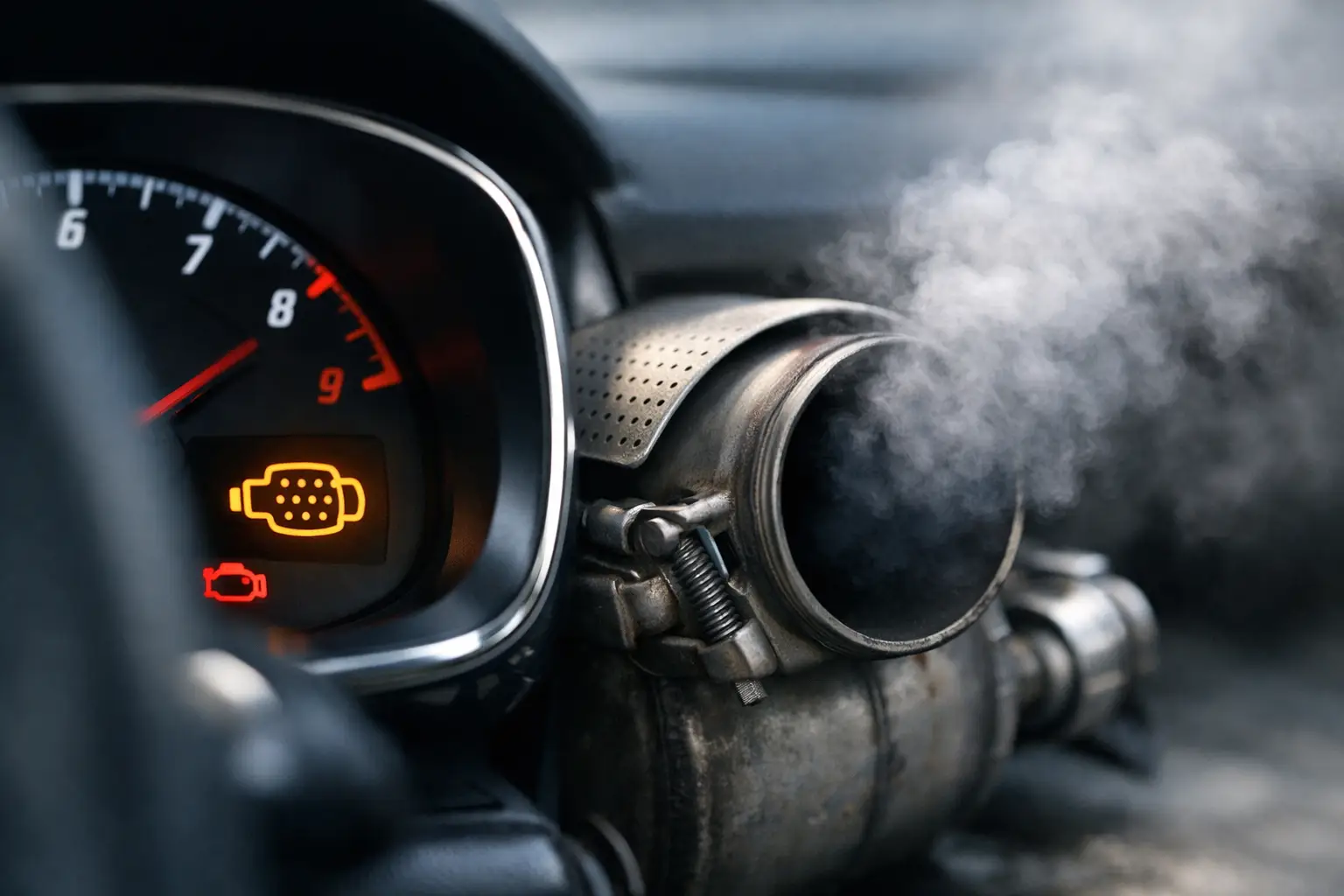
You are cruising home, nothing feels wrong, and then a diesel particulate filter warning lights up on the dash. That moment catches a lot of drivers off guard because the car may still seem to run normally. But this is one warning light that is worth taking seriously early, while the fix is still simple, affordable, and less disruptive.
A diesel particulate filter, usually called a DPF, is designed to trap soot from the exhaust before it leaves the vehicle. Over time, that soot builds up and has to be burned off through a process called regeneration. When that process is interrupted too often, or when another fault prevents it from happening properly, the filter starts to clog. The warning light is your car telling you the system needs attention before drivability, fuel economy, and repair costs get worse.
What a diesel particulate filter warning usually means
In most cases, the warning does not mean the filter is ruined. It often means soot levels are higher than normal and the vehicle has not been able to complete a proper regeneration cycle. This is common on diesel vehicles that mainly do short trips, low-speed town driving, or long periods of idling.
The DPF needs heat to clean itself. If the engine never stays hot long enough, the soot remains trapped and keeps building. Many drivers think they have an engine problem when the real issue is simply that the vehicle’s driving pattern does not suit the way the emissions system works.
That said, a warning light can also point to something more than soot buildup. A failed pressure sensor, faulty temperature sensor, stuck EGR valve, injector issue, turbo problem, or even the wrong engine oil can all contribute to DPF trouble. This is why guessing can get expensive. A warning light may start as a maintenance issue and become a parts-replacement issue if it is ignored.
Why the warning appears in the first place
Modern diesel systems are efficient, but they are not forgiving when the car is used outside the conditions they were built for. If your trips are mostly ten minutes at a time, school runs, local errands, or stop-start commuting, the engine may never reach the sustained exhaust temperatures needed for passive regeneration.
The vehicle may try active regeneration instead. During active regeneration, the engine management system raises exhaust temperatures to burn off the soot. If the driver switches off the engine halfway through, the process stops. Repeat that often enough and the filter reaches a point where the warning light appears.
There are also cases where the DPF is not the root cause. If the engine is over-fueling, burning oil, or running inefficiently, it creates excess soot. In that situation, cleaning the filter alone is only part of the answer. The underlying cause has to be diagnosed, or the warning will come back.
What you should do when the warning light comes on
The right next step depends on whether the light is steady, flashing, or joined by other warning lights.
If the diesel particulate filter warning is on by itself and the vehicle still drives normally, check the owner’s manual for the manufacturer’s guidance. Some vehicles respond well to a sustained highway-speed drive that allows regeneration to complete. That usually means keeping the engine at operating temperature for a decent stretch, not just taking a quick loop around the block.
If the light is flashing, performance is reduced, the engine feels sluggish, or you also have an engine management light, it is time for proper diagnostics. Continuing to drive in that condition can push the system from a manageable soot load into a blocked filter, limp mode, or damage to related components.
A common mistake is reaching for a fuel additive and hoping for the best. Some products have their place, but they are not a substitute for testing. If the problem is a pressure sensor, injector fault, failed regen, or ash accumulation, an additive will not solve it.
Can you keep driving with a DPF warning?
Sometimes, briefly. Always, no.
If the warning has just appeared and the car is otherwise behaving normally, there may be a short window where a successful regeneration prevents further trouble. But that only applies if the system is healthy enough to regenerate in the first place.
Keep driving for too long with a clogged or struggling DPF and you risk more than a warning light. Back pressure in the exhaust can rise, fuel consumption can increase, performance can drop, and engine components can come under extra stress. In more severe cases, the vehicle may go into reduced-power mode to protect itself.
The trade-off is simple. Acting quickly may mean a straightforward forced regeneration or a minor repair. Waiting too long can mean deeper cleaning, sensor replacement, or a full DPF replacement, which is a much more expensive conversation.
How a garage diagnoses the problem properly
A proper diagnosis starts with fault-code scanning, but it should not end there. Codes point the technician in the right direction, but live data is what helps confirm what is really happening.
A technician will usually check soot load, ash load where supported, differential pressure readings, exhaust temperatures, regeneration history, and any related engine or emissions faults. That matters because a blocked DPF is not always just blocked. Sometimes it is overloaded with soot and recoverable. Sometimes it is full of ash, which is different and cannot simply be burned away. Sometimes the filter is fine, but the sensors feeding the control unit are not.
This is where experience and equipment matter. On a modern diesel, replacing parts based on assumption can waste money quickly. A transparent garage should be able to explain whether the problem is driving-pattern related, a sensor issue, an engine fault causing excess soot, or a filter that has reached the end of its service life.
Repair options depend on the cause
There is no single fix for every DPF warning. If the issue is early soot buildup, a controlled regeneration may clear it. If the filter is heavily loaded but structurally sound, off-car cleaning may be the better route. If sensors or related components have failed, those parts need to be tested and replaced as needed.
In some cases, the DPF itself is no longer recoverable. That tends to happen when the vehicle has been driven too long with the warning ignored, when there is internal damage, or when ash buildup has reached the point where normal cleaning will not restore proper flow.
This is also why low-cost shortcuts can backfire. Drilling, removing, or bypassing emissions equipment creates legal, inspection, and drivability problems. It also shifts the issue rather than fixing it. A proper repair keeps the vehicle compliant, reliable, and easier to maintain later.
How to reduce the chances of it happening again
If your diesel is mainly used for short local trips, the DPF system will need more support than a car that regularly sees open-road driving. That does not mean diesel ownership is impossible, but it does mean maintenance habits matter.
Using the correct low-ash engine oil is one part of it. Staying on top of servicing is another. Letting injector, EGR, turbo, or sensor issues linger often increases soot output and shortens DPF life.
It also helps to recognize the signs that regeneration may be taking place. Depending on the vehicle, idle speed may rise slightly, cooling fans may run, fuel economy may dip for a while, or the engine note may change. If you notice that and it is safe to do so, avoid shutting the engine off immediately. Giving the cycle time to finish can make a real difference.
For drivers who mostly stay in town, an occasional longer drive at steady speed can help, but it is not a cure-all. If there is already a fault in the system, no amount of highway driving will fix a bad sensor or a failing injector.
When it is time to book it in
If the warning has returned more than once, if the vehicle has entered limp mode, or if you have noticed poor acceleration, excessive fuel use, rough running, or frequent fan operation after short trips, the smart move is to have it checked properly. A diesel particulate filter warning is one of those problems that rewards early action.
At AutoNet VIP, this kind of issue is approached the way it should be – with clear diagnostics, plain-English explanations, and repair advice that fits the actual fault rather than guesswork. That matters because the best outcome is not just clearing a light. It is making sure the warning does not keep coming back.
If your diesel is asking for attention, treat that warning light as a prompt, not a panic. The sooner you find out why it is on, the more options you usually have.