A warning light, a hesitant gearbox or an infotainment system that keeps freezing can leave drivers asking: can garages update car software, or does every issue require a main dealer visit? The answer is often yes, but the right route depends on your vehicle, the update required and the equipment available to the workshop.
Modern cars are not simply mechanical machines with a few electrical extras. Their engine, brakes, steering, gearbox, safety systems, battery management and dashboard functions are controlled by dozens of electronic modules. Software is what allows those modules to communicate and operate correctly. When it is outdated, corrupted or incorrectly configured, a car can develop faults that look mechanical but are not.
Can garages update car software?
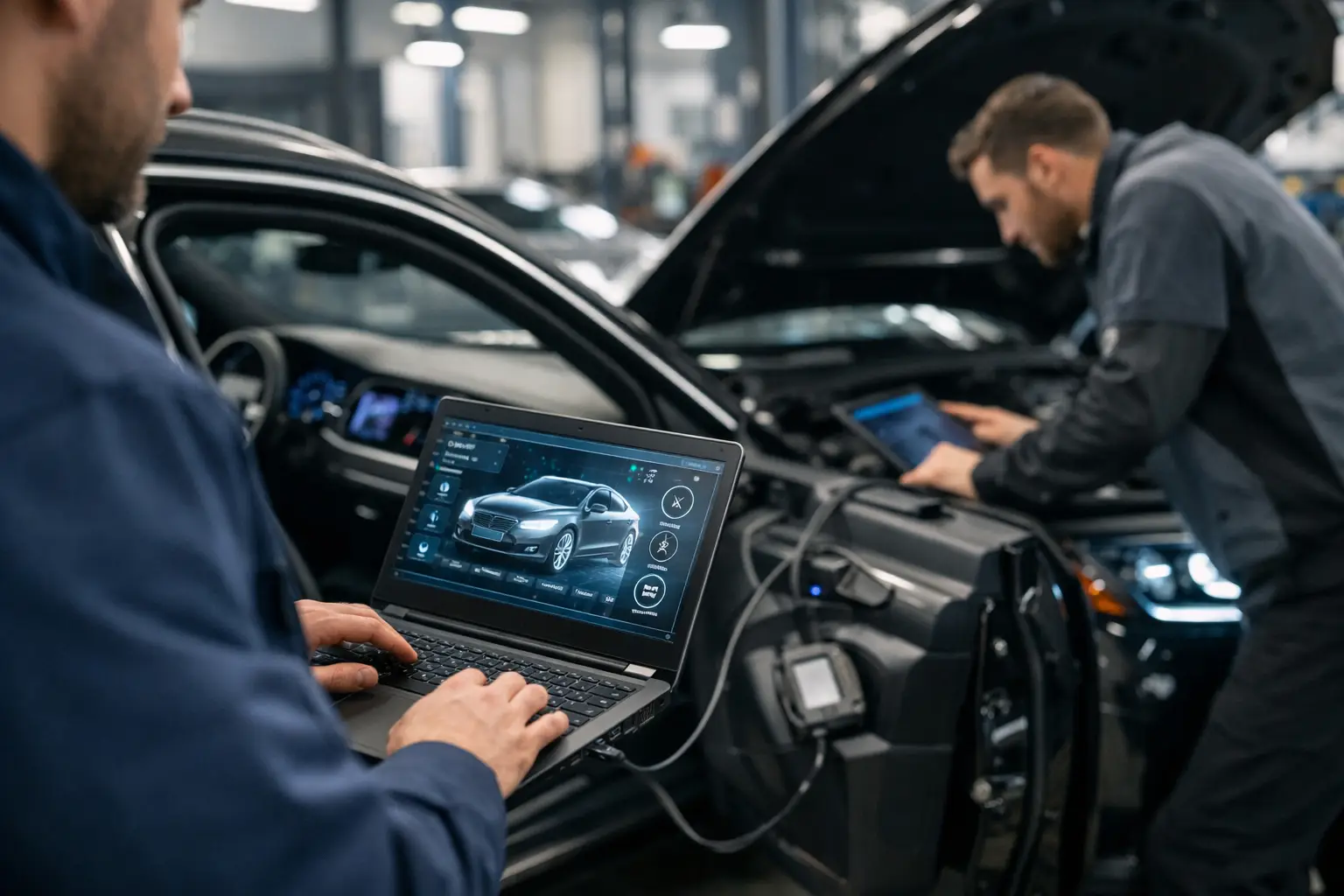
A properly equipped independent garage can update software on many makes and models. This may involve installing a manufacturer-approved update, programming a replacement control unit, resetting adaptations after repair or configuring systems following work on components such as injectors, batteries, gearboxes and sensors.
However, not all updates are the same. Some can be completed using professional multi-brand diagnostic equipment and authorised technical platforms. Others require a manufacturer-specific system, online security approval or direct dealer access. A trustworthy garage will explain which applies before work begins, rather than promising a solution it cannot safely deliver.
For many everyday issues, an independent workshop with advanced diagnostics is a practical alternative to a franchised dealer. It can offer quicker appointments, clear communication and competitive labour costs, while still following the correct procedures for the vehicle.
What a software update can fix
Manufacturers release updates for more reasons than a new screen layout or navigation feature. They may issue revised software to address a known fault, improve drivability, reduce unnecessary warning messages or ensure a system works properly after a repair.
Common examples include an engine management update to correct rough running, a gearbox calibration update to improve shift quality, or a battery management update for a hybrid or electric vehicle. Updates may also resolve faults in parking sensors, cameras, digital instrument displays, keyless entry and infotainment systems.
Software programming is often necessary after replacing certain parts. A new battery on a vehicle with battery monitoring may need to be registered to the car. A replacement diesel injector may require coding. A new electronic steering module, ABS unit or transmission control module may need programming and configuration before the vehicle is safe to drive.
That is why fault diagnosis matters. If a warning light appears, simply clearing the code is rarely a proper repair. The underlying cause could be a faulty component, damaged wiring, low system voltage, old software or a combination of these. The correct answer comes from methodical testing, not guesswork.
When a dealer may still be necessary
There are situations where a main dealer is the most appropriate option. A manufacturer recall, for example, is normally completed through the manufacturer network and should generally be carried out at no cost to the owner. Some warranty campaigns and security-related programming also require dealer-only access.
Newer vehicles can have tightly controlled cybersecurity systems. Access to certain modules may require authenticated technician credentials and a live connection to the manufacturer server. This is designed to prevent unauthorised programming, theft-related changes and safety-critical errors.
A good independent garage should not treat this as a failure. It is simply part of choosing the safest and most efficient repair route. If dealer programming is genuinely required, you should be told why, what work needs to be done there and whether any diagnostic or repair work can still be completed locally.
Why the right equipment matters
Car software should never be updated with a cheap code reader or an unverified file downloaded from the internet. A programming session can take time and, during that period, the vehicle must have stable voltage. If power drops or communication is interrupted, a control unit can be left unusable.
Professional workshops use suitable diagnostic tools, regulated power support and vehicle-specific procedures. Before programming, they check the battery condition, identify the correct module and confirm whether the vehicle has outstanding fault codes that could affect the process. They also record the vehicle details and software status where appropriate.
The process is not always a simple click-and-wait job. Some vehicles require a pre-programming scan, a backup of existing settings, security access, calibration or a road test afterwards. On hybrid and electric vehicles, technicians also need the training and equipment to work safely around high-voltage systems.
At AutoNet VIP, diagnostics are approached as an investigation rather than a sales opportunity. That means explaining whether software is likely to solve the problem, whether a mechanical repair is also needed and what the expected costs are before unnecessary work is authorised.
Software updates, servicing and your warranty
Drivers often worry that using an independent garage will invalidate their warranty. In many cases, routine servicing and repairs can be carried out outside the dealer network, provided the work follows the manufacturer’s specification and suitable parts, fluids and procedures are used. Keeping clear invoices and service records is sensible.
Software updates are more nuanced. Manufacturer recall work should be handled through the manufacturer. If a vehicle is under a specific service plan, lease agreement or extended warranty, there may also be terms about where certain work must be completed. Check the paperwork before booking, particularly if the update relates to a major drivetrain or safety system.
Avoid unauthorised remapping or alterations if warranty protection and long-term reliability are priorities. A manufacturer software update is intended to restore or improve the vehicle’s approved operation. Performance modifications are different: they can affect emissions, insurance, component life and warranty cover.
What to ask before booking a car software update
You do not need to become an expert in vehicle programming, but a few direct questions will help you choose the right garage. Ask whether the workshop can update the specific make and model, whether the update is manufacturer-approved, and whether the fault has been diagnosed first.
It is also reasonable to ask if the price includes a diagnostic scan, programming, configuration and post-update checks. Some updates take only a short time; others require extended connection to diagnostic equipment and a battery support unit. A clear estimate should reflect this rather than offering a vague flat fee.
If the garage believes dealer involvement is needed, ask for the reason in plain English. It may be due to a recall, security access, a manufacturer-only campaign or a module that requires an online coding session. Clear advice helps you make the right decision without paying twice for the same investigation.
Signs your car may need programming rather than a mechanical repair
A software issue can imitate a more serious fault, although it should never be assumed without testing. Repeated warning messages that disappear and return, erratic infotainment behaviour, delayed gear changes after a battery issue, or a fault appearing immediately after a component replacement can all justify a diagnostic assessment.
Likewise, if your vehicle has had a manufacturer notification, a known technical campaign or an advisory during a previous service, it is worth checking whether an update is outstanding. Not every update is urgent, but ignoring one can sometimes lead to worsening symptoms, reduced efficiency or avoidable inconvenience.
The sensible approach is to book diagnostics rather than request an update blindly. A technician can establish whether your car needs new software, a repair, a calibration or simply a correctly coded replacement part. That protects your wallet as well as your vehicle.
For drivers in Harlow and the surrounding area, the best garage is not necessarily the one that says yes to every job. It is the one that has the capability to programme your vehicle where appropriate, the honesty to refer dealer-only work when required, and the care to explain the difference before the work starts.