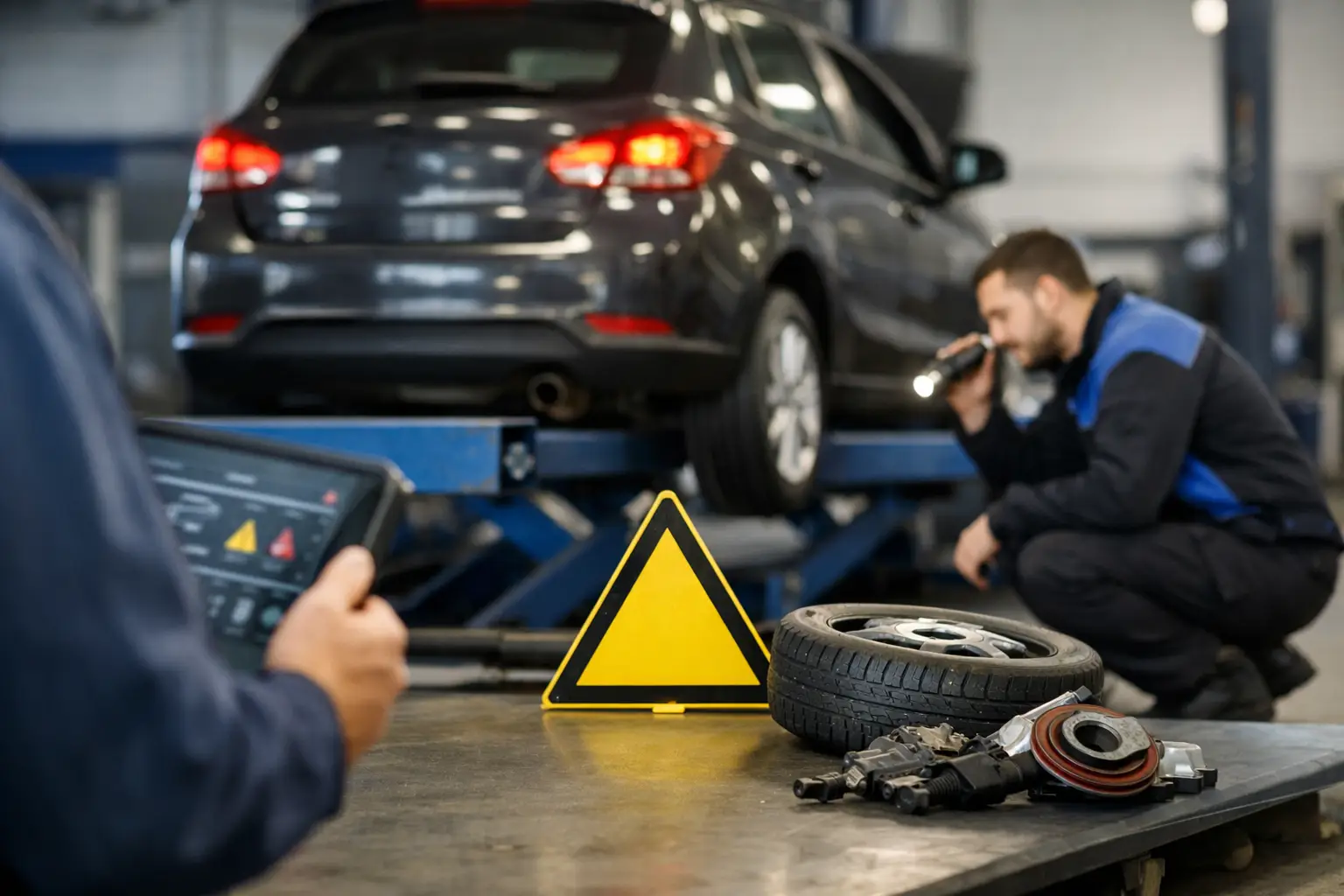
A failed MOT is often caused by something that took just a few minutes to spot: a blown bulb, worn tire tread, an empty washer bottle, or a warning light that has been ignored for too long. Understanding the top reasons MOT failures happen gives you a real chance to deal with smaller issues before they become a stressful failed test, an unexpected repair bill, or time off the road.
An MOT is not the same as a service. It is a roadworthiness inspection that checks whether your vehicle meets the required safety and environmental standards on the day it is tested. A car can drive reasonably well and still fail if a key component is worn, damaged, insecure, or not working as intended.
The Top Reasons MOT Failures Happen
Faulty lights are easy to miss
Lighting faults are among the most common reasons for an MOT failure because drivers do not always see every light while they are behind the wheel. Headlights, brake lights, indicators, rear lights, fog lights, number plate lights, and hazard lights all need to work correctly where fitted.
A single failed bulb can be enough to cause a failure, but the issue may be more than a bulb. Condensation inside a lamp, damaged lenses, insecure light units, incorrect bulb colors, or headlights aimed too high or low can also be a problem. Poor headlight aim is particularly common after a bulb replacement, minor front-end damage, or suspension work.
Before your test, ask someone to stand outside the vehicle while you operate the lights and brakes. Check the hazard lights too. It is a simple pre-MOT check that can prevent an avoidable return visit.
Tires fail on tread, damage, and condition
Your tires are the only point of contact between the vehicle and the road, so MOT standards are rightly strict. For most cars, the legal minimum tread depth is 1.6 mm across the central three-quarters of the tire, around its full circumference. However, waiting until tires are at the legal limit is not a good maintenance strategy, especially in heavy rain.
An MOT tester will also look for cuts, bulges, exposed cords, serious cracking, incorrect tire sizes, and tires that are rubbing against bodywork or suspension components. Uneven wear matters as well. If one edge is worn much more heavily than the rest, the car may need wheel alignment or have a worn suspension or steering part.
Check tire pressures regularly, including the spare if your vehicle has one. Low pressure can accelerate wear and affect handling, while overinflation can reduce grip and wear the center of the tread. If you notice vibration through the steering wheel, pulling to one side, or a repeated loss of pressure, arrange an inspection rather than waiting for MOT time.
Brakes need to be effective and balanced
Brake problems can range from worn pads and corroded discs to seized calipers, damaged brake lines, or a weak parking brake. Some warning signs are obvious: squealing, grinding, a soft brake pedal, a vehicle that pulls under braking, or a handbrake that needs to be pulled unusually high. Others are not as noticeable until a test reveals them.
During an MOT, braking performance is measured, including whether braking is balanced across the same axle. A car may still stop, but it can fail if one brake is doing significantly less work than the other. Corrosion is also a concern on older vehicles, particularly on brake pipes and underneath components that are exposed to water and road salt.
Do not put off a brake inspection because the car “feels fine.” Brake wear can progress gradually, and addressing pads or discs early is usually more straightforward than waiting until damage affects multiple components.
Suspension and steering wear can build up quietly
Potholes, speed bumps, curb contact, and everyday mileage all take a toll on suspension and steering. Worn shock absorbers, broken springs, damaged bushings, loose ball joints, and play in steering components are frequent MOT concerns.
You may notice knocking over rough roads, a bouncy ride, uneven tire wear, vague steering, or the vehicle sitting lower on one corner. A broken spring can sometimes remain hidden inside its mounting area, so the car may not look obviously damaged from the outside.
These faults are not only about comfort. Suspension and steering components affect how predictably your vehicle turns, stops, and maintains contact with the road. If your car has started feeling less settled or more difficult to control, it is worth investigating before the MOT is due.
Visibility problems include more than the windshield
A clear view of the road is essential. Chips or cracks in the windshield can lead to an MOT failure if they are in the driver’s direct line of sight or are large enough to affect the swept area. Damaged or ineffective windshield wipers, an empty washer fluid reservoir, and badly worn wiper blades are also common causes of failure.
The tester will check mirrors, so cracked, missing, or insecure mirrors need attention. Items hanging in the driver’s view, such as large phone mounts, stickers, or air fresheners, can also create an obstruction. Keep the windshield clear before the appointment and make sure washer jets actually spray onto the glass.
Warning lights often signal a test failure
Modern vehicles monitor a wide range of systems. If the engine management light, ABS warning light, airbag light, electronic stability control light, or another relevant safety warning remains illuminated, it may result in an MOT failure.
It is tempting to assume a warning light is a minor sensor issue, particularly if the car is driving normally. Sometimes it is. But a diagnostic check is the only fair way to identify the fault and decide what repair is needed. Clearing the light without fixing the cause is unlikely to solve the problem for long.
This is especially relevant for hybrid and electric vehicles, where electronic systems and high-voltage components require specialist knowledge. A modern workshop should use suitable diagnostic equipment and follow safe procedures rather than treating every warning light as a generic fault.
Emissions failures are not always an exhaust problem
Petrol and diesel vehicles must meet emissions limits based on their age and type. A failed emissions test can be linked to engine faults, poor combustion, an overdue service, a damaged exhaust, a failing catalytic converter, a diesel particulate filter issue, or a warning light that indicates an emissions-related fault.
Short journeys can contribute to problems, particularly for diesel vehicles that need longer runs to help the diesel particulate filter regenerate. That does not mean every diesel needs a motorway drive before an MOT, but a car used only for short trips may benefit from a proper assessment if it has warning lights, reduced performance, or repeated regeneration concerns.
An exhaust system must also be secure and free from serious leaks. Unusual exhaust noise, rattling underneath the vehicle, or fumes entering the cabin should never be ignored.
Seat belts, plates, and doors still matter
Some failures come down to basic safety and identification items. Seat belts must latch securely, retract properly, and be free from serious damage. Doors need to open and close safely, and the driver’s door must be openable from the inside and outside. The hood must latch securely too.
Number plates must be secure, readable, and correctly displayed. A faded plate, damaged characters, incorrect spacing, or a plate that is difficult to read can cause unnecessary trouble. These are small details, but they are part of keeping a vehicle legal and safe.
How to Prepare Without Guesswork
A quick check of lights, tires, wipers, washer fluid, dashboard warning lights, and number plates before booking is worthwhile. It can catch the most visible problems. But a pre-MOT check is not a substitute for professional inspection when you have noticed noises, vibrations, braking changes, fluid leaks, or warning messages.
If your MOT date is approaching and you are unsure about the vehicle’s condition, arrange a check early enough to make informed decisions. At AutoNet VIP, the aim is to explain what has been found clearly, separate urgent safety work from sensible maintenance, and give you transparent options. A little preparation before the test can turn MOT time from a worry into a routine part of looking after your vehicle.