That little amber light on your dashboard — the one that reads “ABS” — is easy to ignore when everything else seems fine. The car drives. The brakes feel alright. Nothing sounds wrong. So you carry on, telling yourself you’ll deal with it at the weekend.
But here’s the thing — and this is coming straight from the workshop floor in Harlow — when the ABS warning light stays on, your anti-lock braking system has already taken itself offline. That means in an emergency stop, on a wet roundabout, or on one of those greasy Essex A-roads on a January morning, your wheels could lock up. And that’s a situation nobody wants to be in.
According to data published by Essex County Council Road Safety in 2025, braking system faults were cited as a contributing factor in 1 in 9 road incidents across the county — a figure that’s actually crept up year on year since 2022. It’s not scaremongering. It’s a pattern that our technicians here in Harlow see reflected in the vehicles that come through the garage doors.
The good news? In most cases, the fix is entirely manageable — and often far less expensive than people fear. What matters is understanding what’s actually going on so you can make an informed decision and get back on the road safely.
Let’s walk through the seven most common reasons your ABS warning light stays on — and what each one really means for your vehicle.
1. A Faulty Wheel Speed Sensor
This is, without question, the most common culprit we diagnose at the garage — and it accounts for the majority of ABS warning light faults across the UK. The wheel speed sensor is a small but critical component that sits near each wheel hub. Its job is to constantly monitor how fast each wheel is spinning and feed that data back to the ABS control module.
When one sensor fails or sends a corrupted signal — whether due to road debris, corrosion (a real issue in the UK’s salty winter road conditions), or physical damage — the system can’t do its job. So it flags the fault and disables itself. Hence the light.
The sensor itself is usually inexpensive. Labour is straightforward for an experienced technician. In many cases, this is a same-day job, and drivers leave the workshop with a clear dashboard and peace of mind.
What to watch for: The ABS light appearing after a drive on rough terrain, or after your car has been through standing water. In some vehicles, you may also notice the speedometer behaving oddly, which is a useful indicator that a wheel speed sensor is the cause.
2. Low Brake Fluid Level
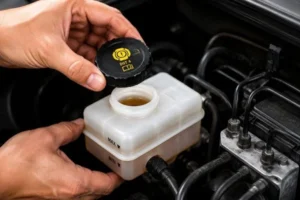
Your ABS system runs on hydraulic pressure — and that pressure depends entirely on having sufficient brake fluid circulating through the system. When fluid levels drop below the minimum threshold, the ABS module detects it and throws a warning.
Now, low brake fluid is sometimes a straightforward case of topping up. But experienced mechanics will tell you: brake fluid doesn’t just evaporate. If levels are consistently dropping, there is a leak somewhere in the system. That could be a brake line, a caliper, the master cylinder, or even a seal. Ignoring a leak doesn’t just keep your ABS light on — it puts your entire braking system at risk.
The UK MOT standards are clear on this: any brake fluid leak is an automatic MOT failure. And rightly so. If you’re in Harlow or the surrounding Essex area and your ABS light has come on alongside what feels like a slightly spongier brake pedal than usual, do not delay getting it checked.
3. A Damaged or Corroded ABS Ring (Tone Ring)
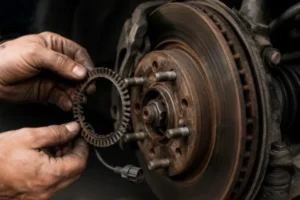
Working closely with the wheel speed sensor is a component called the ABS reluctor ring or tone ring — a toothed metal ring that rotates with the wheel and allows the sensor to measure speed by counting the gaps between teeth.
These rings are tough, but they’re not indestructible. Road debris, kerb strikes, and the slow creep of rust can chip or warp the teeth. When that happens, the sensor picks up an inconsistent signal, the ABS module throws a fault, and the warning light comes on.
Essex roads in winter are particularly unforgiving in this respect. Gritting salt accelerates corrosion, and the region’s mix of motorways, A-roads, and older rural routes means vehicles absorb a fair amount of punishment year-round. The 2025 RAC Breakdown Report noted that corrosion-related brake component failures were 14% higher in the East of England compared to the national average — a statistic that should prompt every Essex driver to have their wheel hubs inspected annually.
Replacing a tone ring is a straightforward repair when caught early. Left unchecked, however, the associated wear can extend to the wheel bearing itself — turning a modest fix into a considerably more involved job.
4. A Failing ABS Control Module
The ABS control module is the brain of the operation. It receives signals from all four wheel speed sensors, processes them in real time, and directs the hydraulic modulator to adjust brake pressure wheel by wheel during an emergency stop.
When the module itself develops a fault — caused by water ingress, electrical shorts, age, or software corruption — the entire ABS system loses its coordinator. The warning light comes on, and the system shuts down to prevent erratic operation.
This is a diagnostic job. A technician will use a vehicle-specific scan tool to pull fault codes directly from the module and determine whether the issue lies with the module itself or with the sensors feeding data into it. In some cases, a module can be reprogrammed. In others, it requires replacement.
It’s worth noting that when the ABS module fails on modern vehicles, it can sometimes trigger additional dashboard warnings alongside the ABS light — including traction control, stability control, or even the brake system light. If you’re seeing multiple warnings at once, a module fault is one of the more likely explanations.
5. Worn Brake Pads Triggering a System Conflict
This one catches a lot of drivers off guard. Severely worn brake pads can actually cause the ABS warning light to come on, even though the pads themselves aren’t directly part of the ABS system.
Here’s the mechanics of it: as pads wear down, the brake calipers extend further to compensate, which draws more fluid from the reservoir. In some vehicles, the sensors interpret this as a brake fluid drop, which then flags an ABS fault. In other cases, excessive pad wear changes the rotational characteristics of the wheel — just enough to confuse the wheel speed sensor.
The DVSA’s 2025 MOT data for the East of England showed that brake pad wear was cited as a defect in approximately 18% of all MOT failures in the region. It’s not a minor issue — and it’s one that tends to creep up on drivers who haven’t had their brakes physically inspected in 12 months or more.
If your ABS warning light has appeared and your brakes have felt slightly different — grabby, soft, or requiring more pressure than usual — a full brake inspection should be your first port of call.
6. A Hydraulic Pump or Modulator Fault
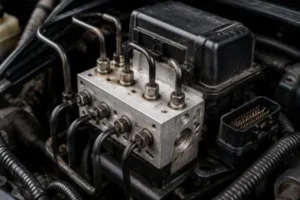
When a wheel locks during hard braking, the ABS system’s hydraulic pump and modulator work together to rapidly pulse the brake pressure — releasing and reapplying it dozens of times per second to prevent the skid. It’s an extraordinary bit of engineering that most drivers never think about until it fails.
A fault in the hydraulic pump or modulator assembly will trigger the ABS warning light immediately. You might also hear an unusual noise from beneath the bonnet during braking — a grinding, buzzing, or cycling sound that’s quite distinct from normal brake operation.
This is one of the more complex ABS repairs, and it’s important to have it diagnosed by a specialist rather than a general tyre shop. The modulator unit on modern vehicles is integrated with various other systems, and replacing it incorrectly can introduce new fault codes or compromise stability control functionality.
The honest truth is that this repair can be costly — but so can the alternative. Driving without a functioning ABS system on a dual carriageway in wet conditions is a risk that no responsible driver should take.
7. Electrical Wiring Issues and Blown Fuses
Modern vehicles are rolling computers, and the ABS system is wired into a complex network of circuits. A blown fuse, a damaged wiring loom, a corroded connector, or a short circuit anywhere in that network can disable the ABS and illuminate the warning light — even if every physical component is in perfect working order.
Electrical faults can be notoriously elusive. The light might come on and off intermittently. It might only appear at certain temperatures. It might disappear after a restart and return an hour later. This intermittent behaviour is actually a strong indicator of an electrical rather than mechanical fault.
Vehicles that have had aftermarket audio or alarm systems fitted are particularly susceptible to this kind of wiring interference — especially if the installation wasn’t done by a qualified auto-electrician. This is increasingly common with older vehicles in the Harlow area that have been handed down or purchased second-hand.
A proper diagnostic scan, followed by a methodical electrical inspection, is the only reliable way to identify and fix this type of fault. It requires patience and the right equipment — and it’s precisely the kind of work that separates a competent garage from a guessing shop.
What Should You Actually Do When the ABS Warning Light Stays On?
The most important thing — and we say this as people who work on brakes every single day — is not to normalise it. The ABS warning light is not a nuisance notification. It is your vehicle telling you that a safety-critical system has identified a fault and taken itself offline.
Your standard brakes will still function. The pedal will still work. But in the event of an emergency stop — particularly on a wet or loose surface — you will not have ABS intervention. That means longer stopping distances and a higher risk of wheel lock and skidding.
Here’s a practical approach:
- Do not ignore the light, even if the car feels fine to drive.
- Check your brake fluid reservoir level as a first step (consult your handbook for its location).
- Note when the light appeared and whether any changes to driving feel accompanied it.
- Book a diagnostic inspection as soon as possible — ideally within a few days, not weeks.
- If the ABS light appears alongside the main brake warning light, treat it as urgent and avoid motorway or high-speed driving until inspected.
Get It Sorted Properly: AutoNet VIP in Harlow
If you’re based in Harlow or anywhere across Essex and your ABS warning light stays on, AutoNet VIP – Car Repairs, MOTs & Electric & Hybrid Specialists in Harlow is the kind of garage that doesn’t deal in guesswork.
The team at AutoNet VIP uses professional-grade diagnostic equipment to read fault codes directly from your ABS module — giving a clear, accurate picture of exactly what’s wrong before any work is carried out. No unnecessary parts swapped. No vague estimates. Just a straightforward diagnosis and an honest conversation about what the repair involves and what it will cost.
What makes AutoNet VIP stand out in Harlow isn’t just the technical capability — it’s the approach. They work on everything from conventional petrol and diesel vehicles to hybrid and fully electric cars, which matters more than ever as Essex’s vehicle landscape continues to shift. ABS systems in electric vehicles operate differently and require technicians who genuinely understand the integration between the braking system and the vehicle’s energy recovery functions. That’s a level of expertise that isn’t universally available.
They also handle full MOT preparation and testing, servicing, and a wide range of repairs — so if your ABS fault has flagged other underlying issues during the diagnostic process, everything can be addressed in one visit rather than spread across multiple garage trips.
You can read more on their blog about common vehicle warning lights and what they mean — it’s a useful resource written by their own technicians, covering the kind of practical information that actually helps drivers make better decisions.
Why Essex Drivers Need to Take This Seriously in 2025 and Beyond
The 2025 annual vehicle safety report published by the Driver and Vehicle Licensing Agency (DVLA) and cross-referenced with MOT failure data from the East of England showed a notable increase in ABS-related advisory and failure notices compared to 2023 figures. Specifically, ABS component faults rose by approximately 11% across Essex, Hertfordshire, and Suffolk — a trend that mechanic specialists in the region attribute to an ageing vehicle fleet and the cumulative effects of several consecutive harsh winters on road surfaces and vehicle components.
The average age of a car on UK roads is now over nine years, according to figures from the Society of Motor Manufacturers and Traders (SMMT) from early 2025. At that age, ABS sensors, wiring, and hydraulic components start to show meaningful signs of wear — particularly in regions like Essex where road conditions and winter maintenance create an environment that accelerates deterioration.
This isn’t a reason to panic. It’s a reason to be proactive. Annual brake inspections — not just MOT checks — are the single most effective habit a driver can adopt to stay ahead of ABS faults before they become dashboard emergencies.
Sorted, Safe and Back on the Road
There’s a particular kind of confidence that comes with knowing your vehicle has been properly checked by people who know exactly what they’re looking at. That moment when the diagnostic report comes back, the fault is identified, the repair is carried out, and you drive out of the forecourt with a clear dashboard — it’s a genuinely good feeling.
Most ABS faults are not the end of the world. They are fixable. They are often affordable. And the vast majority of drivers who get their ABS warning light diagnosed and repaired at a specialist garage are back on the road without any drama whatsoever.
What you don’t want is to be the driver who left it six months, convinced everything was fine, and then found themselves in an emergency braking situation where ABS would have made the difference.
If your ABS warning light stays on — book it in. Get it diagnosed. Know what you’re dealing with. Then make the call.