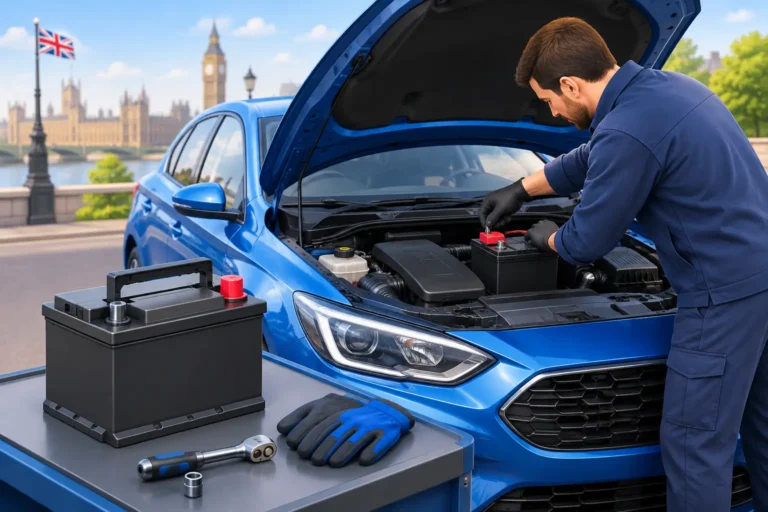
A car that will not start outside your home, workplace or school run is rarely convenient. This car battery replacement guide explains what the warning signs mean, how to choose a suitable replacement and when a professional fitting can prevent a simple fault becoming an expensive one.
Most 12-volt batteries last between three and five years, but mileage is not the deciding factor. Short journeys, winter weather, frequent stop-start driving and electrical accessories can all shorten battery life. The aim is not to replace a battery at the first slow start, but to test it properly and act before it leaves you stranded.
How to Tell if Your Car Battery Needs Replacing
A flat battery and a failed battery are not always the same thing. Leaving an interior light on, a dash camera running or a door slightly open can drain a healthy battery. If it recharges fully and holds its charge, replacement may not be necessary. If the problem keeps returning, the battery, charging system or an electrical drain needs investigation.
The most familiar warning sign is an engine that cranks slowly before starting. You may also notice dim headlights at idle, a battery warning light, electric windows moving sluggishly or the infotainment system resetting its clock and saved settings. Modern vehicles can produce several unrelated warning messages when voltage is low, so a dashboard full of alerts does not automatically mean multiple components have failed.
Cold weather often exposes a weak battery. Low temperatures reduce the battery’s available power while the engine needs more effort to turn over. A battery that copes in mild weather but struggles on frosty mornings should be tested before the next cold spell.
The battery warning light deserves particular attention. It usually indicates a charging-system issue rather than simply a worn battery. The alternator, drive belt, wiring or battery connections may be at fault. Replacing the battery without checking the charging voltage could leave you with the same problem days later.
Check the Cause Before Buying a New Battery
A proper battery assessment should look at more than the voltage reading. A battery can show around 12 volts at rest and still lack the capacity to start the engine under load. A garage can test its condition, starting performance and charging system, then inspect terminals and cables for corrosion or poor connections.
This matters because a replacement battery is only worthwhile if it solves the real issue. Corroded terminals may prevent a good battery from delivering power efficiently. An alternator that is undercharging will gradually flatten a new battery. On the other hand, an overcharging alternator can damage it. If a vehicle loses charge while parked, a parasitic drain from an electrical component may be responsible.
For drivers in Harlow and the surrounding area, a quick diagnostic check can be especially useful before winter or before a long journey. It gives you a clear answer rather than relying on guesswork, jump leads and crossed fingers.
Choosing the Correct Replacement Battery
Car batteries are not interchangeable simply because they fit in the tray. The correct unit must match the vehicle’s electrical requirements as well as its physical dimensions. Check the vehicle handbook, the original battery label or a reliable parts catalogue using the registration number and engine specification.
Pay attention to battery type, capacity and terminal layout. Capacity is usually shown in amp hours (Ah), while cold cranking amps (CCA) indicate the power available for starting in cold conditions. Fitting a battery with insufficient capacity can lead to poor starting and reduced life. Going substantially larger is not always beneficial either, particularly if the charging system and battery-management settings are designed for a specific specification.
Standard, EFB and AGM Batteries
Conventional lead-acid batteries are common in older vehicles and cars with modest electrical demands. Vehicles with stop-start technology generally need either an EFB battery, meaning Enhanced Flooded Battery, or an AGM battery, meaning Absorbent Glass Mat.
An EFB battery is designed to handle more frequent engine starts than a standard battery. AGM batteries are built for higher electrical loads and deeper cycling, making them common in cars with advanced stop-start systems, regenerative braking and numerous electrical features. They cost more, but fitting a cheaper conventional battery where AGM is specified is false economy. It may fail early, affect stop-start operation and cause electrical faults.
As a general rule, replace like for like unless a qualified technician confirms that an approved upgrade is suitable. The physical details matter too: confirm the length, width, height, hold-down arrangement and positive-terminal position before ordering.
Why Battery Registration Matters on Modern Cars
Many newer petrol, diesel, hybrid and electric vehicles use a battery-management system. After fitting a new 12-volt battery, the vehicle may need battery registration, coding or adaptation through diagnostic equipment.
This tells the vehicle that a fresh battery has been installed and, in some cases, records its type and capacity. Without this step, the charging strategy may continue treating the battery as old and degraded. That can reduce battery life, affect stop-start performance or leave warning messages on the dashboard.
Not every car needs registration, but it is common on many premium and modern vehicles. This is one reason professional replacement is often the sensible option when your car has stop-start technology, an electronic parking brake, complex infotainment or multiple driver-assistance systems.
Safe Steps for Replacing a 12-Volt Battery
If you are confident with basic vehicle maintenance and your vehicle does not require coding, replacement may be a manageable job. Always work with the engine switched off, the key removed and the vehicle parked on level ground. Batteries are heavy, contain corrosive electrolyte and can release flammable gas, so wear suitable eye protection and avoid sparks, flames and smoking nearby.
Before starting, make sure you have the correct replacement battery, a suitable socket or spanner, gloves and a way to secure the old battery for recycling. Then follow the vehicle manufacturer’s instructions. The usual process is:
- Switch off all electrical equipment and allow the vehicle to settle before opening the battery compartment.
- Disconnect the negative terminal first, then the positive terminal, taking care not to allow tools to bridge the terminals.
- Remove the battery clamp and lift the battery upright. It may be heavier than expected, so use safe lifting technique.
- Clean any corrosion from the terminal clamps, place the new battery securely in the tray and refit the hold-down clamp.
- Connect the positive terminal first, then the negative terminal, checking that both connections are secure before starting the engine.
Never place a metal tool across the battery terminals. Do not force connectors that do not fit, and do not discard the old battery with household waste. Vehicle batteries must be recycled through an authorised collection point or garage.
Some cars may lose radio presets, window settings or other stored functions when power is disconnected. A memory saver can help in certain cases, but it must be used correctly. On vehicles with complex electrical systems, the potential inconvenience and risk often outweigh the modest saving of fitting the battery yourself.
Hybrid and Electric Vehicle Battery Safety
Hybrid and electric vehicles have a conventional 12-volt battery as well as a high-voltage traction battery. The 12-volt battery can still fail and may prevent the car from waking up or selecting drive, even when the high-voltage battery is charged.
However, the high-voltage system must never be treated as a DIY repair. Orange cables and high-voltage components require specialist training, correct isolation procedures and approved equipment. If you own a hybrid or electric vehicle, make sure the garage understands both its low-voltage battery needs and its high-voltage safety requirements.
When to Book a Professional Battery Replacement
Professional fitting offers more than a new battery. It should include testing the existing battery and charging system, confirming the correct specification, fitting the unit securely, registering it where required and disposing of the old battery responsibly. That is particularly valuable if the fault is intermittent or the vehicle has already displayed several warning lights.
At AutoNet VIP, the focus is on explaining what the test results show before work is approved. If your battery is healthy, you should be told that clearly. If it needs replacement, you should know why, what specification is required and whether additional coding is needed.
A battery is a small component with a large role in your car’s reliability. If starts are becoming slower, warning lights are appearing or the battery is reaching the end of its expected life, arrange a proper test now. It is a straightforward way to avoid turning a routine journey into an unexpected recovery call.