You’re driving along the A414 on a grey Essex morning, coffee in the cup holder, radio on, when a small amber glow catches the corner of your eye on the dashboard. Your stomach sinks. The engine oil light on car has just switched on — and suddenly that ordinary Tuesday commute feels a great deal more stressful than it did two minutes ago.
Here’s what we see at the garage: half of drivers who come in with an oil light issue admit they spotted it days — sometimes weeks — before they acted. The other half? They’re on the back of a flatbed because they convinced themselves it would “come on and go off again.” It usually doesn’t work that way. And the bill at the end of the delay is always significantly larger.
According to RAC breakdown data published in early 2025, oil-related engine failures accounted for approximately 22% of all roadside breakdowns across the East of England region — making it one of the most common, and most preventable, causes of roadside stops in Essex. The Retail Motor Industry Federation’s 2025 regional digest specifically flagged Harlow, Chelmsford, and Basildon as hotspots for oil system-related workshop visits.
At AutoNet VIP – Car Repairs, MOTs & Electric & Hybrid Specialists in Harlow, our mechanics deal with this situation several times every week. Some arrive as a quick fix. Others arrive as a rebuild job that could have been avoided entirely. The difference, almost every single time, is how quickly the driver acted.
So let’s go through the nine things you need to check — in order — when the engine oil light on your car comes on. Practical. Direct. Written by people who actually fix engines for a living in Essex.
First, Know Which Warning Light You’re Looking At
This matters more than most drivers realise because there are two distinct oil-related warning lights, and they have different levels of urgency.
The oil pressure warning light — typically an oil can symbol on its own — signals that your engine is not receiving adequate oil pressure at this moment. This is the urgent one. If this illuminates while you are driving, do not wait for a convenient moment. Pull over safely and switch the engine off immediately.
The oil level warning light — often the same oil can symbol with a drip or wavy line beneath it — indicates your oil level has dropped below the safe minimum. This gives you slightly more breathing room, but “slightly” is doing a lot of work in that sentence. Left unchecked, low oil and oil pressure issues lead to identical outcomes: internal engine damage that is expensive, time-consuming, and entirely preventable.
Not sure which light you’re looking at? Your vehicle handbook will tell you, and our team at AutoNet VIP in Harlow is always happy to take a look free of charge.
1. Pull Over and Switch the Engine Off
It sounds elementary. It still needs saying, because the consequences of ignoring it are severe.
When oil pressure drops critically, your engine’s internal components — pistons, crankshaft, camshaft, bearings — are no longer being lubricated. Modern engines are built to extraordinarily tight tolerances. Without oil between those surfaces, you’re looking at metal-to-metal friction within minutes. That friction generates heat and wear at a rate that causes permanent damage to components that cost thousands of pounds to replace.
If the oil pressure light is on, pull over safely. Switch the engine off. Do not restart and drive to a garage. Call for recovery. Your engine will thank you.
2. Check Your Oil Level on the Dipstick
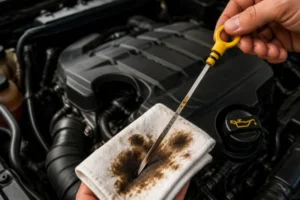
Once safely stopped and the engine has had a few minutes to cool, locate your dipstick — usually identifiable by a yellow or orange handle under the bonnet. Pull it out, wipe it clean with a rag, reinsert it fully, then draw it out again. Check where the oil level sits between the minimum and maximum markers.
The Society of Motor Manufacturers and Traders (SMMT) 2025 annual UK vehicle maintenance report found that approximately 35% of cars on Britain’s roads are running with oil levels below the manufacturer’s recommended minimum at any given time. That’s more than one in three vehicles. Our mechanics at AutoNet VIP see this reflected constantly in routine service checks across Essex.
If the level is below the minimum, top it up with the grade of oil specified in your handbook or on the oil filler cap. This may resolve the warning light. However, understanding why the level fell is equally important — and that brings us to the next check.
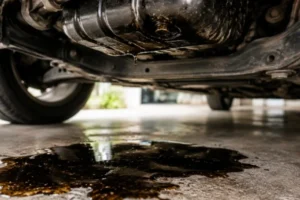
3. Look Underneath the Car for Oil Leaks
Park on a clean, dry surface and examine underneath the car. Any dark patches, wet residue, or active drips in the engine bay area or on the ground beneath the vehicle are a clear indicator that oil is escaping somewhere it shouldn’t be.
Common sources of leaks include the sump gasket, the rocker cover gasket, oil filter housing seals, and crankshaft seals. Some leaks are gradual and go unnoticed for months. Others develop suddenly and cause rapid oil loss during a single journey.
At AutoNet VIP in Harlow, we use UV dye-based leak detection to identify the precise source of even minor, intermittent leaks. Don’t try to guess the source yourself — a misidentified leak can lead to wasted money on the wrong repair.
4. Examine the Oil’s Colour and Consistency
Healthy engine oil is amber to golden-brown when fresh, darkening to a rich brown with use. That’s completely normal. However, the following are not:
- Milky or creamy white oil — coolant is mixing with your oil. This strongly suggests a blown head gasket or cracked cylinder head. Seek professional diagnosis immediately.
- Gritty or metallic-feeling oil — metallic particles indicate serious internal wear. The engine needs professional assessment without delay.
- Fuel-contaminated oil — oil that smells strongly of petrol and appears unusually thin suggests fuel is entering the oil system, often through a faulty injector or excessive short-journey cold starts.
- Jet-black, thick sludge — your oil is well past its service life and has likely lost most of its lubricating properties. A change is well overdue.
The appearance and smell of your oil is among the most telling diagnostics an experienced mechanic will use. It’s worth checking and describing it accurately when you contact your garage.
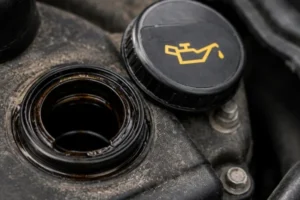
5. Check Under the Oil Filler Cap
Remove the oil filler cap on top of your engine and inspect the underside. If you see a creamy, yellowish-brown deposit — colloquially known in the trade as “mayonnaise” — that’s a sign of coolant contamination within the oil system.
This is one of the classic indicators of a blown head gasket or cracked cylinder head. Essex experienced a notably cold spell through January and February 2025, and our mechanics saw a corresponding uptick in head gasket-related visits from drivers whose older vehicles had been subjected to temperature extremes or had previously overheated without a full resolution.
A head gasket failure sounds alarming, and the repair is not inexpensive — but it is a repair that skilled mechanics handle successfully every week. At AutoNet VIP, we’ve brought back many vehicles from situations that owners had written off. Don’t assume the worst before getting a proper diagnosis.
6. Listen to Your Engine — It’s Usually Trying to Tell You Something
Engines often give audible warning before a warning light even appears, or alongside it. Pay attention to the following sounds:
- Ticking or tapping at idle — a rhythmic metallic tick often indicates the valve train running without adequate lubrication. Caught early, this can be addressed without significant expense. Left too long, camshaft and lifter damage follows.
- Deep knocking from low in the engine — a low, rhythmic knock often points to big-end or main bearing failure. Significant, but still repairable with prompt action.
- Startup rattle that disappears after a few seconds — sometimes normal on cold mornings, but if it persists or worsens, it can indicate that oil isn’t reaching upper engine components quickly enough, often linked to a worn oil pump or low oil viscosity.
An Institute of the Motor Industry (IMI) survey from 2025 found that 68% of UK drivers admitted to ignoring unusual engine noises for more than a fortnight before seeking help — and in the vast majority of cases, the resulting repair bill was substantially higher than it would have been had they acted immediately.
7. Recall When Your Oil Was Last Changed
Degraded oil is a frequently overlooked cause of the engine oil light on car dashboards. Over time and mileage, oil loses its viscosity and its chemical additives break down. It stops doing its job — and reduced flow characteristics can trigger oil pressure warnings even when the level itself appears acceptable.
Most modern vehicles require an oil and filter change every 10,000 to 15,000 miles, or annually — whichever comes first. Many manufacturers now recommend even shorter intervals for vehicles primarily used on short urban journeys, which describes the driving patterns of a significant number of Essex commuters.
An oil and filter change is among the most cost-effective maintenance jobs available. At AutoNet VIP, our service includes a complimentary multi-point vehicle health check alongside the oil change — so you leave with fresh oil and a comprehensive picture of your vehicle’s overall condition. Book your service here.
8. Consider Whether the Sensor Itself May Be Faulty
Here’s a check that many drivers — and even some less thorough mechanics — overlook: the oil pressure sensor that triggers the warning light can itself fail, producing a false positive. The light comes on, the alarm is raised, but the oil pressure and oil level are entirely within normal parameters.
This is a documented issue on several popular UK models, including various Ford, Vauxhall, and Volkswagen Group vehicles with higher mileages. The sensor itself is usually relatively inexpensive, but — crucially — you should never assume it’s “just the sensor” without first ruling out genuine oil system issues.
A professional OBD diagnostic scan will retrieve stored fault codes and, combined with a physical oil system check, will give your mechanic a clear picture of whether you’re dealing with a faulty sensor or an underlying engine problem. Replacing the sensor without this step risks missing a serious issue that is now masked by a new, functioning sensor.
9. Get a Professional Diagnostic — Act, Don’t Guess
Eight checks you can carry out yourself or with basic tools. This ninth one is the most important of the lot: when your engine oil light on your car stays on, get it professionally assessed by a qualified mechanic. Full stop.
The engine is the most expensive single component of your vehicle. Diagnostic fees at a reputable garage are a fraction of the cost of an engine repair. And engine repairs — while absolutely achievable — are a fraction of the cost of an engine replacement.
The AA’s 2025 used car health report found that vehicles over eight years old are three times more likely to experience oil-related warning lights, and that the average cost of an engine repair resulting from oil neglect in the UK in 2025 was between £2,200 and £6,800. Contrast that with the cost of an oil change and diagnostic — typically under £200 at a local Essex garage — and the case for acting promptly makes itself.
At AutoNet VIP – Car Repairs, MOTs & Electric & Hybrid Specialists in Harlow, our mechanics work across the full range of petrol, diesel, hybrid, and electric vehicles. We serve drivers across Harlow, Epping, Cheshunt, Bishops Stortford, and the wider Essex and Hertfordshire area. We invest in the latest diagnostic equipment and manufacturer training, and we believe in plain, honest communication with every customer who walks through our doors.
Why Essex Drivers Come to AutoNet VIP in Harlow
AutoNet VIP isn’t a franchise or a faceless chain. We’re a proper local garage based in Harlow, built on the straightforward principle that drivers deserve skilled work, fair prices, and honest advice — without the runaround.
Our services relevant to engine oil warning lights and engine health include:
- Full vehicle diagnostics and fault code reading
- Engine oil and filter changes
- Engine repairs, head gasket diagnosis and repair
- MOT testing with free pre-MOT advisory checks
- Electric and hybrid vehicle specialist servicing
We will always explain what we find, why it matters, and what your options are — including what happens if something is left unaddressed. You will never receive a bill you weren’t expecting. That’s not a marketing line. It’s how we operate, and it’s why customers keep coming back and sending their family and colleagues our way.
That Warning Light Is on Your Side — Act on It
Here’s the mindset shift that changes everything: the engine oil light on your car is not a threat. It’s one of the most useful things your vehicle does for you. It sees something you can’t. It’s asking you to pay attention.
The drivers who come through oil-related issues with minimal cost and minimal disruption are not the ones with luck on their side. They’re the ones who stopped when the light demanded it, got to a qualified mechanic promptly, and didn’t convince themselves it would resolve itself.
Whatever stage you’re at right now — whether the light has just appeared, whether you’ve been watching it for a few days and hoping for the best, or whether a more serious issue has already developed — there is a clear path forward. Engines can be repaired. Problems can be solved. And with skilled, honest mechanics on your side, your car can come through this in fine shape.
If you’re in Harlow or anywhere across Essex and you’ve got the engine oil warning light showing on your dash — don’t sit on it. Get in touch with the team at AutoNet VIP. We’ll tell you straight what’s going on, what needs doing, and what it’ll cost. No surprises. Just proper, professional car care from mechanics who genuinely know their trade.
➡ Book Your Diagnostic at AutoNet VIP Today – Harlow, Essex
FAQs: Engine Oil Light On Car
Can I drive with the engine oil light on?
If the oil pressure warning light is on (oil can symbol without drops), pull over and stop the engine immediately. If it’s the oil level warning, you may safely drive a very short distance to a safe stop, but check and top up the level before driving further. In both cases, do not drive normally until the issue has been assessed.
How quickly can engine damage occur with no oil pressure?
Serious internal engine damage can begin within minutes of losing oil pressure. There is no “safe distance” to drive. Treat the oil pressure warning light as a stop-immediately situation every time it appears.
Will topping up the oil turn the warning light off?
If the cause is genuinely low oil level, topping up to the correct mark should resolve the warning light after the engine has circulated the new oil. However, you should also establish why the level dropped. Regular top-ups without an obvious cause indicate a leak or an internal consumption issue that requires investigation.
How much does it cost to fix an engine oil warning light issue in Essex?
It varies by cause. An oil pressure sensor replacement typically costs £80–£150. An oil and filter change is generally £60–£120. Head gasket repair ranges from £700 to £1,800 depending on the vehicle. Rebuilds and engine replacements can run considerably higher. Early action is always the most cost-effective option by a significant margin.
Does AutoNet VIP offer free checks for engine oil warning lights?
If you’re concerned and you’re in the Harlow or Essex area, come in and our team will carry out a complimentary visual inspection. We’d always rather help you identify a problem early than see you return later with a much larger bill.