A search for “harlow essex: mechanic uses thermal camera to fix unexplained car heat” often starts with a frustrating experience: a car feels hot in one area, yet there is no warning light, no obvious leak and no clear explanation. Perhaps one wheel is unusually warm after a short journey, the cabin gets hot with the heater switched off, or there is a persistent hot smell under the bonnet. These are not faults to guess at.
A thermal camera gives a skilled mechanic a fast, non-invasive way to see temperature differences that cannot be identified reliably by sight alone. It does not replace proper testing or mechanical knowledge. It gives the diagnostic process a clearer starting point, helping locate the source of abnormal heat before parts are replaced.
Why unexplained heat deserves prompt attention
Cars generate heat in normal use. The engine, exhaust, brakes, gearbox, battery systems and electrical wiring all operate within expected temperature ranges. The concern is heat appearing in the wrong place, rising too quickly, or affecting one component differently from the equivalent part on the other side of the vehicle.
For example, a warm brake disc after driving is normal. One front wheel that is significantly hotter than the other after a gentle local journey may point to a brake caliper that is binding, seized slide pins, a sticking handbrake mechanism or a restricted brake hose. Left unresolved, a binding brake can wear pads and discs quickly, reduce braking performance, damage a wheel bearing and, in serious cases, create a fire risk.
Unusual heat can also indicate a cooling-system fault, an overheating electrical connection, a blocked exhaust component or an issue within a hybrid or electric vehicle’s thermal management system. The right response depends on where the heat is coming from and how the vehicle behaves, which is why a diagnosis is more valuable than replacing components on suspicion.
How a thermal camera helps find the fault
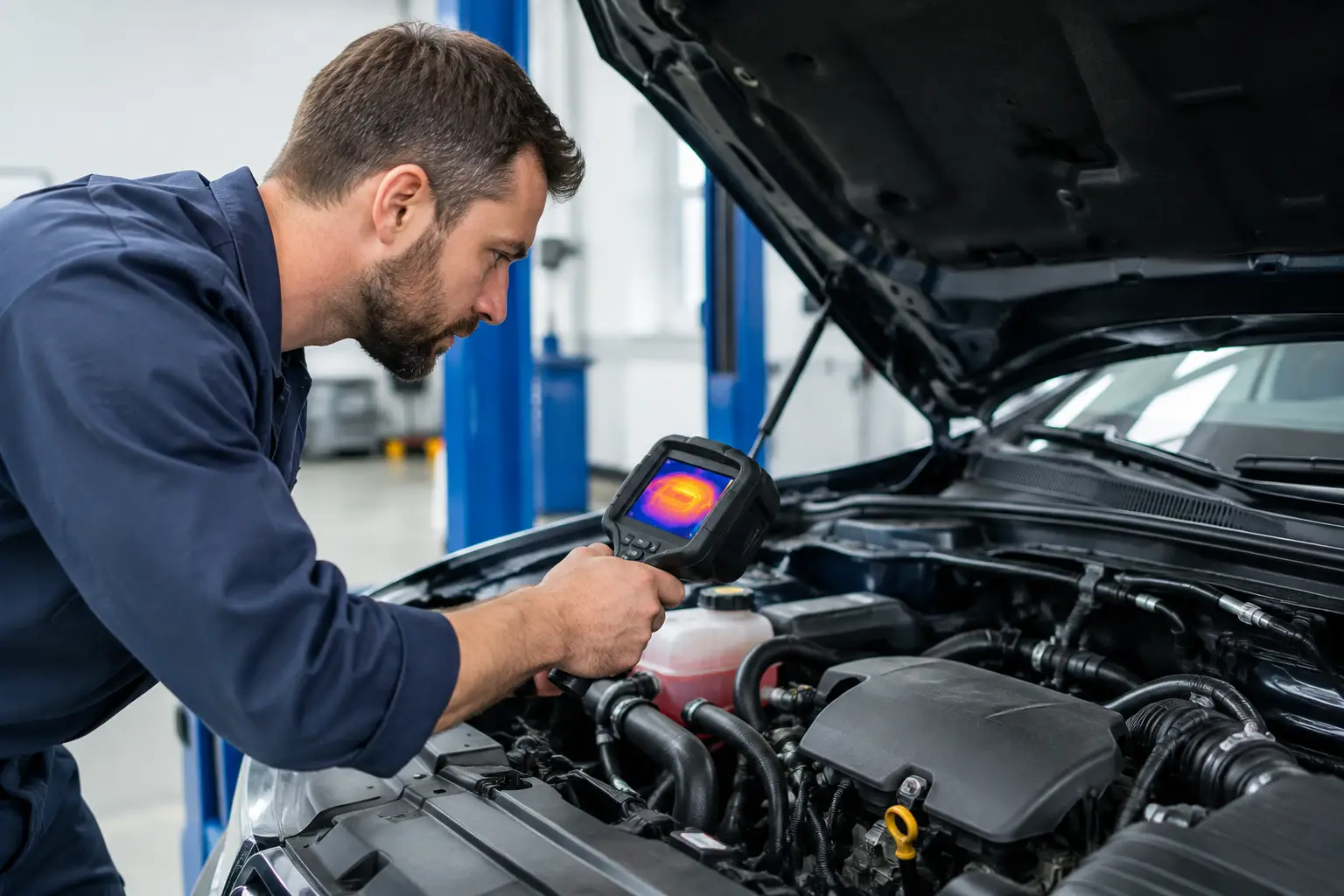
A thermal camera detects infrared energy and displays surface temperatures as an image. Cooler areas appear in darker shades, while warmer areas stand out in brighter colours. The mechanic can compare matching components, follow the path of heat through a system and identify unexpected hot spots.
The image alone is not the diagnosis. Surface temperature can be affected by road conditions, recent braking, sunlight, airflow and the material being scanned. Shiny metal can reflect surrounding heat and give misleading readings if used without care. An experienced technician considers the vehicle’s recent use, checks live diagnostic data where relevant and confirms findings with physical inspections and targeted tests.
That combination matters. A thermal image may show that a rear brake is running hot, but further work is needed to establish whether the cause is the caliper, the carrier, the parking brake mechanism, a flexible hose or an electronic control issue. This approach protects the customer from paying for a part that has not actually caused the problem.
Comparing like with like
One of the camera’s most useful applications is comparison. On a vehicle that has been driven under controlled conditions, the left and right brake assemblies should usually show broadly similar temperatures. A significant difference provides a useful clue.
The same principle applies under the bonnet. Comparing injector temperatures, cooling hoses, radiator sections, electrical connectors and auxiliary drive components can reveal a pattern that is easy to miss during a conventional visual check. A cold patch on a radiator, for instance, may suggest restricted coolant flow, while an unusually hot connection can signal electrical resistance.
Common causes of heat that a camera can reveal
Binding brakes and hot wheels
This is one of the most common reasons drivers notice unexplained heat. You may smell hot brakes, find one alloy wheel too hot to touch, hear a light scraping noise or feel the vehicle pull slightly while driving. In some cases, there may be no obvious symptom until tyre wear or brake performance begins to suffer.
Thermal imaging can show whether one corner of the vehicle is retaining far more heat than the others. The workshop can then inspect the brake components properly and advise whether cleaning and freeing the mechanism is suitable or whether worn or seized parts need replacement. The decision depends on the condition of the system, not simply the temperature reading.
Cooling-system problems
If the engine temperature rises, coolant level falls, the heater output changes or the cooling fan runs more often than expected, a fault in the cooling system may be developing. A thermal camera can help assess temperature variation across the radiator, hoses and thermostat housing, particularly when paired with pressure testing and fault-code checks.
A hot engine is not always caused by a failed radiator or water pump. It could be a thermostat that is not opening correctly, air trapped in the system, a leaking hose, an electric fan issue or, less commonly, an internal engine problem. Accurate diagnosis helps prevent unnecessary expense and reduces the risk of more serious overheating damage.
Electrical hot spots
Electrical faults do not always blow a fuse immediately. A corroded connection, loose terminal, damaged cable or overloaded circuit can create resistance, and resistance creates heat. This is particularly relevant where high current is involved, such as starter motor connections, battery cables, alternator wiring, fuse boxes and heated components.
A thermal scan can identify a connector that is running hotter than surrounding components. The technician can then inspect its condition, test voltage drop and repair the underlying issue. This is far safer than treating a hot cable or burnt smell as something that may resolve itself.
Exhaust and emissions faults
The exhaust system is designed to become very hot, so context is essential. However, an abnormal heat pattern around a catalytic converter, diesel particulate filter or exhaust heat shield can support further investigation. A blocked or regenerating diesel particulate filter, for example, can lead to high exhaust temperatures, while a damaged heat shield can allow heat to affect nearby components.
The vehicle’s diagnostic data, driving history and warning lights all help determine whether the heat is expected. Thermal imaging is useful evidence, not a reason to make assumptions.
Hybrid and electric vehicle thermal management
Hybrid and electric vehicles have additional systems that need controlled temperatures, including high-voltage batteries, power electronics, motors and charging components. These vehicles require suitable equipment, procedures and trained technicians.
Thermal imaging can support checks of cooling circuits and external components, but high-voltage work must only be carried out following correct isolation procedures. If you notice unusual heat, a warning message, reduced range, charging concerns or a burning smell in an EV or hybrid, stop using the vehicle if it is safe to do so and arrange professional assessment rather than investigating it yourself.
What happens during a professional heat diagnosis
A good diagnostic appointment starts with the driver’s observations. When does the heat occur? Is it after braking, motorway driving, charging, stop-start traffic or when the air conditioning is running? Is there a smell, noise, warning light or change in handling? These details can reduce diagnostic time considerably.
The vehicle may then be road-tested where appropriate, scanned for fault codes and inspected with a thermal camera while systems are operating. Brakes, cooling components, electrical connections and under-bonnet areas can be compared against expected temperatures. The mechanic will use the findings to guide further checks rather than offering an instant verdict from a single image.
At AutoNet VIP, the focus is on explaining what has been found in plain language, what needs attention now and what can be monitored. If repair work is required, you should understand the cause of the issue and the options available before authorising it.
When you should stop driving
Do not continue driving simply because there is no dashboard warning light. Arrange assistance or a prompt inspection if you notice smoke, a strong burning smell, visible fluid leaks, a red temperature warning, loss of braking performance, a wheel that is extremely hot, or a vehicle that pulls sharply to one side.
If the temperature gauge is rising, pull over safely as soon as possible and switch off the engine. Do not open a hot coolant expansion tank cap. Pressurised coolant can cause serious burns. For an electric or hybrid vehicle with smoke, strong burning odours or a high-voltage warning, move away from the vehicle if safe and seek emergency guidance.
For less urgent symptoms, such as a recurring warm wheel or mild hot smell after journeys, booking diagnostics early is still sensible. Small heat-related faults can become expensive when they are allowed to damage surrounding parts.
A car should not leave you guessing whether a strange hot spot is normal. A careful inspection backed by thermal imaging can turn an unclear symptom into a clear, evidence-based repair plan – and give you confidence for the next journey.
Don’t guess, let a workshop with high quality equipments help you with your car problem. Look for https://autonetvip.co.uk/contact-us/