A P2307 fault location ignition coil Opel/Vauxhall Mokka-A query usually appears after the engine management light comes on, the car feels hesitant under load, or it begins to misfire. It is tempting to buy a new coil immediately, but that can be an expensive guess. The code points to an electrical issue in a particular ignition-coil circuit, not automatically to a failed coil itself.
For a Mokka-A, the most useful first step is to identify the engine fitted and read the code with diagnostic equipment that can access Vauxhall-specific live data. That allows the fault to be traced properly, the cause to be explained clearly, and repairs to be based on evidence rather than parts-swapping.
What P2307 means on a Vauxhall Mokka-A
P2307 is a generic OBD fault code normally described as an ignition coil C secondary circuit fault. In plain English, the engine control unit has detected a problem in the high-voltage side of the ignition system associated with coil C.
On many four-cylinder engines, coil C corresponds to cylinder three, but this should not be assumed without checking the vehicle’s engine code, wiring diagram and diagnostic information. The exact layout varies across the Mokka-A range, which was sold with several petrol and diesel engines. Petrol engines use ignition coils and spark plugs; diesel models do not use conventional ignition coils in the same way, so a code description needs careful confirmation before any repair is authorised.
The word ‘secondary’ matters. An ignition coil takes low battery voltage and transforms it into the high voltage needed to fire the spark plug. The secondary circuit includes the coil’s high-voltage output, the plug connection or boot, and the spark plug itself. A fault may be caused by excessive resistance, a poor connection, insulation breakdown or a component that fails only when hot or under acceleration.
Where is ignition coil C located?
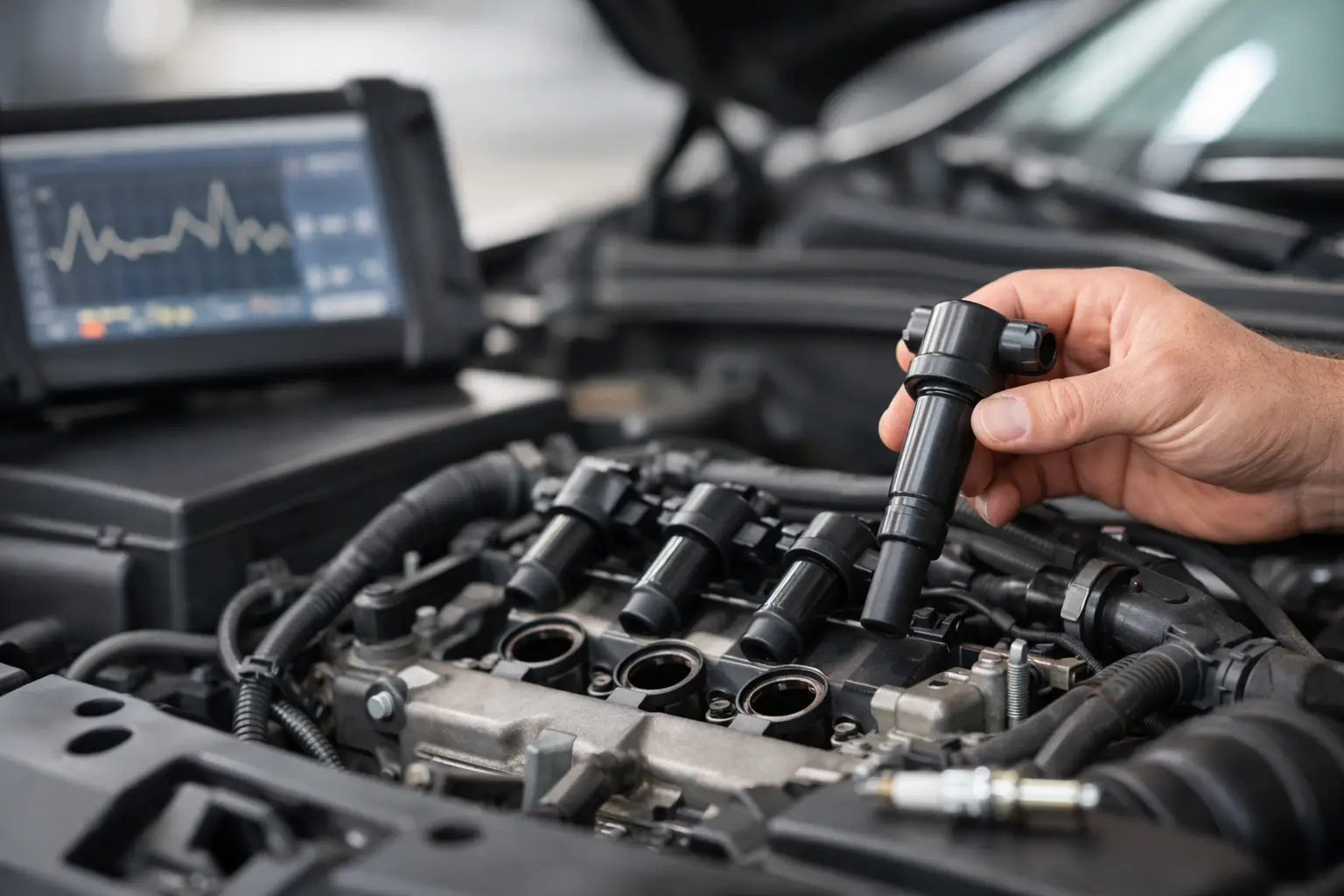
The P2307 fault location on an Opel or Vauxhall Mokka-A depends on the engine. On many petrol Mokka-A models, the coils sit on top of the engine, beneath the plastic engine cover. Some engines use individual pencil coils, with one coil directly above each spark plug. Others use a coil pack or cassette-style assembly serving more than one cylinder.
If the engine has four individual coils, the cylinders are commonly numbered from the timing belt or timing chain end of the engine, rather than from the gearbox end. However, engine orientation and component layout can make visual assumptions unreliable. Coil C may often relate to the third cylinder, but a technician should verify this using the manufacturer’s data before moving coils or ordering parts.
This is especially important because a Mokka-A can develop a fault that looks like a coil issue but is actually caused by a worn spark plug, oil contamination in a plug well, a damaged connector, or a wiring fault further back in the loom.
Symptoms you may notice
A P2307 code can be stored as pending or confirmed. A pending code may appear after one brief fault event, while a confirmed code is more likely to be accompanied by noticeable drivability problems. You may experience a rough idle, reduced power, poor fuel economy, difficult starting or a hesitation when accelerating uphill or joining a dual carriageway.
If the engine management light flashes, treat it as more urgent. A flashing light often indicates an active misfire severe enough to send unburnt fuel into the catalytic converter. Continued driving in that condition can overheat and damage the converter, turning a relatively contained ignition repair into a far larger bill.
A steady engine light with no obvious symptoms still deserves investigation. Intermittent coil faults can progress, particularly in damp weather or when the engine is fully warm. Early diagnosis is generally the fairest way to protect both the vehicle and your budget.
Common causes of a P2307 ignition coil fault
The coil itself is a common cause, particularly as it ages and insulation begins to break down under heat. Yet it is only one possibility. The fault may also stem from:
- a worn, incorrectly gapped or damaged spark plug;
- a split coil boot, carbon tracking, moisture or oil around the plug;
- loose, corroded or heat-damaged coil connectors;
- damaged wiring, poor earth connections or a control-side fault;
- low system voltage from a weak battery or charging issue;
- a less common engine control unit fault.
A spark plug is often overlooked. As the electrode gap grows with wear, the coil has to work harder to create a spark. That extra demand can expose a weak coil or trigger a secondary-circuit code. Replacing a coil without checking the plugs may cure the warning temporarily, only for the issue to return.
How a proper P2307 diagnosis should work
A competent diagnosis starts with a full scan, not just reading one fault code. Other stored codes can reveal whether there is a cylinder-specific misfire, a fuel trim issue, low voltage or a related injector problem. Freeze-frame data is also valuable because it records the conditions when the code was set, such as engine speed, coolant temperature and load.
The technician should then inspect the ignition components and wiring carefully. Signs of arcing, cracked insulation, corrosion, water ingress and oil in the spark-plug wells can often be found before any parts are removed. Plug condition and correct specification should be checked as part of the same process.
Where suitable for the engine design, swapping a suspected individual coil to another cylinder can help establish whether the fault follows the coil. If the associated misfire moves with it, that is strong evidence. It is not appropriate for every coil-pack arrangement, and it should be done carefully to avoid creating additional connection problems.
Electrical testing may include checking power supply, earth quality, wiring continuity and connector pin tension. An oscilloscope can provide a clearer picture of coil operation than a basic code reader alone, particularly where the fault is intermittent. This is why a professional diagnostic assessment is different from simply clearing the warning light and waiting to see if it returns.
Should you drive with P2307 present?
It depends on how the vehicle is behaving. If the engine is misfiring, shaking, lacking power or showing a flashing management light, avoid driving it except where necessary to get it safely repaired. Hard acceleration and long journeys increase the risk of catalyst damage.
If the light is steady and the Mokka-A feels normal, it may be possible to drive a short distance to a garage, but it should not be ignored or treated as a routine service reminder. The problem can become intermittent before it becomes constant, and a misfire at the wrong moment is not something any driver wants during overtaking or heavy traffic.
Do not repeatedly clear the code with a basic scanner. Clearing it removes useful diagnostic evidence and does not repair the underlying fault. It can also make a developing issue appear resolved until it returns under load.
Repair options and what affects the cost
The right repair depends entirely on the diagnosis. It may be a single ignition coil, a set of spark plugs, a connector repair or wiring work. If coils are of the same age and the vehicle has high mileage, replacing more than one can sometimes be sensible, but it is not always necessary. There is no benefit in replacing sound parts simply because they are nearby.
Parts quality matters. Cheap, unbranded coils may appear attractive, but inconsistent output or poor fit can cause repeat misfires and fresh fault codes. A good garage will explain the available options, including the difference between original-equipment quality and lower-cost alternatives, before work begins.
At AutoNet VIP, the focus is on confirming the cause first, then giving clear advice on the repair and costs. For Mokka-A owners in Harlow, that means no vague diagnosis and no pressure to approve unnecessary work.
When to book diagnostic testing
Book diagnostics promptly if P2307 returns after being cleared, the engine management light appears with a misfire, or the car has recently had ignition parts replaced but still runs poorly. Mention any pattern you have noticed, such as faults during rain, when cold, after a long run, or only during acceleration. Those details can shorten the testing process and help locate an intermittent fault.
A P2307 code does not have to mean a major repair, but it does call for a methodical one. Addressing the ignition system early protects smooth running, fuel economy and the catalytic converter – and gives you a clear answer before a small electrical fault becomes a bigger disruption.