A U029E:87 Peugeot upstream NOx sensor fault is rarely a warning to ignore, particularly on a modern BlueHDi diesel. It can bring on the engine warning light, affect AdBlue and emissions-system operation, and eventually lead to reduced performance or a no-start countdown if other SCR faults are present. The good news is that the code points technicians towards a communication issue, rather than automatically proving that an expensive sensor needs replacing.
What does U029E:87 mean on a Peugeot?
U029E is a network communication fault code. In plain terms, one or more vehicle control units have stopped receiving the expected information from NOx Sensor A. On many Peugeot diesel models, this is the upstream NOx sensor – the sensor positioned before the SCR catalyst in the exhaust system.
The additional `:87` is a fault-status suffix used by the diagnostic system. It commonly indicates that an expected message is missing or invalid. Exact wording can differ between scan tools and Peugeot models, so it should not be treated as a part number or a definite diagnosis. What matters is that the engine control unit cannot reliably communicate with, or trust data from, the upstream NOx sensor assembly.
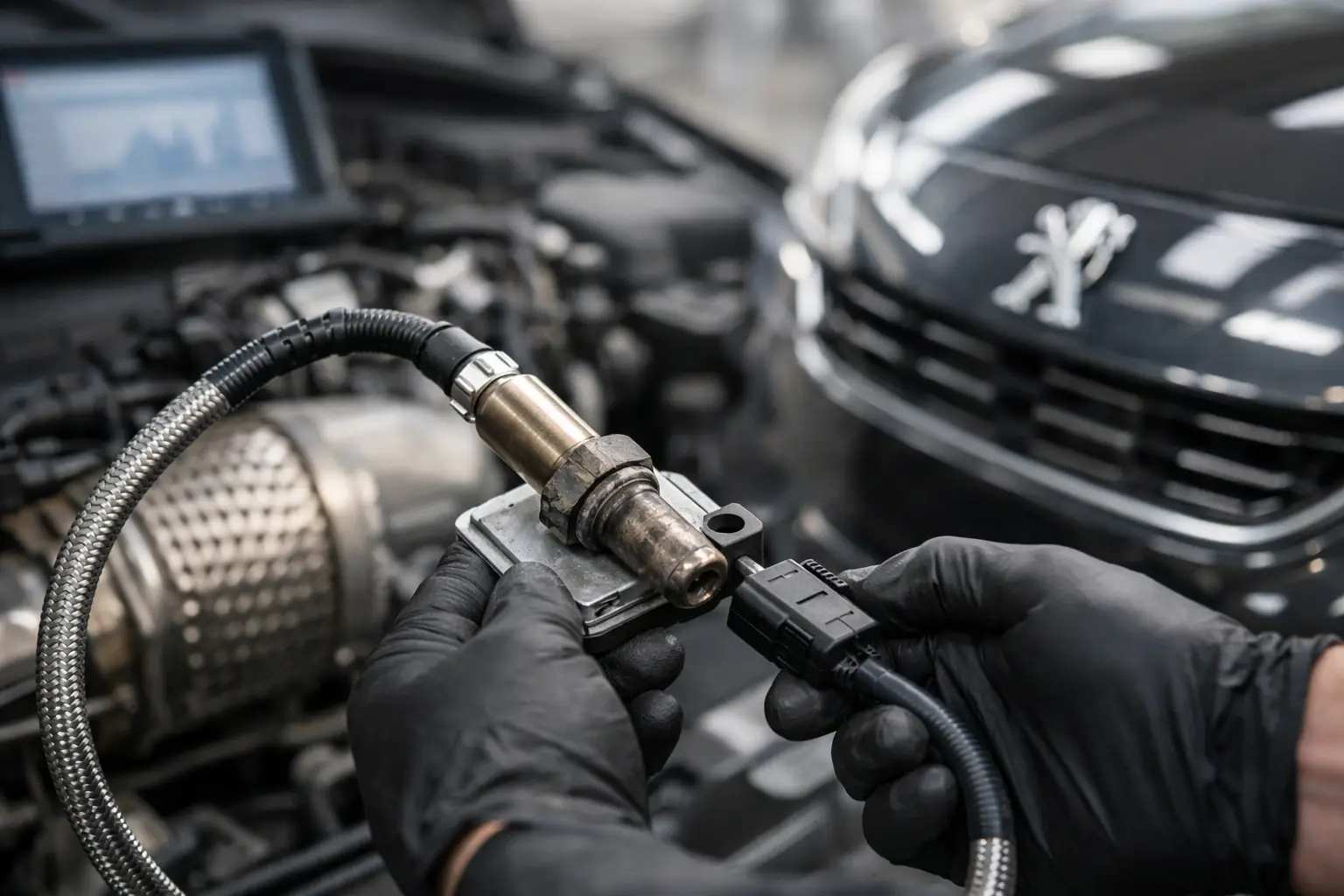
Unlike a simple older-style exhaust sensor, a modern NOx sensor usually has its own control electronics built into the unit. It measures nitrogen oxide levels in the exhaust, processes that reading and sends it across the vehicle network. The engine management system uses this information to control AdBlue injection and confirm that the SCR system is reducing emissions as intended.
Why the upstream NOx sensor matters
Your Peugeot’s diesel emissions system is designed to work as a chain. Combustion creates NOx gases, the upstream sensor measures them, AdBlue is injected where required, and the SCR catalyst converts much of that NOx into harmless gases. A downstream sensor may then help assess how effectively the catalyst is doing its job.
If the upstream sensor stops communicating, the engine management system loses a key reference point. It may use substitute values for a time, but it cannot manage emissions with the same confidence. That is why a communication fault can trigger warning messages even when the vehicle still appears to drive normally.
Depending on the model and which faults are stored alongside U029E:87, you may see messages such as “Emissions fault”, “Engine fault: repair needed”, an AdBlue warning, or an engine management light. A vehicle can sometimes remain usable for a short period, but leaving it unresolved risks turning a straightforward electrical repair into a wider emissions-system problem.
Common causes of a U029E:87 Peugeot upstream NOx sensor fault
The sensor itself is a possible cause, especially on higher-mileage vehicles exposed to heat, moisture and road salt. However, replacing it without testing the circuit can be costly and may not cure the fault. The wiring and connector near the exhaust are just as important.
Heat cycling can make insulation brittle, while water ingress or corrosion in a connector can interrupt power, earth or network communication. A wiring loom may also have been damaged by road debris, previous repair work, or contact with an exhaust component. On some vehicles, a weak battery, poor earth connection or recent low-voltage event can create communication codes that need investigating before any components are condemned.
A failing NOx sensor control module is another common issue. Because the electronics are integrated with the sensor assembly, the repair is usually replacement of the complete unit rather than repair of the sensor element alone. Software calibration or an update may be relevant in some cases, but it should only be considered after the basic supply, wiring and component checks have been completed.
Other stored faults matter too. Problems involving the engine control unit, AdBlue system, CAN network, battery voltage, exhaust temperature sensors or downstream NOx sensor may change the diagnostic direction. U029E:87 should never be read in isolation.
How a proper Peugeot NOx sensor diagnosis works
A good diagnostic process starts before anything is removed. A technician should carry out a full vehicle scan, not merely read the one engine code. This shows whether the NOx sensor module is communicating with other systems and whether related faults were logged at the same time.
Freeze-frame data is useful here. It records conditions when the fault was detected, such as vehicle speed, battery voltage, coolant temperature and engine run time. If U029E:87 occurred during a low-voltage start and has not returned, the approach differs from a permanent communication loss with the engine running.
The next step is a careful visual inspection of the upstream sensor, its harness and its connector. The exhaust must be cool before this work begins. Technicians look for melted wiring, stretched cables, green corrosion in terminals, loose connector locks and signs that the sensor wiring has rubbed against the body or exhaust.
Electrical testing then checks whether the sensor has the correct power supply and earth, and whether the communication lines are intact. A fault in these circuits can mimic a failed sensor perfectly. Checking network resistance and signal quality where appropriate helps identify an open circuit, short circuit or disturbance elsewhere on the communications network.
Live data can provide further evidence. If the scan tool cannot identify the NOx sensor module, or it reports no communication while the power and wiring tests are sound, the sensor module itself becomes the likely culprit. If communication returns intermittently when the harness is moved, the loom or connector needs repair rather than a sensor replacement.
Can you keep driving with U029E:87?
It depends on the warning message, how the car is driving and what other codes are present. If the engine warning light is flashing, the vehicle is in limp mode, there is a strong exhaust smell, or an AdBlue no-start countdown is active, arrange professional assistance promptly. Continuing to drive could lead to further faults and may leave you unable to restart the car.
Where the light is steady and the Peugeot drives normally, it may be possible to drive carefully to a garage for diagnosis. That is not the same as treating the fault as harmless. The emissions system may not be operating correctly, fuel consumption can be affected, and an illuminated engine management light can create an MOT failure where it indicates an emissions-related defect.
Do not try to clear the code repeatedly in the hope it will stay away. If the communication fault is active, it will normally return. Repeated clearing also removes useful evidence that helps a technician establish when and how the issue occurred.
Repair options and what affects the cost
The repair may be as straightforward as restoring a damaged wire, cleaning and securing a connector, or correcting an earth fault. In those cases, the cost is usually lower than replacing a NOx sensor. If testing confirms an internal sensor module failure, replacement of the upstream NOx sensor assembly is normally required.
The final bill depends on the Peugeot model, access to the sensor, the quality of the replacement part and whether programming or configuration is required. Some sensor assemblies need the vehicle to complete a relearn procedure or fault-monitor reset after fitting. A quality replacement part and correct installation are particularly important because inexpensive unverified sensors can create inaccurate readings or repeat communication faults.
Once repaired, the vehicle should be scanned again, the relevant fault memories cleared and the system checked through a proper road test where conditions allow. The aim is not simply to turn the warning light off. It is to confirm that the sensor communicates consistently, live readings are credible and the SCR system can return to normal operation.
If your Peugeot has displayed U029E:87, booking a focused diagnostic inspection is the sensible next move. At AutoNet VIP, the fault can be assessed with the wiring, power supply, sensor communication and related emissions codes checked before any repair is recommended. That gives you a clear explanation, a fair repair plan and a better chance of fixing the warning properly the first time.