A cooling system fault rarely announces itself at a convenient time. It tends to show up in slow-moving traffic, on a family journey, or just when a warning light is the last thing you need. If you are asking when should coolant be replaced, the honest answer is: follow your vehicle manufacturer’s schedule, but do not ignore what the coolant and cooling system are telling you in between services.
Coolant does far more than stop an engine overheating. It helps prevent freezing in cold weather, protects metal components from corrosion and lubricates parts such as the water pump. Over time, those protective additives wear out. The liquid may still look like coolant, but it may no longer offer the protection your engine needs.
When should coolant be replaced?
For many modern cars, coolant replacement is due roughly every five years or 100,000 miles. Some long-life coolants are designed to last longer, while older vehicles may need a change every two to three years. There is no universal interval, which is why the handbook or manufacturer service schedule should always be the starting point.
The correct interval also depends on the type of coolant already in the system. Different formulations are made for different engine materials and cooling-system designs. Using a generic interval without checking the vehicle can be a costly mistake, particularly on modern petrol, diesel, hybrid and performance vehicles.
A proper service history is useful here. If you have recently bought a used car and cannot confirm when the coolant was last renewed, it is sensible to have the system inspected. Replacing old or unknown coolant is usually far cheaper than dealing with a corroded radiator, failed water pump, blocked heater matrix or overheated engine.
Why coolant does not last forever
Fresh coolant contains water, antifreeze and corrosion inhibitors. The inhibitors are the part that gradually becomes less effective. As they deplete, internal metal surfaces can corrode, deposits can form and the cooling system becomes less able to manage heat efficiently.
Heat cycles, contamination and small leaks can speed up this process. A vehicle used mainly for short journeys may not receive an easier life either. It can still experience condensation, repeated temperature changes and reduced opportunities for the engine to reach a stable operating temperature.
Coolant is often referred to as antifreeze, but the two terms are not quite interchangeable. Antifreeze is a key ingredient in coolant; coolant is the correctly mixed fluid that circulates through the system. In most cases, a ready-mixed product or the manufacturer’s specified concentrate mixed with deionised water is the safest choice.
Signs your coolant may need attention sooner
A scheduled change is only one reason to inspect the coolant. Certain symptoms warrant a check sooner, even if the next service is months away.
- The engine temperature gauge rises higher than usual, or a temperature warning light appears.
- The coolant level keeps dropping, even though there is no obvious puddle beneath the car.
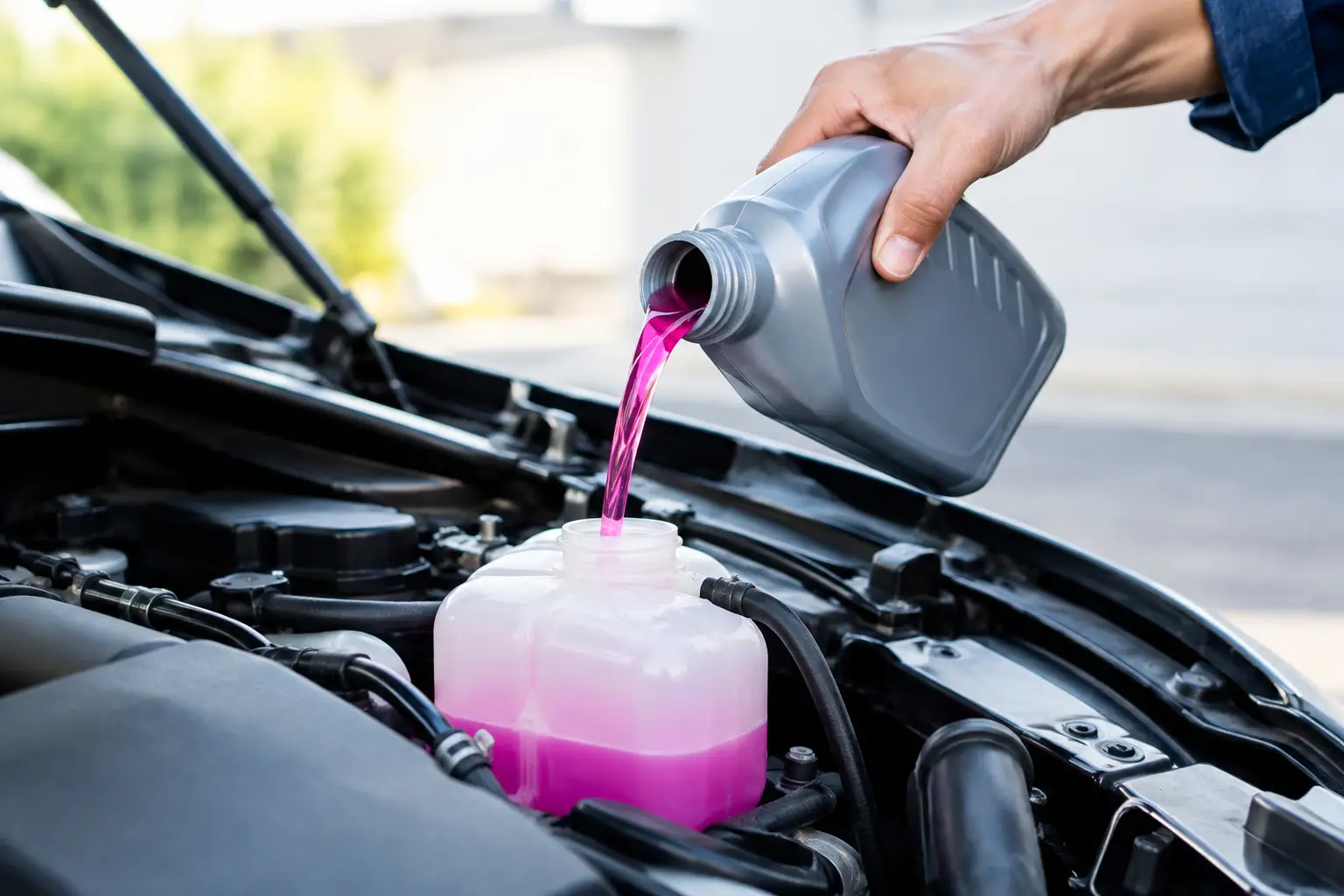
- The coolant looks rusty, cloudy, oily or has visible debris in the expansion tank.
- The cabin heater is weak or inconsistent, especially when the engine is at normal temperature.
- There is a sweet smell around the vehicle, steam from under the bonnet, or dried white, pink or blue staining near hoses and connections.
These signs do not automatically mean the coolant itself is the only problem. Low coolant could point to a leaking hose, radiator, thermostat housing, water pump or, in more serious cases, an internal engine fault. Topping it up repeatedly may hide the symptom, but it does not solve the cause.
If the temperature warning light comes on or steam is visible, stop safely as soon as practical and switch off the engine. Do not open the coolant cap while the engine is hot. The system is pressurised and hot coolant can cause severe burns. Allow it to cool fully before arranging professional assistance.
Coolant colour is not a reliable service schedule
It is tempting to judge coolant by colour. Green, blue, pink, red, orange and purple coolants are all common, but colour is not a dependable guide to chemical type or compatibility. Two products with the same colour may use different technologies, while compatible products may look different.
That matters because mixing unsuitable coolant types can reduce corrosion protection or create sludge. This can restrict coolant flow and lead to expensive cooling-system repairs. Never rely on colour alone when topping up. Check the handbook, specification or existing service record, and if there is any uncertainty, have the system identified and tested.
The same principle applies to water. Plain tap water is not a long-term substitute for the correct coolant mixture. Its mineral content can contribute to scale and corrosion, while water alone offers no meaningful freeze protection. In an emergency, a small amount of clean water may be preferable to running an engine with no coolant at all, but the system should then be checked and corrected promptly.
Is a coolant flush always necessary?
Not every coolant change requires an aggressive flush. If the system is clean, the correct coolant is known and there are no signs of contamination, a standard drain, refill and bleed procedure may be appropriate.
A flush is more likely to be needed where the coolant is badly discoloured, the wrong type has been added, there is evidence of rust or sludge, or a component has failed and contaminated the system. It can also be recommended after certain major engine or cooling-system repairs.
The trade-off is that flushing must be done carefully. On an older vehicle with neglected maintenance, disturbing deposits can occasionally reveal an existing weak point, such as a corroded radiator or brittle hose. That is not a reason to leave degraded coolant in place, but it is a reason to have the work assessed properly rather than treating it as a quick DIY job.
After refilling, the cooling system needs bleeding correctly. Air trapped inside can cause poor heater performance, temperature fluctuations and localised overheating. Many newer vehicles also have specific filling procedures, electronically controlled pumps or cooling circuits that require diagnostic equipment to operate correctly.
Hybrid and electric vehicle cooling systems
Hybrid and electric vehicles still use coolant, although the systems can be more complex than on a conventional car. Depending on the model, coolant may regulate the battery, electric motor, inverter, charging equipment and cabin heating system as well as any petrol engine.
These circuits may use a manufacturer-specific fluid and must not be treated as interchangeable with standard engine coolant. High-voltage components also introduce safety procedures that require appropriate training and equipment. If you own a hybrid or EV, use the specified maintenance interval and choose a workshop equipped to work safely with its cooling and electrical systems.
What a professional coolant service should include
A worthwhile coolant service is more than emptying a tank and adding fresh fluid. The system should be checked for leaks, hose condition, pressure concerns and signs of contamination. The old coolant should be drained responsibly, the specified fluid added at the correct concentration, and the system bled and checked at operating temperature.
At AutoNet VIP, we explain what we find before recommending work, whether the answer is a routine coolant replacement, a leak investigation or a wider cooling-system repair. That approach matters because replacing coolant on schedule is preventative maintenance, while unexplained coolant loss needs diagnosis.
Keep an eye on the coolant level when the engine is cold, use only the specified product and treat any temperature warning seriously. A small amount of attention now can protect one of the most expensive parts of your vehicle later: the engine itself.