A car that cranks slowly on a cold morning, needs a jump-start after sitting overnight, or shows a battery warning light is asking for attention. Knowing how to inspect car battery condition can help you spot simple issues early, before a routine journey turns into a recovery call. A visual check takes only a few minutes, but it must be done safely and with realistic expectations about what you can diagnose at home.
Your battery has a demanding job. It provides the power needed to start the engine, supports electrical systems when demand is high, and helps stabilise voltage across the vehicle. Modern cars also place greater strain on the 12-volt battery through stop-start systems, infotainment, security systems and charging ports. That is why a battery can look acceptable on the outside yet still be nearing the end of its useful life.
Before You Inspect the Battery
Park on level ground, switch off the ignition and remove the key or keep the key well away from keyless vehicles. Apply the handbrake and allow the engine bay to cool if the car has just been driven. Keep flames, cigarettes and sparks away from the battery, as conventional lead-acid batteries can release flammable gas.
Wear gloves and eye protection if possible. Battery terminal corrosion is acidic, and damaged batteries can leak. Remove rings, watches and other metal jewellery before working near the terminals. Accidentally bridging the positive terminal to metalwork with a tool can create a dangerous short circuit.
Do not attempt to inspect, disconnect or repair orange high-voltage cables or components on a hybrid or electric vehicle. This article refers to the ordinary 12-volt battery found in most vehicles, including hybrids and EVs. The high-voltage system requires trained technicians and the correct safety procedures.
How to Inspect Car Battery Condition Visually
Start with the battery case itself. Look for cracks, splits, bulging sides, staining, dampness or signs of fluid around the battery tray. A swollen battery is not something to monitor and hope for the best. It can be caused by overcharging, excessive heat or an internal fault, and it should be assessed promptly.
Check that the battery is held securely by its retaining bracket. A loose battery can vibrate, damage its casing, strain the cables and, in severe cases, cause an electrical short. This is particularly worth checking after work has been carried out in the engine bay or after repeated driving on poor road surfaces.
Next, examine both terminals. The positive terminal is usually marked with a plus sign and often has a red cover. The negative terminal is marked with a minus sign and normally connects to the vehicle bodywork. A small amount of dry residue may not stop the car starting immediately, but heavy white, blue or green corrosion can restrict electrical flow and lead to hard starting or intermittent warning lights.
Also inspect the cables. Their insulation should be intact, with no exposed wire, scorching, stiffness or obvious damage. Check where the earth lead meets the vehicle body as well. A poor earth connection can create symptoms that feel like a failing battery, including slow cranking and unexplained electrical faults.
Check for Loose Connections
With the engine off, gently try to move each terminal clamp by hand. It should not rotate or lift from the battery post. Do not use tools unless you are confident in the correct procedure, as overtightening can damage the clamp or battery terminal.
A loose connection can prevent the alternator from charging the battery properly and may cause the car to lose power unexpectedly. If the clamps are corroded or cannot be tightened securely, professional attention is the sensible next step.
Read the Battery Label and Indicator
Most batteries carry a label showing their voltage, capacity in amp-hours (Ah), and cold cranking amps (CCA). These figures matter when a replacement is needed. Fitting a battery with an unsuitable specification can cause poor starting performance and may disrupt stop-start operation.
Some batteries have a small built-in indicator window, sometimes called an inspection eye. It may show green, black or clear depending on its reading. Treat this only as a rough guide. It reflects the condition of one cell, not the overall health of the battery, and it cannot reliably confirm that the battery will perform under starting load.
If your vehicle uses stop-start technology, it may require an AGM or EFB battery rather than a standard lead-acid unit. Replacing it with the wrong type can shorten battery life and affect vehicle functions. Many newer cars also need the replacement battery to be registered or coded to the vehicle, so the charging system can manage it correctly.
Clean Corrosion Carefully
If you find light corrosion, cleaning the terminals may improve the connection. First make sure the car is fully switched off. If you need to disconnect the battery, consult the vehicle handbook because some cars require a specific procedure to protect settings, alarms or electronic systems.
The usual sequence is to disconnect the negative terminal first, then the positive terminal. Use a suitable battery-terminal cleaner or a small amount of bicarbonate of soda mixed with water on the external corrosion only. Avoid allowing liquid into battery vents or electrical components. A terminal brush can help remove residue, then dry everything thoroughly before reconnecting the positive terminal first and the negative terminal last.
Corrosion often returns if there is an underlying issue, such as a failing battery, a damaged terminal seal or overcharging. Cleaning is useful maintenance, not always a permanent repair.
Test the Charge – and Understand Its Limits
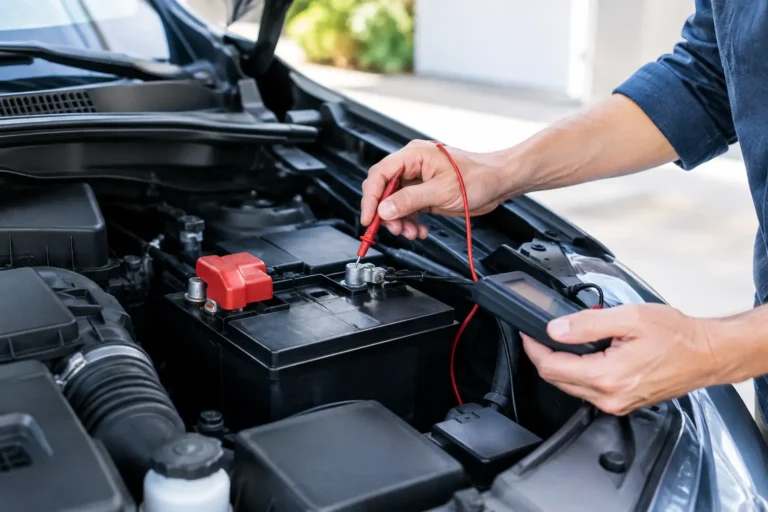
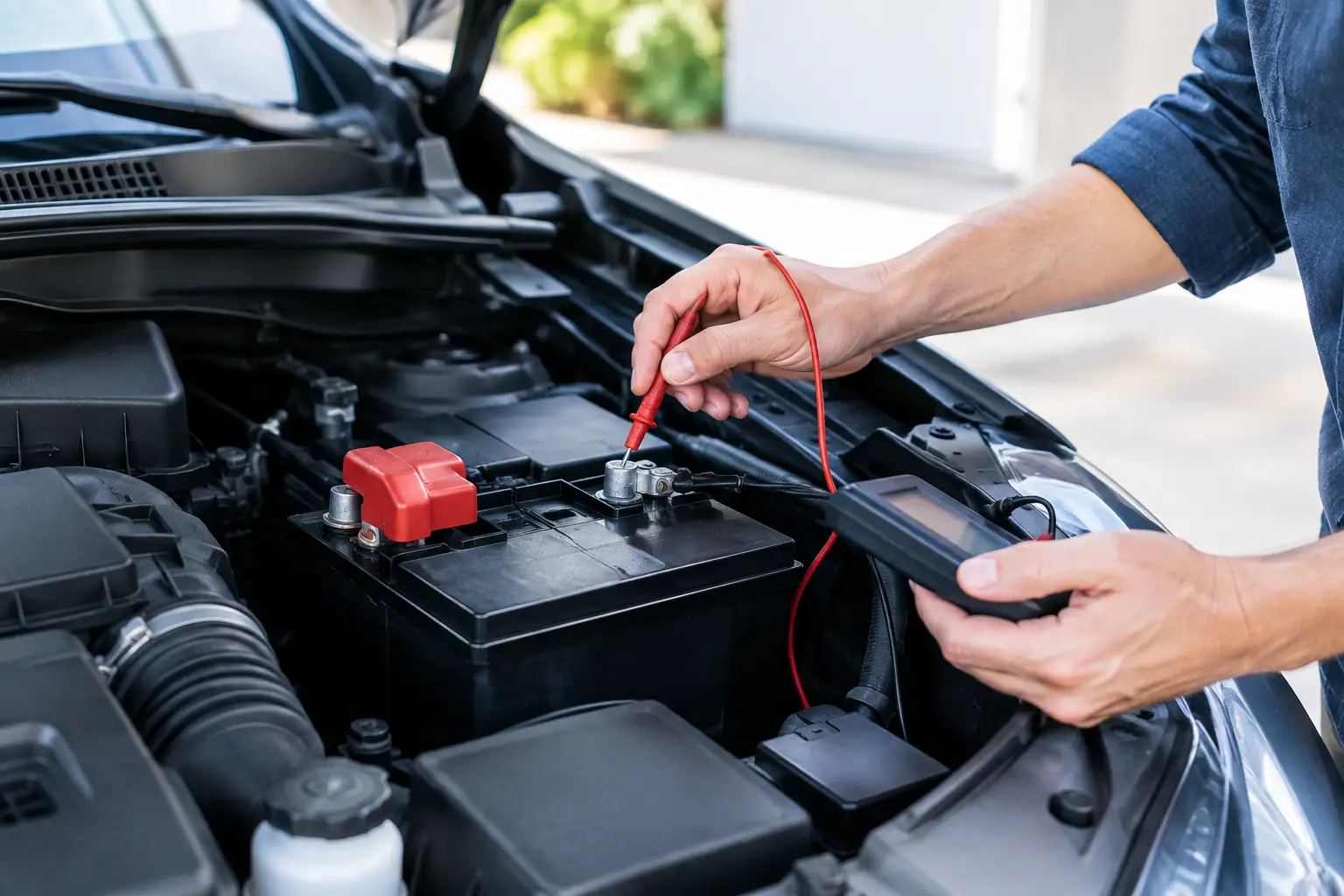
A multimeter can provide a useful snapshot of battery voltage. After the car has been switched off for several hours, a healthy fully charged 12-volt battery often reads around 12.6 volts. Around 12.4 volts suggests it is not fully charged, while 12.2 volts or below may indicate a discharged or deteriorating battery.
Voltage alone does not tell the whole story. A weak battery can show an acceptable resting voltage and still collapse when asked to start the engine. For a more meaningful result, a garage can carry out a battery health and load test. This checks available starting power, internal resistance and the charging system’s performance.
With the engine running, voltage is commonly higher because the alternator is charging the battery. However, charging voltages vary by vehicle and smart charging systems do not always behave in the same way. Avoid making a diagnosis solely from one running-voltage reading, especially on modern vehicles.
Know the Signs That a Test Is Due
Battery problems rarely appear at a convenient time. If you notice repeated slow cranking, dimming headlights at idle, electrical functions resetting, a stop-start system that no longer operates, or a battery warning light, arrange a proper check rather than waiting for a complete failure.
Age is another useful clue. Many car batteries last roughly three to five years, but the real lifespan depends on mileage, journey length, weather, electrical demand and charging condition. Cars used mainly for short trips may not give the battery enough time to recharge fully. Equally, a car that sits unused for weeks can gradually lose charge through normal background electrical draw.
A warning light does not always mean the battery itself is at fault. It may point to an alternator, drive belt, wiring or charging-control issue. Replacing the battery without testing the wider system can mean paying twice for the same problem.
When to Leave It to a Professional
Book a diagnostic inspection if the battery casing is damaged, there is fluid leakage, the car regularly needs jump-starting, or a warning light remains on. This is also the right choice where battery access is restricted, such as under a seat, in the boot or behind trim, or where the vehicle requires battery coding.
At AutoNet VIP, a battery concern can be checked alongside the charging system and related electrical faults, giving you a clear explanation before any work is recommended. That matters because the cheapest-looking fix is not always the one that prevents the next breakdown.
A quick inspection is worthwhile each time you check fluids, tyres or lights, particularly before winter or a long journey. If anything looks loose, corroded, swollen or unfamiliar, stop there and have it assessed – reliable motoring starts with dealing with small warning signs before they become an inconvenient no-start.