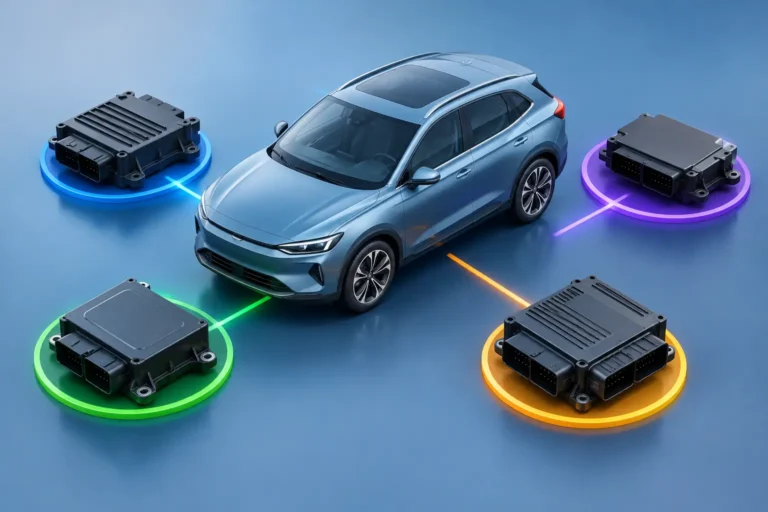
A diagnostic report can look alarming when it lists names such as VCFront/Left/Right/Batt – vehicle controllers. They sound like faults in their own right, but they are usually names for electronic control units, or areas of the vehicle network, rather than a clear diagnosis. The key question is not simply whether a controller appears on a scan, but what faults, warning lights and symptoms are linked to it.
Modern vehicles rely on dozens of computers communicating with one another. This is especially common on hybrid, electric, premium and performance vehicles, where battery, charging, braking, steering and driver-assistance systems must share information quickly and reliably. A professional diagnostic check separates a stored historical entry from a fault that needs attention now.
What VCFront/Left/Right/Batt vehicle controllers usually mean
Vehicle manufacturers and diagnostic tools use different abbreviations, so these labels are not universal across every make and model. In general, they identify controllers by their function or location within the vehicle.
VCFront may refer to a controller positioned towards the front of the vehicle or one that manages front-end electrical systems. VCLeft and VCRight can identify modules located on the left or right side, depending on the vehicle’s design. VCBatt commonly points towards a battery-related controller, particularly in vehicles with high-voltage battery systems, battery monitoring or complex energy-management functions.
The wording alone does not prove that the controller itself has failed. A scan tool may show that a module has reported a communication issue, low voltage event or intermittent signal. The actual cause could be a weak 12-volt battery, a connector with moisture or corrosion, damaged wiring, a blown fuse, a software issue, or a fault in another module on the same network.
That is why replacing a controller based solely on its name is rarely sensible. These units are often expensive, may need coding to the vehicle and can be affected by faults elsewhere.
Why controller faults need proper diagnosis
Electronic control units communicate through a network of wiring, usually described as CAN communication. Think of it as a shared conversation between the vehicle’s systems. If one module loses power, has a poor earth connection or sends incorrect information, other modules may log faults too.
This can create a long list of codes that looks much worse than the underlying issue. For example, a vehicle with a tired 12-volt battery may start normally one morning but produce multiple warning messages after a cold night. The battery voltage drops during starting, modules briefly lose communication, and several controllers store fault codes.
At the other end of the scale, a warning linked to a battery controller in an electric or hybrid vehicle may require prompt attention. High-voltage systems must be assessed by trained technicians using suitable equipment and safe working procedures. It is not an area for guesswork or home repairs.
Stored, pending and current faults
A useful diagnostic assessment looks at the status of each code. A stored code may relate to something that happened previously, such as a low-voltage condition after the vehicle was left unused. A pending or intermittent code may need monitoring and further testing. A current code, particularly alongside a dashboard warning or noticeable driving issue, deserves more immediate investigation.
Fault codes also need to be read alongside live data. Voltage readings, communication status, sensor values and the point at which a fault returns can reveal far more than a generic code description.
Symptoms drivers should not ignore
Some controller entries are discovered during routine servicing with no obvious problem. Others appear because the vehicle is already giving clear signs that something is wrong. Arrange a diagnostic inspection if you notice warning lights that remain on, repeated dashboard messages, charging problems, starting difficulty or unusual electrical behaviour.
Other signs include central locking that works intermittently, windows or mirrors behaving unpredictably, loss of driver-assistance features, reduced-power messages in a hybrid or EV, or infotainment and instrument display faults. On commercial vans, electrical issues can also affect lighting, access systems and features needed for daily work.
If an EV or hybrid shows a high-voltage system warning, charging fault, battery isolation message or red warning light, do not continue using the vehicle simply because it still drives. Follow the vehicle manufacturer’s guidance and arrange professional help. The urgency depends on the exact warning, but high-voltage safety messages should always be treated seriously.
What a good diagnostic process looks like
A proper investigation starts with the customer’s experience. Knowing whether the warning appeared after a flat battery, heavy rain, body repairs, jump-starting, charging, or a recent service can save considerable time. The technician should then carry out a full vehicle scan, rather than focusing on one controller in isolation.
The next stage is to check the basics that can affect an entire electrical network: battery health, charging voltage, fuses, power supplies, earth points and visible wiring or connector condition. This may sound simple, but it is often where the real fault is found.
Where necessary, further testing checks whether the affected controller is communicating correctly and receiving the power and signals it needs. Depending on the vehicle and fault, this can involve network testing, wiring continuity checks, inspecting connectors, reviewing live data and confirming whether manufacturer software updates apply.
Only once those checks support the diagnosis should repair or replacement be recommended. If a module needs replacing, it may require programming, configuration or calibration before all vehicle functions work correctly again.
Why low voltage causes so much confusion
The conventional 12-volt battery still matters greatly, even in many hybrids and electric vehicles. It powers the systems that wake up the vehicle, operate relays and allow modules to communicate. When it is weak, a vehicle can generate apparently unrelated errors across several controllers.
A battery test should assess more than its voltage at rest. A battery can show a reasonable voltage and still struggle under load. The charging system and battery connections also need checking, because a new battery will not solve a charging or connection problem.
Can you clear the codes and carry on?
Clearing codes can be useful after a repair to confirm whether a fault returns. It is not, however, a repair in itself. If the cause remains, the warning may return immediately, after a few journeys or only when certain conditions occur.
There are occasions where a historical low-voltage code does not return and no warning light remains. In that case, a technician may advise monitoring rather than replacing parts. This is a good example of why an honest diagnosis can save unnecessary expense.
Equally, clearing a current fault can remove valuable evidence and make an intermittent issue harder to trace. If your vehicle has a warning message, take a photograph of it before it disappears, and make a note of when it occurs. Details such as cold starts, wet weather, motorway driving or charging can be genuinely helpful.
The right approach for EVs, hybrids and complex vehicles
Vehicles with high-voltage systems have additional controllers for battery management, power electronics and charging. Their diagnostic procedures are more specialised, and the risks are higher if work is carried out incorrectly. Any concerns involving high-voltage batteries, orange cables, charging faults or isolation warnings should be left to appropriately trained technicians.
The same principle applies to premium vehicles with extensive driver-assistance equipment. A repair may require recalibration or coding, particularly after work around sensors, cameras, steering components or body panels. Choosing a garage with the right diagnostic capability helps avoid incomplete repairs and recurring warnings.
At AutoNet VIP, diagnostics are approached as an investigation, not a reason to sell parts. If a scan identifies VCFront, VCLeft, VCRight or VCBatt-related entries, the aim is to explain what the information means, test the likely causes and discuss the most sensible next step before work goes ahead.
A controller name on a report is a useful starting point, not a verdict on your vehicle. If a warning is recurring, the electrical systems are behaving oddly or an EV or hybrid reports a battery-related issue, booking a proper diagnostic assessment is the clearest way to protect safety, reliability and your budget.