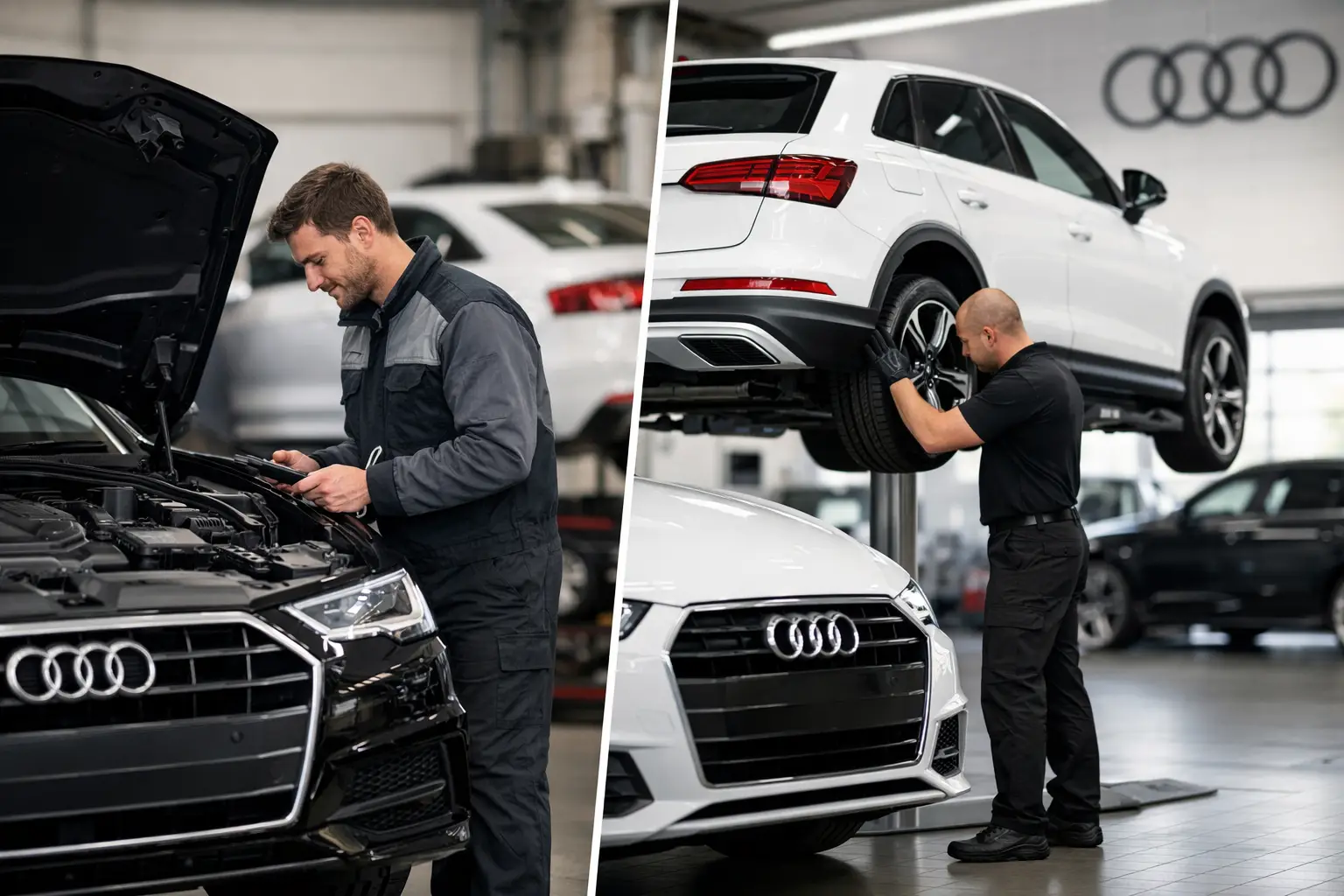
If you have searched for an “audi independent authorised main dealer garage in harlow,” you probably want a straightforward answer: who can look after your Audi properly without leaving you unsure about quality, cost, or warranty protection? The wording can be confusing because an independent garage and an authorized main dealer are not the same thing. Both can be the right choice, but the best option depends on the work your vehicle needs.
For routine maintenance, repairs, diagnostics, and MOT preparation, a capable local independent with the right equipment can offer excellent care and a more personal service. For certain manufacturer recalls, warranty-authorized repairs, and some factory software campaigns, an Audi authorized dealer may be required. Knowing the difference helps you spend wisely and keep your car in safe, dependable condition.
Audi Independent vs. Authorized Main Dealer in Harlow
An Audi authorized main dealer is part of, or officially approved by, the Audi franchise network. Its technicians work to manufacturer processes and have direct access to Audi systems, parts channels, recall information, and factory-led technical updates. This is often the correct route for recall work, a repair being claimed under an Audi warranty, or a campaign that can only be completed through the manufacturer network.
An independent garage is not tied to one manufacturer. A well-equipped independent can still service and repair Audi vehicles to a high standard, using trained technicians, quality parts, current diagnostic equipment, and the correct service data. The benefit is often a more flexible approach, clearer conversations with the people doing the work, and pricing that is easier to understand before authorization is given.
The key is not simply choosing between “dealer” and “independent.” It is choosing a workshop that can explain what your particular Audi needs, why it needs it, and what options are available.
When an Independent Audi Garage Is a Smart Choice
For many owners, an independent garage is a practical choice for scheduled servicing, brake replacement, tires, suspension repairs, air conditioning work, wheel alignment, batteries, engine repairs, and MOT-related issues. These are common jobs, but they still need to be completed accurately. Audi models use sophisticated electronics, so a garage should be able to carry out more than basic mechanical work.
The strongest independent workshops combine experienced technicians with professional diagnostic systems. That matters when a dashboard warning light could be caused by anything from a weak battery or sensor fault to a wiring issue, emissions problem, or control module communication error. Guesswork can turn a manageable repair into an expensive series of parts replacements. Proper diagnosis identifies the cause before work begins.
Independent servicing can also be suitable while your vehicle is within its manufacturer warranty, provided the service follows the manufacturer’s schedule and uses parts and fluids of the required quality. Keep all invoices and service records. There can be exceptions, particularly where a repair is being made as a warranty claim or where the manufacturer requires its own network to perform a specific action, so it is sensible to check the terms of your cover when in doubt.
For drivers who value direct communication, an independent workshop can be especially reassuring. You should be told what has been found, whether it is urgent, what can safely wait, and what the expected cost is before repairs go ahead. That is the difference between servicing that feels like a transaction and car care that helps you plan ahead.
What to expect from a capable Audi specialist
A good garage will begin with your vehicle’s history, mileage, warning lights, driving symptoms, and service requirements. From there, it should use suitable diagnostic equipment, inspect related components rather than treating the first fault code as the entire answer, and provide an estimate in plain language.
Ask whether the workshop can update the electronic service record where applicable, reset the service indicator correctly, use manufacturer-specification oil, and source original equipment or equivalent-quality parts. These questions are reasonable, especially for premium vehicles. Clear answers are a good sign that the garage understands the responsibility involved.
When an Authorized Main Dealer May Be Necessary
There are times when booking with an Audi authorized dealer is the most direct route. Safety recalls are a clear example. These are manufacturer-led actions and are normally carried out through the authorized network. If your Audi has a recall outstanding, arrange it promptly, even if the vehicle seems to be driving normally.
A dealer may also be needed for work that is covered by a current Audi warranty, certain goodwill claims, or manufacturer software updates that are restricted to factory systems. Some software-related concerns can be diagnosed and repaired by advanced independent garages, while others require dealer access. The answer depends on the vehicle, its age, its systems, and the exact update required.
This does not mean a dealer is automatically the best choice for every issue. A vehicle outside warranty that needs brakes, suspension, a clutch, air conditioning repair, tires, a diagnostic inspection, or regular servicing may be better served by a trusted independent garage. The useful question is: does this job require manufacturer authorization, or does it require skilled technicians and the right tools? Often, it is the latter.
Diagnostics Matter More Than the Badge on the Building
Modern Audi ownership is as much about electronic systems as mechanical components. Driver-assistance features, emissions controls, automatic gearboxes, infotainment, battery management, and hybrid systems all rely on accurate communication between modules. A warning light is not a diagnosis. It is a signal that the vehicle needs to be checked properly.
This is particularly relevant for Audi hybrid and electric models. High-voltage systems require trained staff, appropriate safety procedures, and equipment designed for that work. The same applies to advanced diesel and petrol models with turbochargers, particulate filters, complex emissions systems, and electronically controlled transmissions.
Choose a garage that is honest about its capabilities. A professional workshop will not claim every issue can be resolved in-house if a manufacturer-only action is required. Instead, it should diagnose the problem, explain the route forward, and help you avoid spending money on work that will not fix the underlying fault.
How to Compare Your Local Options
Start with the service you actually need. If it is a scheduled service, ask what is included at your mileage and whether the work follows the correct Audi schedule. If it is a repair, ask how the fault will be diagnosed and whether the estimate includes parts, labor, fluids, and any additional checks.
Price matters, but the lowest quote is not always the best value. A cheap initial price can rise quickly if the inspection is incomplete, the wrong part is fitted, or faults are addressed one at a time without identifying their connection. Equally, a higher price should come with a clear reason, such as better-quality components, additional testing, or a more comprehensive service scope.
Look for transparency rather than pressure. You should be able to approve work before it starts, understand any advisories, and distinguish between safety-critical repairs and maintenance that can be planned for a later date. This is particularly valuable for families, commuters, and van drivers who need to manage running costs without compromising roadworthiness.
At AutoNet VIP, the focus is on giving drivers clear advice alongside the technical work, whether the vehicle needs routine servicing, an MOT, detailed diagnostics, or a more involved repair. A premium service experience should not mean confusing language or surprise charges. It should mean skilled work, honest communication, and respect for your time.
Keep Your Audi’s Records Working for You
A well-maintained service history can support resale value and give future buyers confidence, but it is also useful for you. It shows which items have been replaced, when fluids were changed, whether recurring faults have appeared, and what maintenance is likely to be due next.
Keep invoices, inspection reports, and any records of diagnostic work. If you have a service plan, extended warranty, or lease agreement, check its requirements before booking. These arrangements can have specific conditions around approved repairs, service intervals, and documentation.
Your Audi does not need a one-size-fits-all answer. It needs the right level of expertise for the job in front of it. Choose a garage that can explain that distinction clearly, and you will be in a far better position to protect your vehicle, your budget, and your confidence behind the wheel.