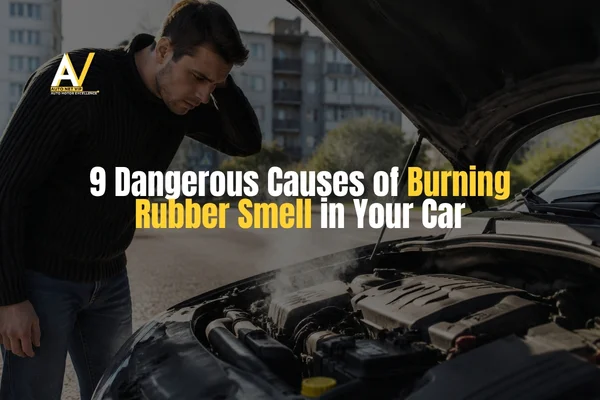
That acrid, burning rubber smell coming from your car is not something you ignore — it is something you act on, right now.
You have just pulled off the A414 near Harlow town centre, parked up outside the Queensgate shopping complex, and the moment you step out of the car you catch it — that sharp, unmistakable stench of burning rubber drifting up from somewhere beneath the bonnet. Your stomach drops a little. You are not imagining it. The smell is real, it is coming from your vehicle, and it is telling you something important.
According to data published by the Driver and Vehicle Licensing Agency (DVLA) in 2025, over 340,000 vehicles across the East of England — including a significant proportion registered in Essex — were flagged during MOT inspections for issues related to excessive heat build-up in mechanical or electrical components. That is not a small number. And a burning rubber smell is frequently the very first warning sign that puts a car on that list.
| We know how unsettling it feels — you rely on your car every single day. Whether you are doing the school run in Old Harlow, commuting into Liverpool Street, or heading out to the Retail Park, the last thing you need is an unexpected breakdown or, worse, a fire risk you could have caught earlier. |
The good news? Most of the causes behind a burning rubber smell are absolutely fixable — and the sooner you understand what is happening, the sooner you can get it sorted without it costing you a fortune. At AutoNet VIP – Car Repairs, MOTs & Electric & Hybrid Specialists in Harlow, our experienced technicians see these issues week in, week out. This guide is written with their hands-on knowledge and the realities of Essex driving in mind.
1. A Slipping or Overheating Clutch
If your car smells like burning rubber and you drive a manual, the clutch is the first suspect. When the clutch plate slips — either from wear, driving habits, or a fault in the hydraulic system — it generates intense friction heat. That heat burns off the clutch facing material, which has a smell that is distinctly rubbery and slightly sulphurous.
In Essex and Hertfordshire, stop-start driving on routes like the A10 corridor or the M11 approach into Harlow contributes significantly to premature clutch wear. A 2025 report by Kwik Fit’s national data team noted that clutch replacements in the East of England increased by 14% compared to the previous year, with urban congestion cited as a primary contributing factor.
What to do: Book a clutch inspection immediately. Continuing to drive on a slipping clutch accelerates wear exponentially — what might be a clutch adjustment today becomes a full replacement tomorrow.
2. Brakes That Are Binding or Stuck
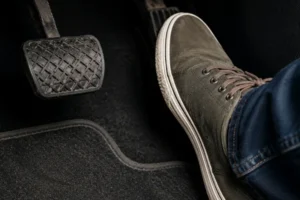
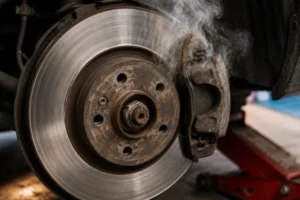
A brake calliper that is seized, a handbrake that has not fully released, or brake pads that are worn down to the metal — all of these generate serious heat at the wheel. When brake components overheat, the rubber in nearby hoses, dust boots, and seals begins to cook.
You will often notice this smell most strongly after a journey rather than during it, and in some cases one specific wheel will be noticeably hotter than the others. This is a safety-critical issue. Overheated brakes have reduced stopping power — the very last thing you want when approaching a roundabout on the A1184.
| Essex Road Safety Partnership data from 2025 recorded 47 collisions in the Epping Forest District and Harlow borough area where defective brakes were listed as a contributing mechanical factor. Do not put yourself or others at risk. |
What to do: If a wheel feels unusually hot or you notice uneven braking, stop driving and have the vehicle recovered to a garage. AutoNet VIP offers same-day brake inspections for Harlow and surrounding areas.
3. An Electrical Fault or Burning Wiring
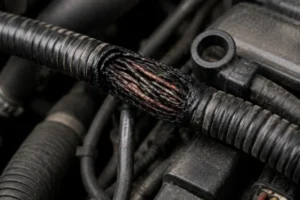
Not every burning rubber smell actually comes from rubber. Sometimes it is the plastic insulation around your car’s wiring that is overheating — and that smell can mimic burning rubber very convincingly. Electrical faults such as a short circuit, an overloaded fuse, or a failing alternator can cause localised heat that melts wire insulation.
This is particularly common in older vehicles or cars that have had aftermarket accessories poorly fitted — dashcams, stereos, lighting kits. If the smell is accompanied by flickering dashboard lights, a battery warning light, or the smell intensifies when you switch certain systems on, an electrical issue is very likely.
What to do: Switch off non-essential electrics and have the vehicle diagnosed with a proper OBD scan and visual wiring inspection as soon as possible. Electrical fires in vehicles start quickly and spread faster. This is not one to sit on.
4. A Foreign Object Caught in the Engine Bay or Exhaust
It sounds almost too simple — but it happens more often than you would think, especially in autumn and winter across Essex when fallen leaves, plastic carrier bags, and road debris get drawn into wheel arches or caught against the exhaust system. As the exhaust heats up during a journey, anything trapped against it burns off, producing that sharp rubbery or plasticky odour.
This one is often harmless, but you should not assume so without checking. A plastic bag melting against a catalytic converter can restrict exhaust flow, and in rare cases debris caught near hot engine components poses a genuine fire risk.
What to do: Pull over safely, let the engine cool, and visually inspect the underside of the vehicle. If you cannot see anything obvious but the smell persists, have a technician put it on a ramp for a proper look.
5. Low or Leaking Engine Oil
Engine oil does not smell like rubber on its own — but when it leaks onto a hot exhaust manifold or a heated engine casing, the combination produces a thick, acrid smell that many drivers describe as burning rubber. Oil leaks from a degraded rocker cover gasket, a failing sump seal, or cracked oil filler cap can be the culprit.
A 2025 MOT failure analysis published by the Society of Motor Manufacturers and Traders (SMMT) found that oil leaks and low oil levels remained the third most common advisory issued to vehicles in the East of England region, with Essex topping the list within the county breakdown.
What to do: Check your oil level immediately. If it is low, top it up but also book an inspection to find where the oil is going. Running an engine low on oil is one of the fastest ways to cause expensive, irreversible engine damage.
6. Coolant Leak Onto Hot Engine Parts
Coolant — antifreeze — has a distinctive sweet smell, but when it drips onto exhaust components or a hot engine block, it can produce a burning smell with rubbery overtones. A failing head gasket, a cracked coolant hose, or a leaking water pump can all allow coolant to escape and burn off on contact with heat.
If your temperature gauge is creeping higher than usual, or if you are having to top up your coolant reservoir more frequently than expected, a coolant leak should be near the top of your list of suspects. Overheating engines in the UK summer — yes, even in Essex — are a real concern, and a neglected coolant issue can result in a blown head gasket that costs thousands to repair.
What to do: Do not continue driving an overheating vehicle. Pull over, let it cool, and seek professional diagnosis. AutoNet VIP’s engine health checks cover coolant system integrity as standard.
7. Worn or Damaged Drive Belts
Your engine relies on a series of rubber belts — the serpentine belt, the timing belt, and various auxiliary drive belts — to keep critical systems running. When a belt wears, cracks, or begins slipping on its pulleys, the friction generates heat and a very clear burning rubber smell.
A snapped timing belt, in particular, can destroy an engine in an instant. Yet according to manufacturer service data compiled by the AA in early 2025, approximately 1 in 6 vehicles on UK roads is operating with a cambelt that is overdue for replacement based on mileage or age intervals. That is a staggering statistic — and a preventable one.
What to do: Check your vehicle’s service history and manufacturer guidelines for belt replacement intervals. If you are unsure when yours was last changed, have it inspected. A belt replacement is a fraction of the cost of an engine rebuild.
8. Tyres That Are Overinflated, Misaligned, or Damaged
Tyres that are running at incorrect pressure, a vehicle with significant wheel misalignment, or a tyre with internal damage can all generate unusual heat and friction during normal driving. At highway speeds on the M11 or A120 in Essex, that heat builds rapidly — and the result is a burning rubber odour that is literally coming from your tyres.
Tyre-related issues are particularly relevant in the Harlow area given the volume of commuter traffic and the mix of A-road and motorway driving that many residents do daily. The 2025 TyreSafe annual report noted that 26% of vehicles checked at roadside events across the South East and East of England had at least one tyre with a dangerous fault — including pressure irregularities that contribute to heat build-up.
What to do: Check tyre pressures regularly — at least once a fortnight and before any long journey. Have alignment checked as part of your annual service or any time you notice uneven wear. AutoNet VIP provides full four-wheel alignment checks using laser-guided equipment.
9. An Overworked or Seized Air Conditioning Compressor
The AC compressor is driven by a belt connected to the engine. When it begins to seize — either from low refrigerant, internal wear, or a failing clutch bearing — that belt starts slipping and burning. The smell is immediately noticeable, particularly when you first switch the air conditioning on, and it may be accompanied by a squealing noise or a noticeable drop in cooling performance.
Many Essex drivers report this more frequently in the summer months, particularly during the kind of sustained warm spells the county has been experiencing. But AC issues can surface at any time of year, especially in vehicles where the system has not been regularly re-gassed or serviced.
What to do: Switch off the AC and have the compressor and associated belt inspected. AC re-gassing and compressor diagnostics are both available at AutoNet VIP in Harlow, where the team deal with both conventional and hybrid/electric vehicle climate systems.
So — What Should You Do Right Now?
If your car smells like burning rubber — whether it started today or has been bothering you for a few weeks — the single most important thing you can do is stop normalising it. That smell is your car communicating with you. It is not going to go away on its own, and in almost every case on this list, ignoring it makes the problem worse and the repair more expensive.
Here is a simple sequence to follow the moment you notice the smell:
- Pull over somewhere safe and switch the engine off if the smell is strong or accompanied by smoke.
- Let the vehicle cool for at least 15 minutes before opening the bonnet.
- Do a basic visual check — look for obvious debris, check your oil and coolant levels.
- Note when the smell occurs — on acceleration, during braking, when the AC is on — as this helps narrow down the cause.
- Book a professional diagnostic inspection rather than guessing. A trained technician will identify the source in a fraction of the time.
Why Harlow Drivers Trust AutoNet VIP
| AutoNet VIP – Car Repairs, MOTs & Electric & Hybrid Specialists in Harlow — where your car gets the attention it deserves, from a team that genuinely knows Essex roads. |
AutoNet VIP has become one of the most trusted independent garages in the Harlow area — and not by accident. The team there understand the specific demands that Essex driving puts on vehicles: the stop-start commute patterns, the varied road quality across the district, and the growing number of hybrid and electric vehicles now navigating Harlow’s streets.
Whether it is a burning rubber smell investigation, a full engine diagnostic, brake work, clutch replacement, or an MOT with an honest, no-pressure advisory — AutoNet VIP handles it all under one roof. They are also one of the few independent garages in the Harlow area with specialist equipment and trained technicians for electric and hybrid vehicles, making them the go-to choice as the county’s EV adoption rate continues to climb.
You can read more about their services, book an appointment, and get practical advice on their blog at autonetvip.co.uk. Their blog is a genuinely useful resource — written by people who actually work on cars, not just write about them.
The End Result: Peace of Mind on Every Journey
A car that smells like burning rubber is a car that is asking for help. But it is also a car that, with the right attention at the right time, can be returned to full health and keep you safely on the road for years to come. Nine causes, nine opportunities to catch something before it becomes something much worse.
Essex drivers are practical people. You know the value of acting on a problem rather than hoping it sorts itself out. A burning smell sorted this week is a breakdown avoided next month, a big repair bill avoided next year, and — most importantly — a safer car for you and everyone else sharing the A414, the B183, and every road in between.
Do not wait for a warning light to tell you what your nose is already saying. If your car smells like burning rubber, get it checked. And if you are in or around Harlow, you know exactly where to go.
Book your inspection today with AutoNet VIP — autonetvip.co.uk