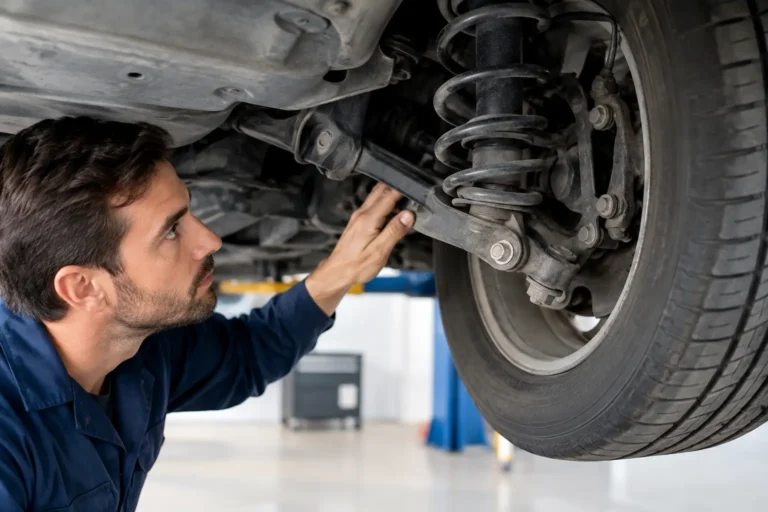
A sharp clunk as you pull away from the kerb, a creak over the supermarket speed bumps or a rattle on Harlow’s uneven roads can make every journey feel uncertain. Common suspension noise causes range from a simple worn rubber bush to a fault that affects steering, tyre wear and braking stability. The sound alone cannot confirm the repair, but where and when it happens gives a skilled technician useful clues.
Your suspension does far more than make the ride comfortable. Springs carry the vehicle’s weight, shock absorbers control movement, and a network of arms, joints, mounts and bushes keeps each wheel correctly positioned. When one part develops wear or play, the resulting noise is often the first warning that something needs attention.
Common Suspension Noise Causes Explained
Clunking over potholes, speed bumps or rough surfaces
A clunk is one of the most familiar suspension complaints. It commonly comes from worn anti-roll bar drop links, which connect the anti-roll bar to the suspension and help limit body roll in corners. Their ball joints can develop play, allowing a distinct knock when a wheel moves quickly over a bump.
Worn suspension bushes can create a similar sound. These rubber or hydraulic components cushion the connection between moving metal parts. As they deteriorate, split or soften with age, the suspension arm can shift more than it should. You may notice a dull thud over bumps, during braking or when changing direction.
Other possible causes include a loose shock absorber mounting, a worn ball joint, a damaged top mount or a broken coil spring. A fractured spring can sometimes make a metallic clang and may be visible as a snapped or displaced coil, although the break is not always obvious without raising the vehicle safely.
Creaking when steering or travelling slowly
Creaking at low speed is often linked to dry, worn or distorted bushes. Rubber bushes gradually harden with age and exposure to water, road salt and heat. They may creak as the suspension compresses, particularly when entering a driveway, crossing a speed hump or manoeuvring into a parking space.
Top mounts are another possibility. On many vehicles, the front suspension strut turns with the steering, and the mount contains a bearing or rotating element. If it wears or binds, you may hear a creak, groan or spring-like twang while turning the wheel.
It is worth remembering that steering and suspension noises can overlap. A creak that occurs only when the steering wheel is turned could also relate to steering joints, track rod ends or the steering rack rather than the suspension itself. This is why replacing a part based only on a noise description can be a costly guess.
Rattling on uneven roads
A light rattle usually points to a component with a small amount of free play. Anti-roll bar links and bushes are frequent culprits, but loose undertrays, brake pad fittings, heat shields and exhaust mounts can make remarkably similar sounds. The difference often comes down to the conditions: a suspension rattle tends to appear as the wheels move over broken tarmac, while a loose heat shield may vibrate at a particular engine speed.
Loose items inside the car can also mislead drivers. Before booking in, check the boot, spare-wheel well, door pockets and glovebox. If the noise remains with the vehicle empty, it deserves a proper inspection.
Knocking when braking, accelerating or changing gear
A knock that appears as weight shifts forwards or backwards can be caused by worn lower arm bushes, ball joints or engine and gearbox mountings. The suspension moves under braking and acceleration, so a worn component may reveal itself when the load changes rather than when driving straight ahead.
This is a case where the exact timing matters. A knock only as the clutch engages may be more likely to involve a drivetrain or engine mount. A knock when braking over a rough surface could be from suspension play, brake components or both. A technician should road-test the car where safe, then inspect it on a lift rather than relying on a quick visual check alone.
Squealing, scraping or metallic grinding
Not every noise from around a wheel is suspension-related. Scraping and grinding should be treated seriously because they can indicate worn brake pads, damaged brake discs, a seized brake component, a wheel bearing issue or a foreign object caught near the brake shield.
A broken coil spring can also rub against a tyre in severe cases. If you hear persistent metallic contact, feel vibration through the steering wheel or notice the vehicle pulling to one side, avoid unnecessary driving and arrange an inspection promptly. Continuing to drive may turn a contained repair into damage to tyres, brakes or surrounding suspension parts.
When Is a Suspension Noise Urgent?
Some noises can wait for a convenient appointment, but no suspension noise should be ignored indefinitely. The decision depends on the accompanying symptoms and how the car behaves.
Stop driving and seek advice as soon as possible if the steering feels vague or unusually heavy, the car pulls sharply, the ride height has dropped at one corner, a tyre is rubbing, or you can see a broken spring. The same applies if there is severe knocking, grinding, a warning light or a clear change in braking behaviour.
Less dramatic creaks and occasional rattles may not mean immediate danger, but they still need diagnosing. Worn bushes and drop links can worsen gradually, while a failing shock absorber may reduce tyre contact on wet roads and increase stopping distances. On hybrid and electric vehicles, the extra vehicle weight can place different demands on suspension components, making correct assessment particularly valuable.
Why the Noise Is Not Always Where You Think It Is
Sound travels through the body of a car. A knock that seems to come from the front passenger side may actually originate from the opposite side, underneath the vehicle or even from a loose exhaust mounting. Temperature and weather can change the symptoms too. Rubber bushes may creak more on cold mornings, while a loose component might only knock after a longer drive.
That is why a dependable diagnosis follows a process. A technician will listen to your description, check tyre condition and pressures, inspect springs, shock absorbers, bushes, joints and mountings, and test for excessive movement. A controlled road test may be used to reproduce the sound. If the cause is not obvious, the workshop should explain what has been found, what requires attention now and what can be monitored.
At AutoNet VIP, the focus is on clear findings rather than parts-changing. You should know what is worn, why it is causing the noise and what the recommended repair involves before any work goes ahead.
What You Can Do Before Your Appointment
Make a short note of the circumstances in which the noise occurs. Does it happen over bumps, only during turns, when braking, at a certain speed or with passengers in the car? Note whether it is a clunk, rattle, creak, squeak or grind, and whether you feel anything through the steering wheel or pedals.
Avoid spraying lubricants onto suspension components in an attempt to silence the noise. This can mask the symptom temporarily, attract dirt and make an accurate inspection harder. It is also unwise to tighten suspension bolts at home without the correct equipment and torque settings. Many fasteners must be tightened at the vehicle’s normal ride height to prevent premature bush wear.
Do check for obvious tyre damage, unusual tyre wear and anything loose in the boot. If a wheel has recently been removed for a puncture repair or tyre replacement, mention this when booking. It may be unrelated, but a complete history helps narrow down the fault.
Preventing Repeat Suspension Problems
Potholes, kerb strikes and heavily loaded journeys all take their toll, but routine checks can catch developing issues early. Have tyres inspected regularly, maintain correct pressures and arrange wheel alignment if the car pulls, the steering wheel sits off-centre or tyre wear is uneven. Alignment will not repair a worn joint or bush, but it protects tyres once the underlying fault has been corrected.
Servicing and MOT inspections are useful opportunities to identify wear before it becomes noisy. Still, do not wait for the next MOT if the car feels different or a new sound appears. An MOT is a safety assessment on the day, not a substitute for investigating a changing symptom.
A quiet suspension is not simply about a more pleasant drive. It is part of keeping the tyres planted, the steering predictable and every family, commuter or work journey less stressful. If a noise is making you question whether your car is safe, a timely inspection is the clearest way to replace uncertainty with a proper answer.