A Tesla Model X that will not charge, loses range suddenly or displays a battery warning can make every journey feel uncertain. When people search for how to fix Tesla Model X battery problems, the right answer is rarely a quick reset or a replacement part ordered online. The Model X uses several linked electrical, cooling and software systems, so a proper diagnosis is the safest way to avoid replacing the wrong component.
The good news is that not every battery-related warning means the main high-voltage battery has failed. Some faults come from the smaller low-voltage battery, charging equipment, cooling system or a sensor issue. Identifying which system is involved is the first step towards a fair repair decision.
Start by identifying the battery warning
Pay close attention to the message shown on the centre display and any change in how the vehicle behaves. A warning that says the car may not restart often points towards the low-voltage battery. Reduced acceleration, restricted charging, a noticeably lower usable range or a message about maximum battery charge level can indicate a high-voltage system fault.
Make a note of when the issue began, the battery percentage at the time, outside temperature, charging location and whether the car had been left parked for several days. This information helps a technician separate an intermittent charging issue from a battery, thermal-management or software fault.
Do not ignore repeated alerts simply because the Model X still drives. The vehicle may limit power or charging to protect itself, and continuing to use it can turn a manageable fault into an inconvenient breakdown.
Check the simple causes before assuming battery failure
Before arranging major work, rule out the issues around the battery. Try a known working charger at a different location if charging has failed, and inspect the charge port for visible dirt, moisture or damage. Do not insert tools or attempt to clean internal electrical contacts.
If the vehicle is charging more slowly than usual, cold weather may be a factor. Lithium-ion batteries charge and deliver power less efficiently when cold, particularly if the car has not had time to precondition. Navigating to a rapid charger through the Tesla system can prompt battery preconditioning on suitable models, but it will not cure a warning message or a persistent inability to charge.
A temporary software fault can occasionally be resolved by a normal screen reboot, but this should not be treated as a repair. If the warning returns, the underlying fault code still needs investigating. Never use a reset as a reason to dismiss a safety-related message.
The low-voltage battery is often mistaken for the main battery
The Model X has a high-voltage traction battery that powers the motors and a separate low-voltage battery that runs essential electronics, locks, displays, control modules and the process that wakes the high-voltage system. Depending on the model year, this low-voltage unit may be a conventional 12V battery or a lithium-ion low-voltage battery.
A weak low-voltage battery can produce surprisingly broad symptoms. You may see warning messages, find the car slow to wake, experience erratic electrical behaviour or be unable to drive after it has been parked. That does not automatically mean the large battery pack has a serious fault.
Low-voltage battery replacement still needs to be carried out correctly. The vehicle’s electrical systems must be handled in the right order, and a technician should confirm why the battery discharged in the first place. If a new battery is fitted without checking for excessive standby drain, charging-system faults or water ingress, the same problem may return.
How to fix Tesla Model X battery faults safely
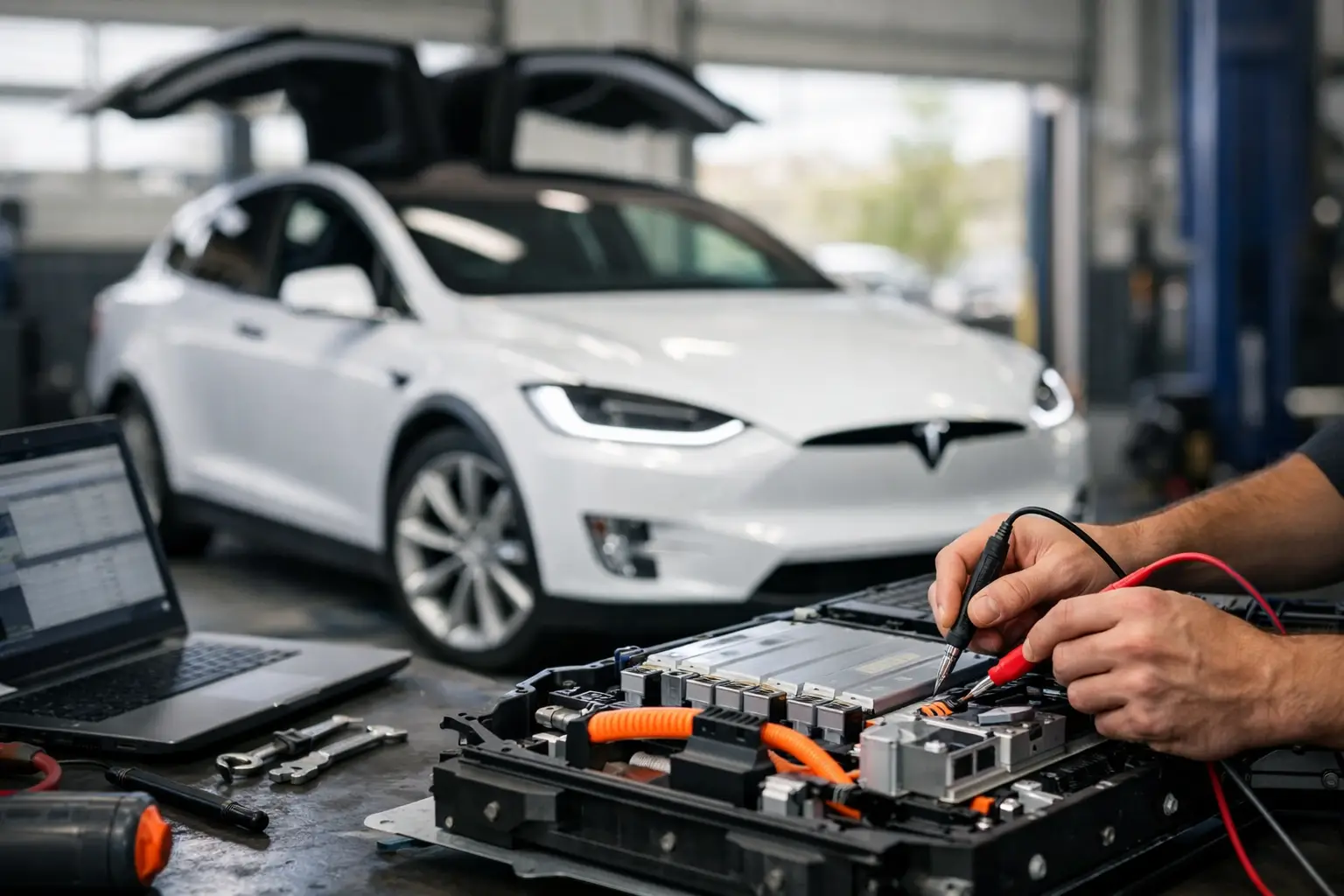
A reliable repair starts with a full diagnostic scan rather than a guess. A suitably equipped electric vehicle workshop can read battery-management, charging, thermal-system and low-voltage fault codes, then assess live data such as pack temperature, insulation readings, charging behaviour and individual battery-module performance where available.
The next step depends entirely on the result. Common outcomes include correcting a low-voltage battery issue, repairing charge-port or wiring faults, resolving a coolant-system problem, addressing a failed sensor or completing a required software update. These repairs can be far less costly than replacing the full traction battery.
If diagnostics indicate a fault within the high-voltage pack, the repair approach needs careful consideration. On some vehicles, specialist repair may be possible when the issue is isolated to a serviceable component or connection. In other cases, the battery pack may require replacement. The condition of the vehicle, fault severity, warranty position and availability of suitable parts all matter.
High-voltage battery work is not a DIY job. The system carries potentially lethal voltage even when the car is switched off. Opening a battery enclosure, bypassing safety devices, attempting module replacement or handling orange high-voltage cables without correct training, equipment and procedures creates a serious risk of electric shock, fire and costly damage.
Battery cooling faults need prompt attention
The traction battery relies on a liquid thermal-management system to remain within a safe operating temperature. If coolant circulation, valves, pumps, sensors or refrigerant-related components are not working correctly, the vehicle may restrict rapid charging, reduce performance or display battery warnings.
Owners sometimes notice a loud fan, reduced range or charging that stops earlier than expected before a clear fault message appears. These symptoms can also be caused by ordinary weather conditions, so they should be diagnosed rather than assumed to be a battery-pack failure.
Coolant leaks deserve particular attention. Any visible fluid under the vehicle, a sharp sweet smell, repeated thermal warnings or a sudden change in charging performance should be assessed promptly. Do not attempt to top up or use an unsuitable coolant, as electric vehicle cooling systems have specific requirements and contamination can cause further damage.
Understand your repair and warranty options
Before authorising work, ask for the fault findings in plain language. A good repairer should explain whether the issue is with the low-voltage battery, charge system, thermal management, wiring, software or high-voltage pack. You should also be told what testing supports that conclusion and whether there are alternative repair routes.
For high-voltage battery concerns, check the terms of your Tesla battery and drive-unit warranty for your exact vehicle and delivery date. Warranty coverage, mileage limits and exclusions vary by model year and specification. If the car remains covered and the fault appears to fall within the terms, it may be sensible to pursue that route before paying for substantial work elsewhere.
Once outside warranty, an independent electric vehicle specialist may offer a more practical option for diagnostic work and associated repairs. The lowest quote is not always the best value if it does not include correct high-voltage safety procedures, calibrated diagnostic equipment and a clear explanation of what is being repaired.
At AutoNet VIP, Tesla Model X owners in Harlow and the surrounding area can book diagnostics to establish the cause of a warning before committing to unnecessary parts or major repairs. Clear findings and transparent pricing give you the information needed to choose the next step confidently.
Protect the battery after the repair
No battery lasts forever, but sensible charging habits can support long-term performance. For everyday use, set a charge limit appropriate to your routine rather than leaving the car at 100% for long periods unless a full charge is needed for a journey. Rapid charging is useful for travelling, but regular home or workplace charging is generally gentler for day-to-day use.
Avoid leaving the Model X at a very low state of charge for extended periods. If it will be parked for several weeks, follow the vehicle’s storage guidance and make sure the low-voltage system is considered too. Keeping the car updated and responding early to new alerts can also prevent minor issues from becoming more disruptive.
A battery warning does not have to mean the end of your Model X or an automatic five-figure bill. Arrange a proper diagnosis early, keep a record of the symptoms, and make decisions based on evidence rather than alarming assumptions.