A car that starts perfectly on Monday but has a flat battery by Wednesday is rarely ‘just an old battery’. Something may be drawing power while the vehicle is parked. This is how we use thermal imaging to find hidden car electrical drains in seconds: by looking for the tiny areas of heat created when electrical current is flowing where it should not be.
For drivers, the benefit is simple. Rather than replacing parts on a guess, we can narrow the search quickly, explain what we have found and confirm the fault with proper electrical testing. It is a smarter route to an accurate repair, especially on modern vehicles packed with control units, convenience features and safety systems.
Why hidden battery drains are difficult to trace
Every vehicle uses a small amount of power when switched off. The alarm, central locking receiver, clock, immobiliser and some control modules need a standby supply. This is known as the quiescent current. In a healthy vehicle, systems enter sleep mode after a set period and the remaining draw should be low enough for the battery to hold its charge.
The problem begins when a component stays awake, a relay sticks, wiring is damaged, or an accessory has been fitted incorrectly. The drain may be intermittent too. A boot light might remain on only when the latch is in a certain position. A module might fail to sleep after the car is locked. A corroded connection can create resistance and heat without blowing a fuse.
Traditional current-draw testing remains essential, but it can take time. The vehicle may need to be left undisturbed while modules go to sleep, and opening a door or disturbing a circuit can wake systems again. On a car with several fuse boxes and dozens of circuits, checking each possibility one by one is not the best first move.
How thermal imaging finds hidden car electrical drains
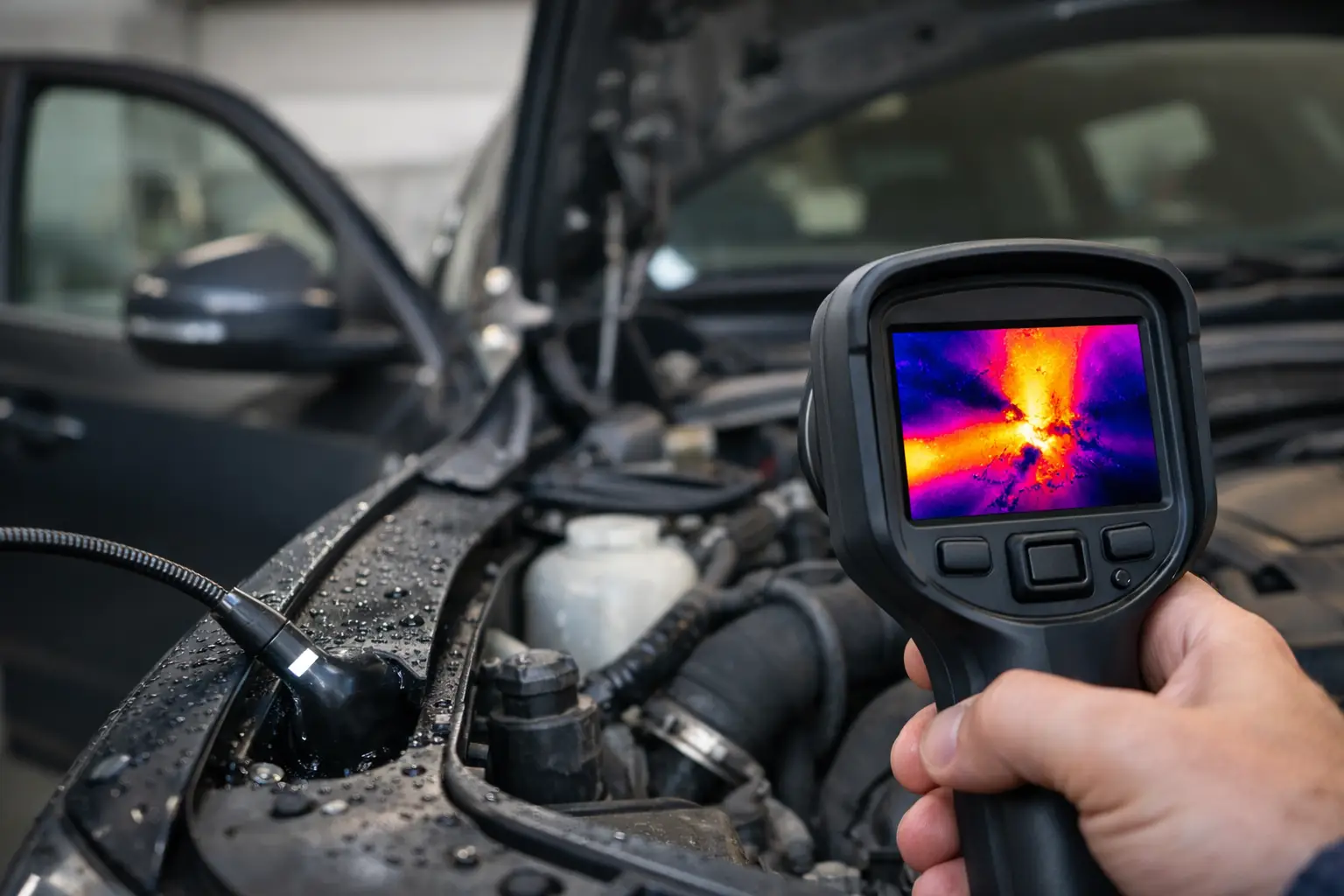
A thermal camera does not see electricity itself. It detects infrared energy – in practical terms, heat. When electrical current passes through a component or connection, it can produce a small but measurable temperature rise. That warmth can stand out clearly against cooler surrounding parts.
With the vehicle safely prepared, we use a thermal camera to inspect likely areas such as fuse boxes, relays, battery terminals, wiring junctions and electrical modules. A fuse carrying unexpected current, for example, may appear warmer than neighbouring fuses. A relay that has remained energised may show a distinct heat signature. The image gives our technician an immediate visual clue about where to investigate.
This is what ‘in seconds’ really means. A scan can reveal a suspicious hot spot very quickly, often far quicker than starting with a lengthy circuit-by-circuit search. It does not mean we promise to diagnose every electrical fault in a few seconds. Thermal imaging identifies the most useful direction, then we prove the cause with targeted tests.
What a heat pattern can reveal
A warmer fuse can point to the circuit responsible for the draw. From there, we check the vehicle wiring information, identify the components protected by that fuse and test them in a controlled way. This might lead us to a glovebox lamp, infotainment unit, parking sensor module, electric seat circuit, aftermarket tracker or a relay that has failed internally.
Heat can also expose high-resistance faults. A loose battery terminal, tired earth strap or corroded cable joint may become warm because the connection is struggling to carry current efficiently. These faults are particularly important because they can cause poor starting, warning lights and charging problems, even where there is no conventional parasitic drain.
The thermal image is useful evidence for customers as well. Instead of being told that an electrical fault is ‘somewhere in the system’, you can see the area that needs closer investigation and understand why further testing is recommended.
The checks that confirm the real fault
Thermal imaging is powerful, but it is one part of a professional diagnostic process. A component can be warm for a legitimate reason, and a very low-level drain may not create enough heat to show clearly. That is why we never base a repair solely on a camera image.
Once we identify a likely circuit, we measure current draw with the correct test equipment. We check whether the vehicle has entered sleep mode, compare the draw against the manufacturer’s expectations where available, and isolate the circuit carefully. Voltage-drop testing, battery testing and charging-system checks may also be required.
This matters because a weak battery and a drain can look similar from the driver’s seat. Both can leave you with slow cranking or a no-start condition. Yet the repair could be completely different: one vehicle may need a correctly specified battery, another may have a faulty alternator diode, and another may have a module that is staying awake overnight.
At AutoNet VIP, the aim is to establish the cause before recommending parts. It protects you from paying for a battery, alternator or control unit that has not actually failed.
Common causes of parasitic battery drain
Some faults appear more often than others, although every vehicle needs its own diagnosis. Common causes include interior, boot or vanity-mirror lights that do not switch off; sticking relays; damaged wiring; moisture in connectors; and accessories such as dash cameras, trackers, chargers or audio equipment connected to a permanent live feed.
Modern cars add another layer of complexity. Keyless-entry systems, telematics, electric tailgates, infotainment screens and body control modules all rely on electronic communication. A software issue, a faulty door latch signal or a network fault can prevent a module from sleeping. This is why a fault may only happen after the car has been parked for several hours.
Hybrid and electric vehicles require additional care. Their high-voltage systems are separate from the standard 12-volt battery system, but the 12-volt battery still powers critical control functions. Diagnostics must be carried out by technicians who understand both systems and follow the correct safety procedures. Thermal imaging can be helpful here, but it is never a substitute for high-voltage safety training or manufacturer-led test methods.
When thermal imaging is most useful
Thermal imaging is especially valuable when the drain is substantial enough to generate heat, when a fault is intermittent, or when access is difficult. Fuse boxes hidden behind trim, tightly packed engine bays and complex under-dash wiring are easier to assess when a heat pattern provides an early lead.
It can also reduce unnecessary dismantling. Instead of removing panels before we have a reason, we can focus work around the circuit or component that is behaving abnormally. That can save diagnostic time and reduce disruption to the vehicle.
There are limits. If the vehicle has only a very small drain, the camera may not show a meaningful temperature difference. If a component has recently been used, residual heat can be misleading. Ambient temperature, direct sunlight and how long the car has been parked all affect the image. A skilled technician accounts for these factors rather than treating a bright patch on the screen as an automatic verdict.
Signs you should book an electrical diagnostic check
A battery that repeatedly goes flat after the car is left for a day or two deserves attention. So does a battery warning light, repeated jump-starting, clicking when you turn the key, electrical features operating unexpectedly, or a burning smell near a fuse box or battery connection.
If you notice heat, melting plastic, smoke or a strong electrical smell, stop using the vehicle where it is safe to do so and arrange professional assistance. These symptoms can indicate a serious wiring or connection fault, not simply a discharged battery.
Avoid the temptation to keep fitting new batteries. Modern batteries can be costly, and some vehicles require battery registration or coding after replacement. More importantly, a new battery will not solve an underlying drain. It may only mask the issue for a short while.
A proper diagnosis gives you a clearer answer: whether the battery is healthy, whether the charging system is working, which circuit is drawing power and what repair is genuinely needed. For a frustrating fault that seems to happen only when the car is parked outside overnight, that clarity is often the difference between another inconvenience and a dependable fix.
If your car keeps losing charge, booking a diagnostic inspection early can prevent a small electrical issue from becoming a repeated breakdown, a damaged battery or an avoidable repair bill.