That shudder through the steering wheel. The judder underfoot when you press the brake pedal on the A414. The faint grinding sound coming through the footwell as you slow down for the roundabout on Edinburgh Way. Sound familiar?
If any of that sounds like your daily drive, there is a very strong chance you are dealing with warped brake rotors — and here in Harlow and across Essex, it is one of the most common reasons drivers bring their cars in for an urgent check.
The roads around Harlow, Epping, Bishops Stortford and the wider Essex area are no picnic. Between the stop-start of the M11 junction queues, the tight bends through Roydon, and the sudden braking that the A10 corridor demands, your brakes are working harder than most people realise.
Warped brake rotors are not just a nuisance. Left unchecked, they can compromise your stopping distance and, on Essex’s busier A-roads, that is a risk nobody can afford to take. The good news? Spotting the signs early means the fix is straightforward — and your car will feel like a different machine once it is sorted.
Here are the eight warning signs every driver in Harlow and Essex should know — explained in plain English, by people who work on brakes every single day.
What Actually Happens When Brake Rotors Warp?
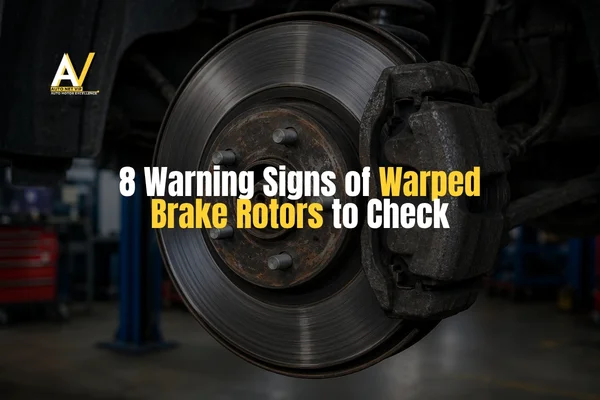
Before diving into the signs, it helps to understand what is actually going on. A brake rotor — sometimes called a brake disc — is the large metal disc that your brake pads clamp against to slow your car down. When everything is working correctly, the rotor surface is perfectly flat and smooth, giving the pads an even surface to grip.
Over time — particularly with repeated heavy braking, long downhill stretches, or driving habits that put excessive heat through the system — the metal can develop what mechanics call uneven thickness variation (UTV).
The disc does not always physically bend in the traditional sense; rather, the surface develops high and low spots, or uneven deposits of brake pad material bake themselves onto the rotor face at high temperature.
The result, however, is the same: the brake pads hit those raised or uneven areas with every rotation, and that is what causes the symptoms you can feel and hear.
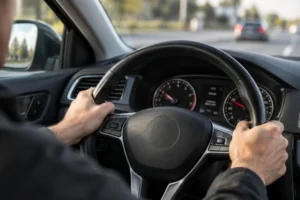
Sign 1: Steering Wheel Vibration When Braking
This is the one that most drivers notice first, and it is hard to miss. As you apply the brakes — even gently — a rhythmic pulsation or shudder travels up through the steering column and into your hands.
It might feel almost like the car is hitting small rumble strips, even on a smooth road surface.
This happens because the uneven rotor surface is pushing the brake caliper and pad back and forth with each rotation. That movement travels directly into the steering rack on front-wheel systems.
It is not subtle — once it starts, it tends to get progressively worse the longer it is left.
If you’re experiencing this problem, read our guide on how to spot brake vibration early to understand the common causes and when your brakes should be inspected.
Worth knowing: if the vibration is coming through the seat or pedal rather than the steering wheel, there is a good chance the problem is with the rear rotors rather than the front. Either way, it needs attention.
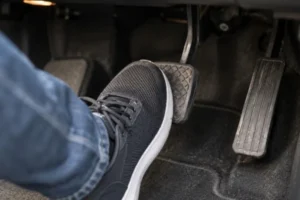
Sign 2: Brake Pedal Pulsation or Spongy Feel
Press your foot on the brake pedal and instead of smooth, progressive resistance, you feel a pulsing — almost as if the pedal is pushing back against your foot in a rhythmic pattern.
In some cases, the pedal might feel softer than usual, or like it travels further before the brakes fully engage.
This pedal pulsation is a direct mechanical signal from the rotor’s high spots pushing against the brake pads and transmitting that force back through the hydraulic system to your foot.
It is particularly noticeable at lower speeds, such as pulling into a car park or approaching a junction, where the rotation is slower and the individual pulses are easier to feel.
A genuinely spongy pedal with no pulsation can also indicate a hydraulic issue such as air in the brake lines — but that is a separate conversation.
If the sponginess comes with a pulse, warped rotors are very much in the frame.
Sign 3: Car Pulling to One Side Under Braking
You brake in a straight line, but the car drifts — sometimes sharply — to the left or right without any input from the steering wheel.
This is both alarming and genuinely dangerous, particularly at speed on dual carriageways like the A414 or the M11.
When one rotor is more warped or worn than the other, the braking force is uneven across the axle. One side grips more effectively, and the car naturally steers towards the side with greater braking force.
This can also be caused by a sticking caliper or uneven pad wear, so a proper inspection is essential to identify the root cause — but warped rotors are frequently the culprit.
Sign 4: Squealing, Squeaking, or Grinding Noises
Your brakes are not meant to be noisy — at least, not as a regular occurrence.
An occasional light squeal when the discs are cold and damp on an Essex morning is fairly normal and usually clears itself within a few seconds.
But a persistent squeal, a high-pitched scraping, or a grinding noise that continues throughout braking is a different matter entirely.
With warped rotors, you often hear a rhythmic squealing that matches the rotation of the wheel — it speeds up as you go faster and slows as you decelerate.
This is the brake pad riding over the uneven surface.
A grinding sound, on the other hand, often indicates that the pads have worn down to the metal backing plate and the rotor itself is being scored — which takes things from a rotor issue to a rotor-and-pad replacement situation.
The moral? Do not assume the noise will sort itself out.
Sign 5: Increased Stopping Distance
This is one of the most serious warning signs.
If your car is taking noticeably longer to stop than it used to — if you find yourself applying the brakes earlier than before to reach the same point — do not pass this off as your imagination.
Warped rotors reduce the effective contact area between the pad and the rotor surface.
Instead of the pad gripping a perfectly flat, smooth face, it is skipping over the high spots and losing contact on the low areas.
Less contact means less friction, and less friction can mean longer stopping distances.
According to the official Highway Code stopping distance guidance, the typical overall stopping distance at 60 mph is around 73 metres, although actual stopping distance can vary depending on weather, road conditions, tyres, brakes and driver reaction time.
On Essex roads — where rural lanes, school zones and busy retail parks all demand rapid, reliable stopping power — poor braking performance is not something to ignore.
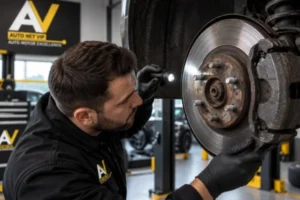
Sign 6: Visible Scoring, Grooves, or Rust Rings on the Rotor
Sometimes you can literally see the problem — you just need to look.
When your wheels have open spokes, as most modern alloys do, crouch down and look through the spokes at the brake disc.
A healthy rotor has a consistently smooth, lightly shiny braking surface with a uniform grey colour.
What you do not want to see is:
- Deep grooves or scoring lines running in concentric circles around the rotor face
- A visible lip or ridge around the outer edge of the disc where the pad does not reach
- Heavy surface rust that does not clear after a few miles of normal driving
- Shiny or glazed patches amid dull areas — a sign of uneven pad material deposits
A thin layer of surface rust is normal after a car has been sitting overnight — particularly in the damp Essex climate.
This should burn off cleanly within the first minute or two of driving.
Rust that lingers, or rust that is deep and pitted into the rotor surface, is a sign of something more serious.
Sign 7: Burning Smell After Driving
Pull into your driveway after a drive on the A10 or coming off the M11, step out of the car, and notice a sharp, acrid smell coming from around the wheels?
That is heat.
And in many cases, it means your brakes are working significantly harder than they should be.
With warped rotors, the pads are essentially bouncing against the disc surface during braking rather than making clean, consistent contact.
This creates friction hotspots — localised areas of extreme heat that can cause the brake pad material to overheat and partially transfer onto the rotor surface.
That is what can generate both the smell and, in more extreme cases, a faint wisp of smoke from the wheel area.
Excessive brake heat can also accelerate wear within the braking system and contribute to brake fade.
If you are noticing heat smells regularly, this has moved beyond a possible rotor problem and into whole brake-system-check territory.
Sign 8: Your Car Is Failing Its MOT on Braking Performance
For many drivers across Harlow and Essex, the first formal confirmation that something is wrong with their brakes comes during an MOT.
Brake performance is one of the most rigorously tested elements of the MOT inspection — and warped or excessively worn rotors can contribute to a vehicle receiving an advisory or, in more severe cases, an outright failure.
The official DVSA MOT brake inspection requirements cover brake condition, brake discs and pads, braking efficiency, imbalance and excessive fluctuation in brake effort.
A rotor that is significantly uneven on one side can cause an imbalance in braking force — and that imbalance may show up during the brake performance test.
The frustrating thing?
Many brake-related problems can be identified before the MOT.
A brake check carried out several months before the test can give you time to address problems without the pressure of a looming MOT date.
If your MOT is approaching, our step-by-step guide to checking when your MOT is due can help you prepare.
You can also read our MOT failure guide if your vehicle has already received an advisory or failed its test.
Not sure whether you need an MOT or a general vehicle service? Read our guide explaining the difference between an MOT test and a car service.
What Causes Warped Brake Rotors in the First Place?
Understanding the cause helps prevent a repeat.
The most common factors that contribute to warped rotors include:
- Prolonged heavy braking — long downhill stretches or repeated high-speed stops without allowing the brakes to cool generate intense heat that can affect the rotor over time.
- Rapid temperature changes — sudden cooling of very hot brake components can contribute to uneven thermal stresses.
- Worn or poor-quality brake pads — unsuitable or unevenly worn pad compounds can deposit material unevenly onto the rotor face.
- Overtightened or unevenly torqued wheel bolts — incorrect wheel-bolt torque can contribute to rotor runout and uneven wear.
- Age and mileage — rotors have a finite service life. Once they wear below the manufacturer’s minimum thickness specification, they must be replaced regardless of surface condition.
Can Warped Brake Rotors Be Fixed, or Do They Need Replacing?
In theory, mildly uneven rotors can sometimes be machined — a process called skimming or resurfacing, where a thin, even layer of metal is removed from the rotor face to restore a smoother surface.
However, this is only viable if the rotor has sufficient thickness remaining after the material is removed.
If the disc is already at or near its minimum thickness specification, skimming is not safe and replacement is the responsible option.
In practice, replacement is often recommended where discs are significantly worn, damaged, scored or heat affected.
A new rotor provides a fresh service life without relying on a component that has already experienced substantial wear or overheating.
Brake pads are commonly replaced at the same time as damaged or heavily worn rotors, because fitting new pads onto badly scored or uneven discs can accelerate wear and may fail to resolve the original braking issue.
AutoNet VIP – Brake Specialists Serving Harlow and Essex
At AutoNet VIP – Car Repairs, MOTs & Electric & Hybrid Specialists in Harlow, brake work is one of the most important jobs that comes through the workshop.
The team works on everything from straightforward pad replacements through to more extensive brake-system repairs on conventional petrol and diesel vehicles, as well as modern hybrid and electric cars.
You can view our full range of vehicle repair services in Harlow, including brake and clutch repairs, MOT testing and electric and hybrid vehicle services.
Hybrid and electric vehicles present a particular challenge when it comes to brake rotor wear.
Because regenerative braking can handle part of the vehicle’s everyday deceleration, the conventional friction brakes may be used less frequently.
This can mean brake discs do not receive the same regular friction cleaning they would on some conventional vehicles, potentially allowing surface corrosion to become more noticeable.
If you drive a hybrid or EV in Harlow or the surrounding Essex area and notice any of the signs above, do not assume the modern drivetrain makes your brakes exempt from inspection.
You can also explore examples of our vehicle repair work and learn more about our garage in Harlow.
How Long Does a Brake Rotor Replacement Actually Take?
One of the most common concerns drivers have when they know something is wrong with their brakes is: how long is my car going to be off the road?
It is a fair concern, especially in Harlow where many people rely on their vehicle for commuting into London, Cambridge and surrounding areas.
For many standard front-axle brake disc and pad replacements on typical family cars, the work can often be completed during the same day.
The exact time will depend on the vehicle, condition of the braking system, availability of parts and whether additional problems are discovered during inspection.
Quick Reference: 8 Warning Signs at a Glance
- Steering wheel vibration or shudder when braking
- Brake pedal pulsation or unusual pedal feel
- Car pulling to one side during braking
- Persistent squealing, scraping, or grinding sounds
- Noticeably longer stopping distances
- Visible scoring, grooves, or persistent rust rings on the disc
- Burning smell after normal driving
- MOT failure or advisory on brake performance or rotor condition
Your Brakes Are Not Something to Sit On
Here is the thing about warped brake rotors: the signs are often there before the situation becomes more serious.
That early vibration, that slight pull, that sound that seems like it might go away on its own — that is your car communicating with you.
And drivers who respond early have a better chance of identifying wear before it develops into a more expensive or potentially dangerous problem.
Drivers are responsible for ensuring their vehicles are safe and roadworthy. GOV.UK’s guidance on keeping your vehicle safe to drive specifically includes checking that your brakes are working correctly.
The roads around Harlow, across the Lea Valley, and out towards the Essex borders deserve drivers who are confident their vehicles are safe.
If you have recognised even one of the signs above in your own driving experience, arrange a professional brake inspection.
📞 Contact AutoNet VIP and book your brake inspection
AutoNet VIP – Car Repairs, MOTs & Electric & Hybrid Specialists | Harlow, Essex